Suro Senen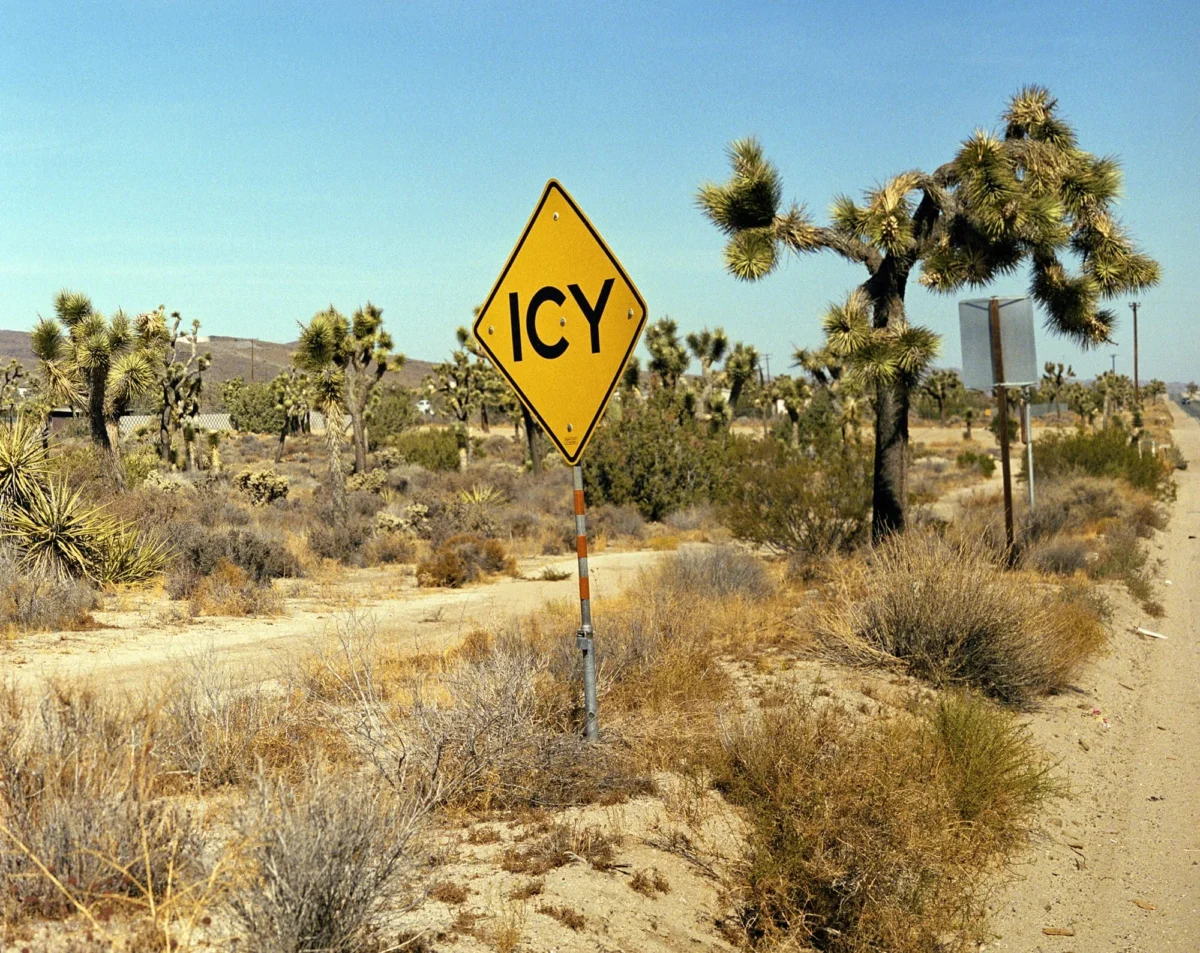
For more than thirty years, the photographer Rob Hann has operated at the intersection of the iconic and the ephemeral. While his professional career is punctuated by the high-profile faces of cultural titans—Tom Hanks, David Byrne, Chloë Sevigny, and Willem Dafoe among them—his most enduring work finds its voice in the silence of the American landscape. Hann’s practice is a study in patience, a disciplined navigation of the country’s storied arteries, from the desert expanses of Arizona’s U.S. 89 to the artistic solitude of Marfa, Texas, along U.S. 90.
Hann’s work transcends simple travel photography. He approaches the remote, the quirky, and the decaying with the same reverence and clinical eye he brings to his portraiture, imbuing handmade road signs, weathered buildings, and oddities like shoe-draped trees with a profound sense of presence. As he prepares to release his latest book, Wonder Valley, it is clear that Hann is not merely documenting places; he is mapping the quiet, often puzzling poetry of the American experience.

The Chronology of a Vision: From Studio to Asphalt
Hann’s artistic trajectory represents a distinct evolution from the controlled environment of the studio to the unpredictable terrain of the open road.
The Early Years: The Portraitist’s Discipline
In the early decades of his career, Hann established himself as a fixture in the worlds of music and entertainment. Working for major record labels and editorial publications, he mastered the art of capturing the "inimitable." This period required a high degree of technical precision and the ability to extract character from subjects often accustomed to the public eye. During this time, his preference leaned heavily toward black-and-white photography, a medium that allowed him to focus on form, light, and the raw mechanics of the human face.

The Shift to the Landscape
Over time, the rigors of commercial portraiture gave way to a more personal exploration of the American periphery. The transition was not abrupt but rather a natural migration of his artistic curiosity. Hann began to apply his portraiture-honed sensibilities to the objects he encountered on the road. Whether it was the stark, geometric lines of Nancy Holt’s Sun Tunnels in the Great Basin Desert or the whimsical, soft textures of Magda Sayeg’s crochet work on a camper in Marfa, Hann treated his inanimate subjects with the same "personality" as his human ones.
The Modern Era: Color and Digital Integration
Recently, Hann has navigated the technical shift from analog to digital, integrating the Hasselblad X2D alongside his long-time companion, the analog Mamiya 7. This period has also marked a significant departure from his monochromatic roots. Having once struggled to find his "voice" in color photography—often feeling forced by commercial assignments—he has now fully embraced the emotive capacity of saturation and warmth, using color as a narrative tool to define the atmosphere of his desert and rural subjects.

Supporting Data: The Technical Philosophy of the Frame
Hann’s approach to his craft is defined by a rigorous, almost ascetic discipline. This is most evident in his equipment choices and his methodology on the field.
- The Analog Constraint: For most of his career, the Mamiya 7 was his primary tool. With a film roll limited to ten frames, the camera demanded a "decisive moment" approach. Each shutter click was a significant investment, preventing the "spray and pray" mentality that often plagues digital photography.
- The Digital Discipline: Even with the advent of the Hasselblad X2D, which offers near-limitless storage, Hann refuses to abandon his disciplined habits. He treats digital frames with the same scarcity mindset as film, preferring to make "good decisions" in the field rather than spending weeks sifting through hundreds of redundant images.
- The Fixed Lens Philosophy: A hallmark of Hann’s consistency is his reliance on a single fixed lens. By limiting his focal length, he forces a specific perspective on the world, creating a cohesive visual language that spans decades of work. This limitation acts as a creative filter, ensuring that the viewer is always seeing the landscape through a singular, recognizable eye.
Official Perspective: The Puzzling Nature of the Ordinary
In an exclusive interview with Colossal, Hann articulated the philosophy that drives his search for the "quirky."

"Although my photos are usually very simple, I often like it when the viewer is not quite sure what it is that they’re seeing, when they have questions," Hann explained. "I’m often attracted to things that are amusing, unintentionally funny, or things that are puzzling."
This desire to elicit questions rather than provide answers is central to his work. He does not seek out the grand vistas of the National Park Service; instead, he finds truth in the incongruous—a sign reading "ICY" in the middle of a scorching California desert or a car buried halfway into the earth. For Hann, the landscape is a collection of riddles left behind by travelers, residents, and the passage of time.

Implications: The Legacy of Wonder Valley
As Hann readies the launch of Wonder Valley with The Artist Edition, his work serves as a critical bridge between the fading history of the American roadside and the modern aesthetic of the desert.
The Preservation of the "Inimitable"
Hann’s work acts as a visual archive of a specific type of American eccentricity that is increasingly rare in an era of homogenization. From the hand-painted "Full Gospel House of Prayer" in Mojave to the surreal stop-sign-roof of a Montana barn, these images are not just aesthetic choices—they are records of individual expressions that are slowly being erased by corporate development and the standardization of infrastructure.

The Emotive Potential of Color
Perhaps the most significant implication of his current work is his successful mastery of color. By moving beyond the binary simplicity of black-and-white, Hann has tapped into the psychological weight of the American West. The warmth of the sun-bleached desert and the cool, shadowed interiors of rural buildings in his color photography evoke a specific nostalgia that resonates with viewers, even those who have never traveled those specific highways.
The Future of the Roadside Trope
By consistently finding beauty in the "unintentionally funny," Hann challenges the viewer to reconsider their own surroundings. His work suggests that the extraordinary is not hidden in inaccessible locations but is, in fact, present in the mundane artifacts of our daily transit.

Conclusion: A Continuous Journey
Rob Hann’s career has been defined by a refusal to settle into a single mode of expression. Whether he is capturing the sharp gaze of a legendary actor or the quiet, peeling paint of a forgotten gas station in North Dakota, his lens remains fixed on the essence of the subject.
As Wonder Valley prepares to debut later this year, it offers more than just a collection of photographs. It offers a travelogue of the American psyche, a testament to the idea that if we look closely enough at the oddities, the handmade signs, and the lonely stretches of highway, we might just catch a glimpse of the country’s true,, shifting face. For Hann, the journey never truly ends; it is simply a matter of finding the next frame that makes us pause, look twice, and ask, "What is that?"


 Nana
Nana
 Nana Wu