In the quiet, contemplative spaces of Chicago’s Zolla/Lieberman Gallery, a new exhibition is challenging the way viewers perceive the intersection of the natural world and the human psyche. Mont Blanc on Wood, the latest solo showcase by the renowned Bozeman-based artist John Buck, invites audiences into a realm where geography is fluid, folklore is tangible, and the boundaries of reality are intentionally blurred. Through his signature pen-and-ink drawings on wood panels, Buck crafts a visual language that is simultaneously deeply grounded in the American landscape and untethered from the logic of the waking world.
Main Facts: The Intersection of Craft and Speculation
John Buck, a celebrated figure in contemporary sculpture and drawing, has long been recognized for his ability to translate complex human emotions and societal observations into material form. While he is perhaps most famous for his life-size, eccentric wooden sculptures—often characterized by their intricate, hybridized forms—this current exhibition shifts the focus toward his two-dimensional work.

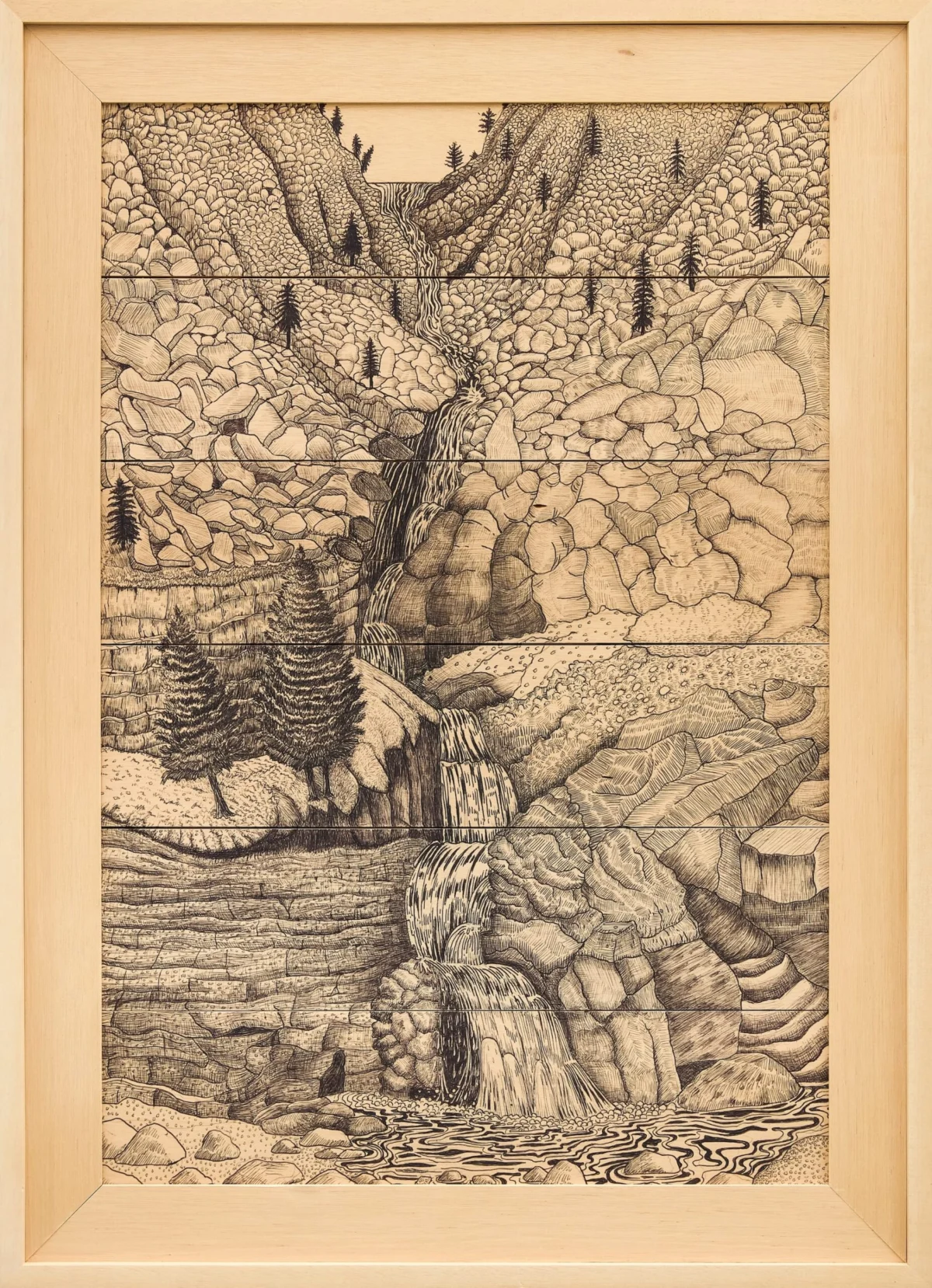
Mont Blanc on Wood features a collection of drawings executed directly onto wood panels. These works are not merely sketches; they are elaborate, dreamlike compositions that utilize the texture and grain of the wood as an essential element of the landscape. From the iconic, jagged silhouettes of Utah’s Three Patriarchs to the humid, tangled depths of the Atchafalaya swamps and the thundering, monumental presence of Niagara Falls, Buck’s subjects are rooted in geography but warped by a surrealist lens.
The central thesis of the exhibition lies in the “uncanny.” By placing recognizable landmarks in impossible configurations—such as a lighthouse standing sentinel over an arid, desert lake in Lighthouse (No. 18)—Buck asks the viewer to reconsider their relationship with their environment. The works act as mirrors, reflecting both the beauty of the physical world and the internal landscapes of memory and imagination.

Chronology: A Career of Evolving Mythologies
To understand the weight of the work presented in Mont Blanc on Wood, one must look at the trajectory of Buck’s artistic evolution. His career has been marked by a constant, restless experimentation with the possibilities of wood as a medium.
- Early Years: Buck’s initial foray into the art world was defined by his interest in the narrative potential of objects. He moved away from traditional static sculpture, opting instead for dynamic, often kinetic wooden figures that drew heavily from the visual vocabulary of folklore.
- The Development of the "Hybrid" Form: Throughout the 1990s and early 2000s, Buck began integrating disparate objects into his figures. This period saw the creation of large-scale, figurative works where human silhouettes were populated by tiny, carved icons—symbols of industry, nature, and commerce that functioned as a visual inventory of American life.
- The Pivot to Landscapes: In recent years, while continuing his sculptural practice, Buck has turned his attention toward the landscape as a primary narrative vehicle. His recent residency and travel experiences have allowed him to distill the essence of the American West and beyond into the precise, rhythmic pen strokes that characterize his current show.
- 2024 – Mont Blanc on Wood: The current exhibition at Zolla/Lieberman represents the culmination of this recent focus. It is a refinement of his craft, where the wood grain itself acts as a topography for his ink-drawn interventions.
Supporting Data: The Anatomy of the Work
The technical execution of the pieces in this collection demonstrates a profound mastery of material. Buck’s process is laborious and deliberate. By selecting specific wood panels, he allows the natural patterns of the wood—the swirls, knots, and veins—to dictate the direction of the landscape.

- Medium: Pen and ink on wood.
- Scale: Ranging from intimate studies (approximately 21 x 26 inches) to expansive, vertical compositions (up to 52 x 37 inches, as seen in Sea Mount).
- Stylistic Markers: The presence of anthropomorphized flora, such as the expressive, eye-bearing cacti in Cactus Grove (No. 13), serves to personify the environment. This is not merely nature; it is a nature that is watching, reacting, and participating in the viewer’s experience.
- Geographic Range: The exhibition traverses a vast territory, incorporating sites from the American West (Zion Canyon), the industrial Northeast (the allusion to mines and factories), and the American South (the swamps of Louisiana).
Official Responses and Curatorial Insight
The Zolla/Lieberman Gallery, a cornerstone of the Chicago art scene, views this exhibition as a vital addition to their long-standing relationship with Buck. In their official statement, the gallery notes:
“Buck reflects on social and political realities, environmental concerns, and the eccentricities of human behavior, all while maintaining a sense of humor and a deep engagement with craft. His art balances storytelling with formal clarity, inviting viewers into a world where the familiar becomes speculative and symbolic.”

The gallery emphasizes that the exhibition is designed to be a conversation. By removing the literal, three-dimensional bulk of his sculptures, the gallery argues that the drawings allow for a more direct, intimate engagement with the artist’s “internal geography.” The inclusion of such diverse landscapes—from the Never Sweat Mine to the soaring peaks of the Cascades—is not incidental. It is a commentary on the fragmentation of the American experience, held together by the unified, rhythmic hand of the artist.
Implications: Why These Landscapes Matter Now
The significance of Mont Blanc on Wood extends beyond the aesthetic pleasure of fine pen-and-ink work. In an era increasingly dominated by digital imagery and algorithmic art, Buck’s work serves as a reminder of the power of the "analog hand."

1. The Environmental Narrative
By distorting these landscapes, Buck invites a dialogue about climate change and human impact. When he depicts a lighthouse in a desert lake, he is not just creating a surreal image; he is posing a question about the longevity and sanity of our own infrastructure in the face of a changing planet. His work suggests that the earth is not a static backdrop, but an active, and perhaps bewildered, participant in our history.
2. The Return of Folklore
Buck’s work functions as a form of modern myth-making. By anthropomorphizing plants and dramatizing rock formations, he taps into an ancient impulse to project human consciousness onto the natural world. In doing so, he makes the environment feel less alien and more like a companion, albeit one that is increasingly fragile.

3. The "Off-Kilter" Aesthetic
The sense that things are “off” is a hallmark of the contemporary psychological state. We live in a world where the familiar is constantly being disrupted by technological and social shifts. Buck’s landscapes, which mirror this unease, provide a safe space to process the “uncanny.” By witnessing these landscapes on wood—a medium of earth and history—the viewer is invited to find comfort in the surreal.
Final Reflections
As Mont Blanc on Wood continues its run in Chicago through August 8, it stands as a testament to the endurance of traditional media in a changing world. John Buck does not merely document the world; he interprets it, rearranges it, and ultimately, reimagines it.

For the collector and the casual observer alike, these works provide a rare opportunity to step out of the frantic pace of the everyday and into a, quiet,, and infinitely layered world. Whether it is the swirling clouds of Sea Mount or the weathered, gnarled trunks in Aspens, each piece in the exhibition is a portal. They remind us that the world is only as solid as our imagination allows it to be, and that perhaps the most interesting landscapes are the ones we carry within ourselves.
The exhibition is a must-see for those interested in the evolution of contemporary drawing and the ways in which an artist can bridge the gap between the monumental and the personal. Through the wood, through the ink, and through his unique vision, John Buck continues to map the territories of the human dream.