In the fast-paced landscape of the New York City art scene, few debuts carry the quiet intensity of Molly Bounds’ latest solo exhibition. Titled The Light That Loses, The Night That Wins, the show marks the Los Angeles-based artist’s formal introduction to the New York gallery circuit. Hosted by Mrs. at their 6040 56th Drive location, the exhibition serves as a profound meditation on the transitional states of human consciousness, the fluidity of time, and the relentless interplay between illumination and shadow.
Main Facts: A Study in Liminality
The Light That Loses, The Night That Wins is not merely an exhibition; it is an atmospheric shift. Opening on the vernal equinox—a date chosen for its astronomical significance as a point of perfect equilibrium between day and night—the show establishes light as its central protagonist.
Bounds, whose work has been steadily gaining traction in the contemporary figurative sphere, follows up her successful presentation at The Armory Show in September 2025 with this comprehensive collection of new paintings. The exhibition will remain on public view through May 2, 2026, offering New Yorkers an extended window to engage with what critics are already calling a masterful exploration of "psychological landscape."
The works on display oscillate between two primary environments: the stifling, introspective interior and the expansive, dreamlike exterior. Through these dual settings, Bounds investigates the liminal moments—those spaces between sleeping and waking, stillness and action—where the human psyche is most vulnerable to the passage of time.
Chronology: The Evolution of an Artist
Molly Bounds’ trajectory toward this New York debut has been characterized by a disciplined focus on the human form in states of repose. Her evolution as a painter has seen a departure from purely observational portraiture toward a more conceptual, narrative-driven style that emphasizes the "unrelenting forward movement of time."
- Early 2024: Bounds solidifies her signature style, blending classical chiaroscuro techniques with a contemporary, often haunting, psychological depth.
- September 2025: The artist makes her debut with the gallery during The Armory Show. This served as a critical testing ground, establishing her ability to command attention in a high-traffic, competitive environment.
- March 20, 2026: The Light That Loses, The Night That Wins opens at Mrs., coinciding with the vernal equinox. This date serves as a conceptual anchor for the show’s themes of seasonal transformation and the struggle between light and dark.
- May 2, 2026: The exhibition is slated to conclude, marking the end of a pivotal chapter in the artist’s career.
Supporting Data: Dissecting the Canvas
The strength of the exhibition lies in Bounds’ ability to translate abstract existential dread and hope into tangible visual form. The exhibition is anchored by several key works that illustrate her technical range.
The Interior Portraits: Tension in Repose
In The Armchair, Bounds presents a masterclass in atmospheric contrast. A subject is depicted in a state of slumped, languid rest, yet the painting is thick with unease. The warm, inviting glow of a fireplace illuminates the texture of the room’s upholstery, while a cold, piercing blue light bleeds in from an exterior window. This juxtaposition creates a visual tug-of-war. The subject’s vacant stare suggests a mind wandering into the territory of "scheming or planning," while the fraying seams of the armchair serve as a subtle metaphor for the erosion of internal stability.
The Influence of the Old Masters
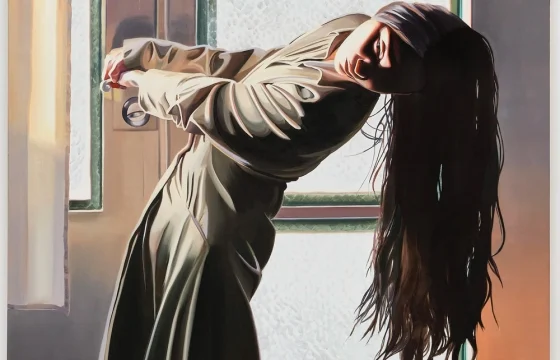
Bounds’ technical debt to the history of art is perhaps most evident in Privacy Glass. Here, she employs a dramatic light source from behind the subject, a technique reminiscent of the French Baroque painter Georges De La Tour. By allowing a beam of light to penetrate the room while simultaneously obscuring the subject’s features, Bounds engages with the vanitas tradition—a reminder of the fleeting nature of life and the inevitability of darkness. The drapery of the subject’s clothing is rendered with a sculptural quality that emphasizes the weight of the moment.
The External Escape: Landscapes of Renewal
Conversely, works like It Sings in Me and Among of Green, Again offer a necessary exhale. These pieces depict figures navigating rolling, sun-drenched hills. While the interior scenes are heavy with the weight of "dormant states," these landscapes suggest the possibility of liberation. Bounds deliberately keeps the origin of these landscapes ambiguous—are they real, or are they manifestations of a desperate, hopeful fantasy? For the artist, the distinction is secondary to the goal: the cultivation of an "optimism and a belief in renewal."
Official Perspectives: The Philosophy of the Brush
In discussions surrounding the exhibition, the curatorial focus is placed heavily on the "threshold" moments. Mrs. gallery has highlighted that Bounds is interested in the transition from winter to spring as a proxy for the human condition. Just as the natural world prepares for growth after a period of dormancy, so too do her subjects seem poised on the edge of a transformative shift.
The gallery notes that Bounds views the light not just as a visual element, but as a "versatile and ever-changing" entity. It acts as a veil, both concealing the subject’s inner turmoil and revealing the truth of their physical posture. By forcing the viewer to confront these candid movements, the exhibition demands a high degree of empathy, asking the audience to sit with the discomfort of the subject as much as with their moments of serenity.
Implications: The Resonance of the Work
The arrival of The Light That Loses, The Night That Wins in the New York market carries significant implications for the contemporary figurative movement. As digital art and AI-generated imagery continue to dominate the discourse, Bounds’ work acts as a recalibration, reminding the viewer of the power of the painted surface to hold human complexity.
A Commentary on the Contemporary Psyche
The psychological weight of these paintings resonates deeply in a post-pandemic world, where the boundaries between the private self and the public persona have become increasingly porous. Bounds captures the "lingering" state of the modern mind—the sense of being permanently on the precipice of change while remaining physically stuck in place.
Defining the "New" Figurative
Bounds is contributing to a growing movement of artists who are reclaiming the figure not as a vessel for realism, but as a vessel for emotional architecture. By blending the bucolic, optimistic landscapes of Among of Green, Again with the claustrophobic interiority of The Armchair, she creates a full-spectrum view of the human experience. The exhibition suggests that "after the darkness of winter, spring wins," offering a hopeful, albeit cautious, conclusion to her narrative arc.
Impact on the Gallery and Market
For Mrs., this exhibition is a strategic consolidation of their commitment to emerging talent. By providing a platform for Bounds’ New York solo debut, the gallery is signaling its role as a tastemaker in the mid-to-high-tier contemporary market. Collectors and critics alike are expected to watch the reception of these works closely; given the thematic density and technical execution of the pieces, the show is poised to influence current trends in gallery programming, particularly regarding the intersection of classical technique and psychological narrative.
Conclusion: A Lingering Presence
As the exhibition continues through the spring, it stands as a testament to the idea that painting remains one of the most effective mediums for exploring the passage of time. Molly Bounds has successfully synthesized the external world of seasons and light with the internal world of memory and anxiety.
The Light That Loses, The Night That Wins is an invitation to pause. It asks the viewer to stop the "unrelenting forward movement" of their own lives for a moment and consider the threshold upon which they stand. Whether through the cold blue light of a suburban evening or the golden warmth of an imagined landscape, Bounds provides a mirror for the complexities of modern existence. As the vernal equinox marks the beginning of the show, it also marks a beginning for the artist—a firm, authoritative step into the heart of the New York art world.