Introduction: A Chromatic Enigma
In the hushed, cavernous spaces of Harper’s gallery, a new, singular vision has taken root. New York-based artist Sophia Huitema makes her solo debut with Prussian Blue, an exhibition that serves as both a formal masterclass in monochromatic painting and a deep dive into the psychology of the "femme fatale." Through seven meticulously rendered oil paintings, Huitema invites viewers into a world where elegance is a weapon and the environment itself is a co-conspirator. The exhibition, which will remain on view through April 25, 2026, marks a significant milestone for the artist, positioning her as a formidable voice in contemporary figurative painting.
Main Facts: The Anatomy of an Exhibition
At the core of the exhibition lies the pigment for which the show is named. Prussian Blue is not merely a color choice for Huitema; it is a conceptual anchor. Historically significant for its chemical origins—linked simultaneously to the production of cyanide and its role as an antidote to heavy metal poisoning—the pigment embodies a paradoxical duality. It is both toxic and curative, lethal and life-saving.
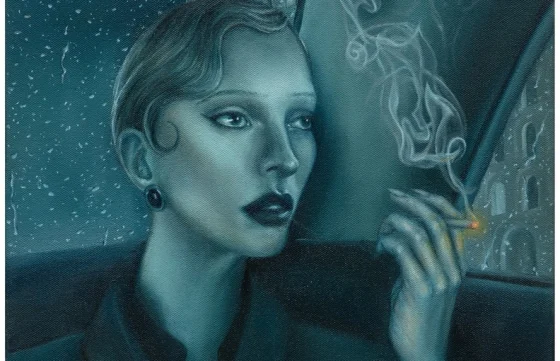
Huitema utilizes this duality to explore the emotional interiority of her subjects. Her paintings are populated by elongated, ethereal women who inhabit dimly lit, opulent interiors. Clad in the trappings of Gatsby-era decadence—pearls, jewel-encrusted headdresses, and backless evening gowns—these figures are rendered in a restricted palette of cool blues and greens. This chromatic restraint forces the viewer to focus on the psychological tension embedded in every brushstroke. The figures are watchful, guarded, and perpetually poised between a state of seduction and one of self-defense.
Chronology and Development: A Self-Directed Evolution
Sophia Huitema’s ascent in the art world is characterized by a deliberate, non-academic trajectory. Unlike many of her contemporaries who follow the traditional MFA-to-gallery pipeline, Huitema’s artistic vocabulary has been forged through a sustained, self-directed studio practice. This independence is palpable in the work; she avoids the rigid dogmas of academic painting in favor of a fluid synthesis of historical and contemporary visual languages.
The development of Prussian Blue represents the culmination of years of experimentation with scale, proportion, and lighting. Her early works hinted at the elongation of form that has now become a signature, but the current exhibition shows a newfound maturity in how she handles "compressed space." By restricting her environment to shallow, dreamlike rooms, Huitema forces the viewer to engage directly with the figures, who often break the fourth wall to confront the observer with a piercing, unnerving gaze.
Supporting Data: Art-Historical Synthesis
To understand Huitema’s work is to navigate a complex map of twentieth-century visual culture. Her figures, characterized by slender necks and exaggerated limbs, draw a clear lineage to the world of early twentieth-century fashion illustration. One can discern the influence of Erté’s streamlined finesse and the theatrical, stylized poses found in interwar stage design.
However, Huitema avoids the trap of mere pastiche. She pushes these historical aesthetics into the realm of the surreal. Her interiors, often reminiscent of film-noir sets, do not function as realistic environments. Instead, they operate as "psychological realms"—phantasmagoric spaces where the laws of physics are secondary to the laws of emotion. In the piece Sleeper Car, for instance, the geometry of the room is manipulated to create a sense of mounting anxiety. The streaks of rain against the window and the elongated, narrowing aisle evoke the apex of a psychological thriller, demonstrating how Huitema uses the language of cinema to heighten the narrative tension of the canvas.
The Duality of the Femme Fatale
A central theme throughout the seven works is the subversion of the "femme fatale" trope. In traditional art history, the female figure is often presented as an object of beauty or a dangerous siren. Huitema reclaims this archetype, infusing her women with a "quietly calculating air." They are not simply being watched; they are watching back. In Sleeper Car, the protagonist’s relaxed pose is betrayed by her hand, which is braced and ready to strike. This detail suggests that the viewer is not merely an observer of beauty, but perhaps a potential threat that the subject is prepared to neutralize.
Official Responses and Curatorial Context
Harper’s gallery has positioned Prussian Blue as a pivotal moment in their 2026 programming. In their official statement, the gallery emphasizes that Huitema’s work acts as a bridge between the illustrative and the painterly. By grounding her work in "sustained studio practice and close observation," she has created a body of work that feels both timeless and urgent.
Critics have noted that the exhibition’s success lies in its coherence. Despite the varied influences—ranging from Art Deco design to Surrealist painting—the exhibition feels like a singular, unified dreamscape. The use of Prussian Blue functions as a "chromatic throughline," ensuring that even as the viewer moves from painting to painting, the mood remains consistent: cool, moody, and impeccably sharp.
Implications: The Future of Figurative Painting
The implications of Huitema’s work extend beyond the walls of the gallery. As contemporary painting continues to oscillate between the digital and the manual, Huitema’s commitment to the tactile nature of oil paint and the deliberate construction of "heightened atmosphere" serves as a reminder of the medium’s enduring power to evoke psychological states.
The Intersection of Threat and Beauty
Huitema’s work asks a provocative question: Can beauty exist without the threat of collapse? By dressing her figures in the finery of the elite while placing them in settings that suggest imminent danger, she highlights the precarity of status and social performance. The "toxicity" of the Prussian Blue pigment is a metaphor for the social circles her figures inhabit—environments that are polished and beautiful on the surface but carry the potential for ruin underneath.
A New Visual Language
By synthesizing illustration, cinema, and fine art, Huitema is contributing to a broader movement of artists who are dismantling the traditional hierarchies of visual culture. Her ability to translate the suspense of a film noir into the stillness of a static image is a rare skill that resonates with a contemporary audience accustomed to visual storytelling.
Conclusion: The Viewer as Participant
As the exhibition remains on view through April 2026, it serves as a destination for those interested in the evolution of figurative painting. Sophia Huitema does not provide the viewer with easy answers. She does not tell the audience whether her figures are victims, predators, or merely women navigating a treacherous world. Instead, she provides a stage—a moody, blue-tinted theater—and leaves the audience to contend with the gaze of those who are watching back.
Prussian Blue is more than an exhibition; it is an exercise in tension. Through the marriage of historical aestheticism and modern psychological depth, Huitema has created a space where the beauty of the image is inseparable from the menace of the story. For those who visit Harper’s, the experience is not just one of viewing art, but of being interrogated by it. As the paintings continue to exert their quiet, cool influence on the viewer, it becomes clear that Sophia Huitema is an artist who understands the weight of a gaze, the importance of a shadow, and the terrifying, beautiful power of the right color in the right hands.
Exhibition Details
- Artist: Sophia Huitema
- Exhibition Prussian Blue
- Location: Harper’s, New York
- Duration: On view through April 25, 2026
- Medium: Oil on canvas
- Number of Works: Seven original oil paintings