Reynand Wu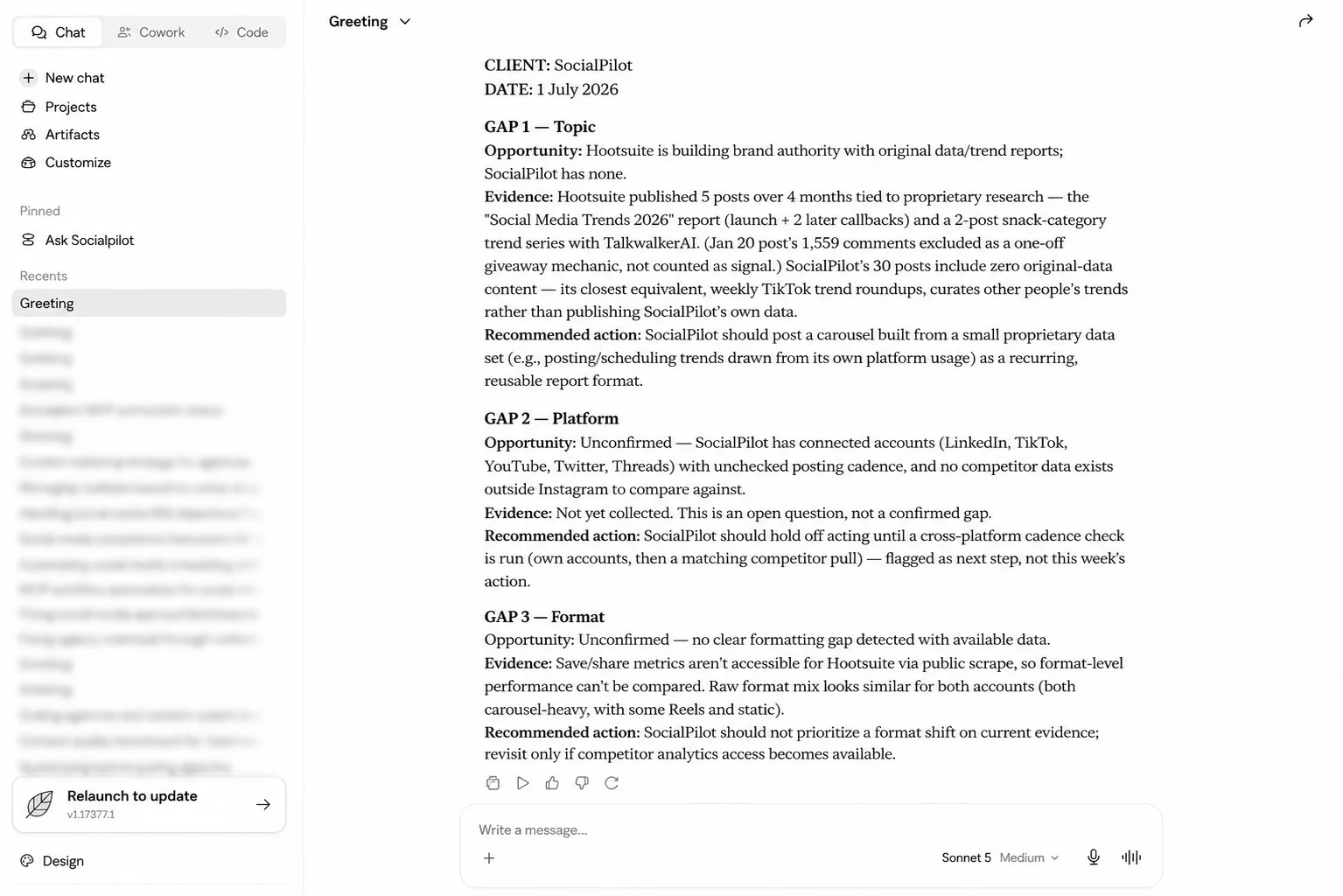
For digital agencies, the most frustrating bottleneck isn’t the lack of data—it is the agonizingly slow journey from insight to execution. You know your client’s competitors are striking gold with a specific content format or topic, but by the time your team finishes the manual cycle of data collection, brief writing, internal approval, and final scheduling, the "moment" has long since evaporated.
This operational drag forces most agencies into a reactive posture. Competitive analysis, which should be a dynamic, weekly engine for growth, is relegated to a quarterly document that sits unread in a team folder. Today, however, a new architectural shift in agency workflows—leveraging Model Context Protocol (MCP) integrations within Claude—is collapsing this entire process into a single, high-velocity conversation.
The Bottleneck: Why Competitive Analysis Stalls
The traditional agency workflow for competitive intelligence is inherently fragmented. A social media manager typically performs a manual audit across three platforms for a single client, compiles the findings into a report, routes it to a strategist, drafts a response, and finally logs into a separate publishing tool to schedule the post.
At the scale of one or two clients, this is a manageable, if tedious, administrative burden. But as an agency grows to manage 10, 15, or 20 clients, the complexity compounds exponentially. Each client carries a distinct brand voice, a unique set of competitors, and specific audience sensitivities. Consequently, most agencies stop treating competitive analysis as a proactive strategy and start treating it as a chore to be completed on a "best-effort" basis—usually quarterly.
The result is a classic failure of agility: the agency spots the gap, but they cannot act on it fast enough to capture the relevant audience interest. The solution is not to work harder; it is to eliminate the "distance" between the identification of a trend and the placement of a post in the content queue.
The Architecture of a Connected Workflow
The new model for agency efficiency relies on three core MCP integrations that turn an AI chat interface into a command-and-control center. By connecting Apify (for data scraping), SocialPilot (for content management and publishing), and Slack (for team and client communication) into a single Claude conversation, the workflow becomes a closed-loop system.
The Integration Layer
- Apify MCP: Acts as the research arm, pulling raw social media data from competitor accounts with surgical precision. It removes the need for manual scrolling and screenshotting.
- SocialPilot MCP: Serves as the operational backbone. It provides the AI with a direct line into your client’s content calendar and publishing history, ensuring that the AI understands exactly what has already been said.
- Slack MCP: Functions as the communication bridge. It allows for seamless collaboration between the agency, the AI, and the client, ensuring that approvals happen in real-time without ever leaving the conversation.
Chronology: From Raw Feed to Published Post
The transition from manual labor to automated intelligence follows a precise, two-phase chronology that can reduce the time spent per client from three hours per quarter to approximately 45 minutes per week.
Phase 1: Identifying the Opportunity
- Context Loading: During onboarding, the agency feeds Claude the client’s brand guidelines, target audience, and specific content pillars. This creates a "system memory" that remains persistent across all future sessions.
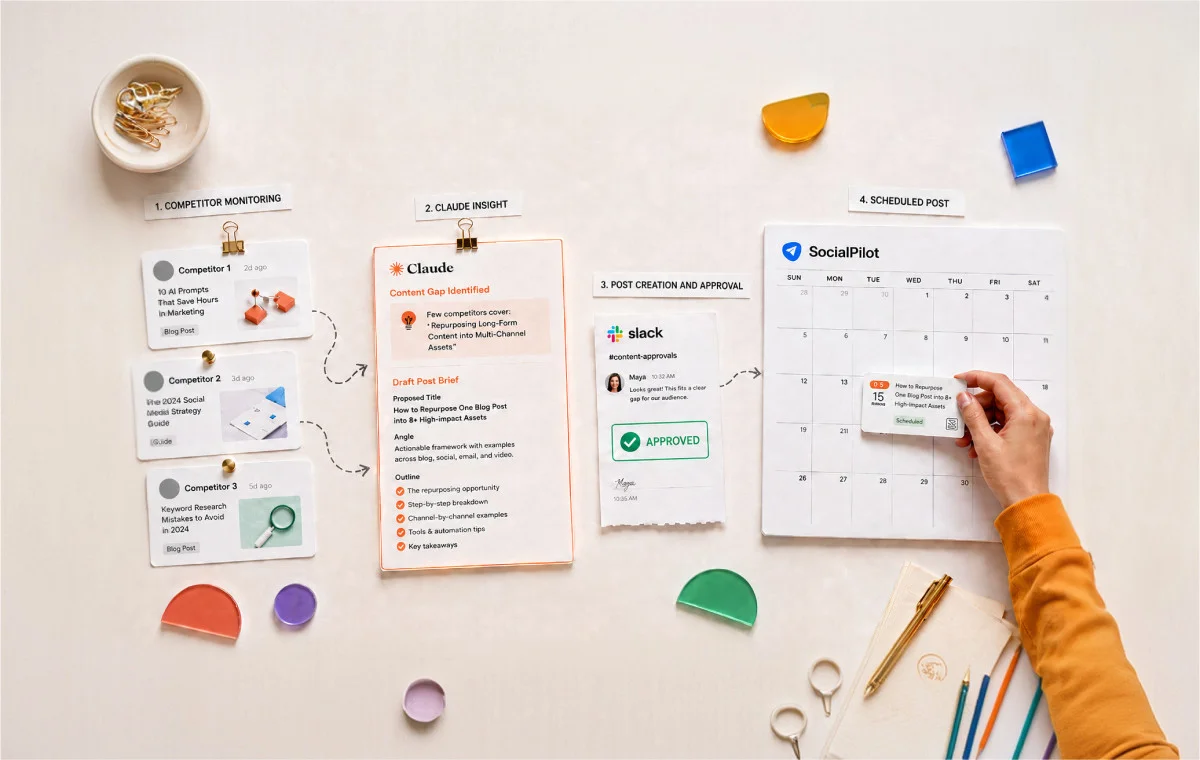
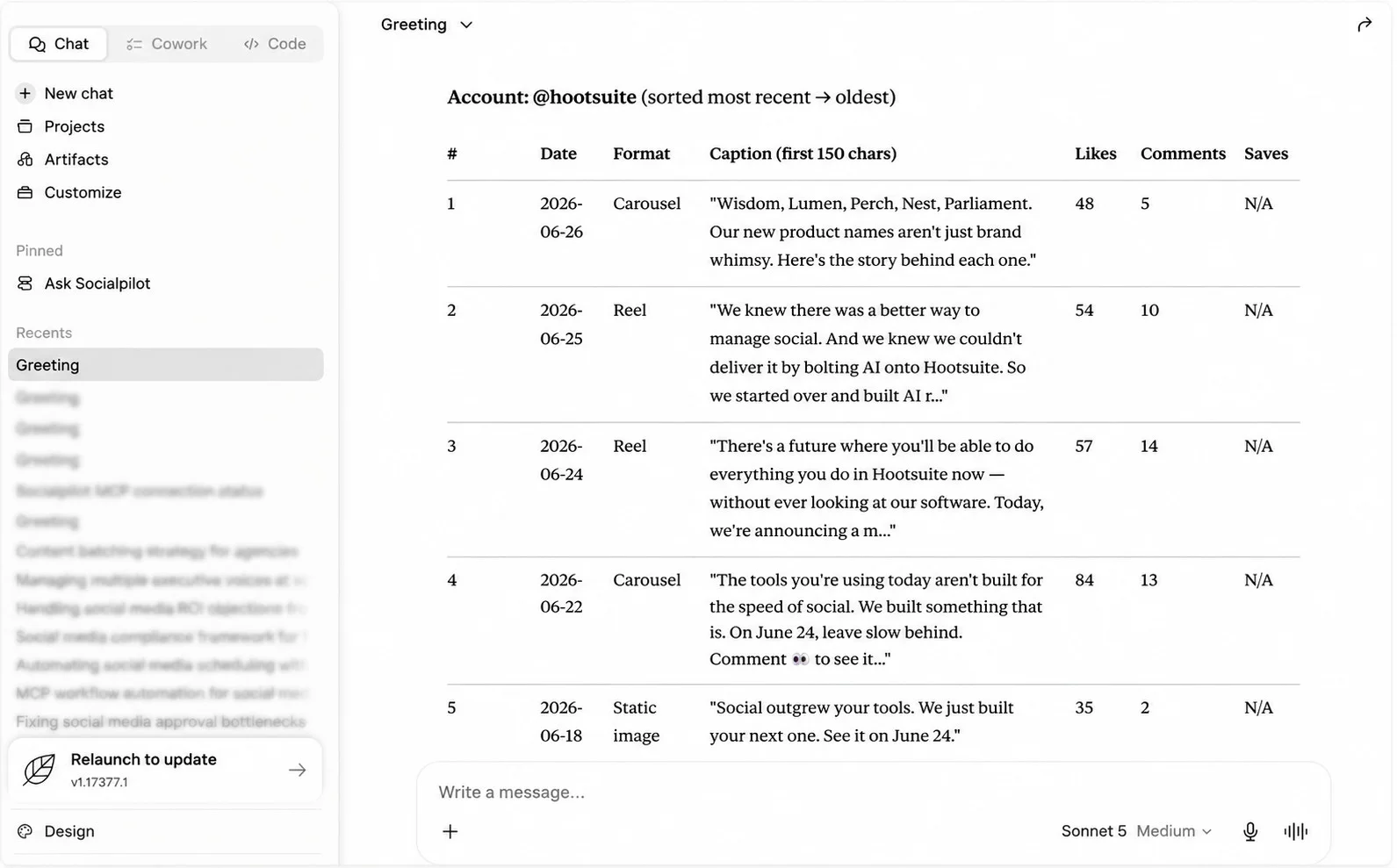
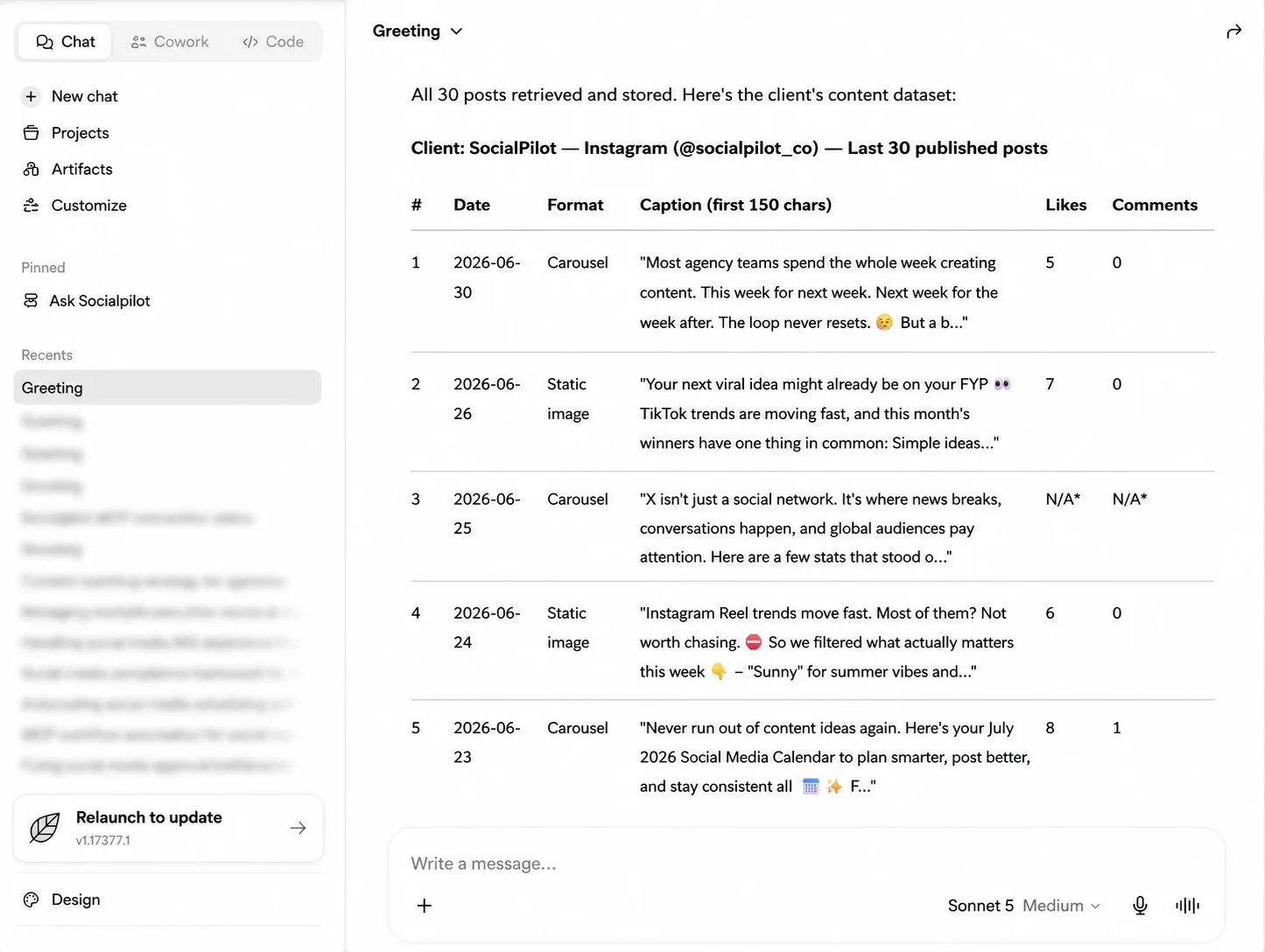
- Data Extraction: Using the Apify MCP, the system scrapes the last 15–20 posts from designated competitor accounts. It gathers caption snippets, content formats, and engagement signals (likes, comments, and saves).
- Audience Alignment: The system then queries the client’s own publishing history via the SocialPilot MCP. This is a critical step: it ensures the AI doesn’t suggest a topic the client has already exhausted.
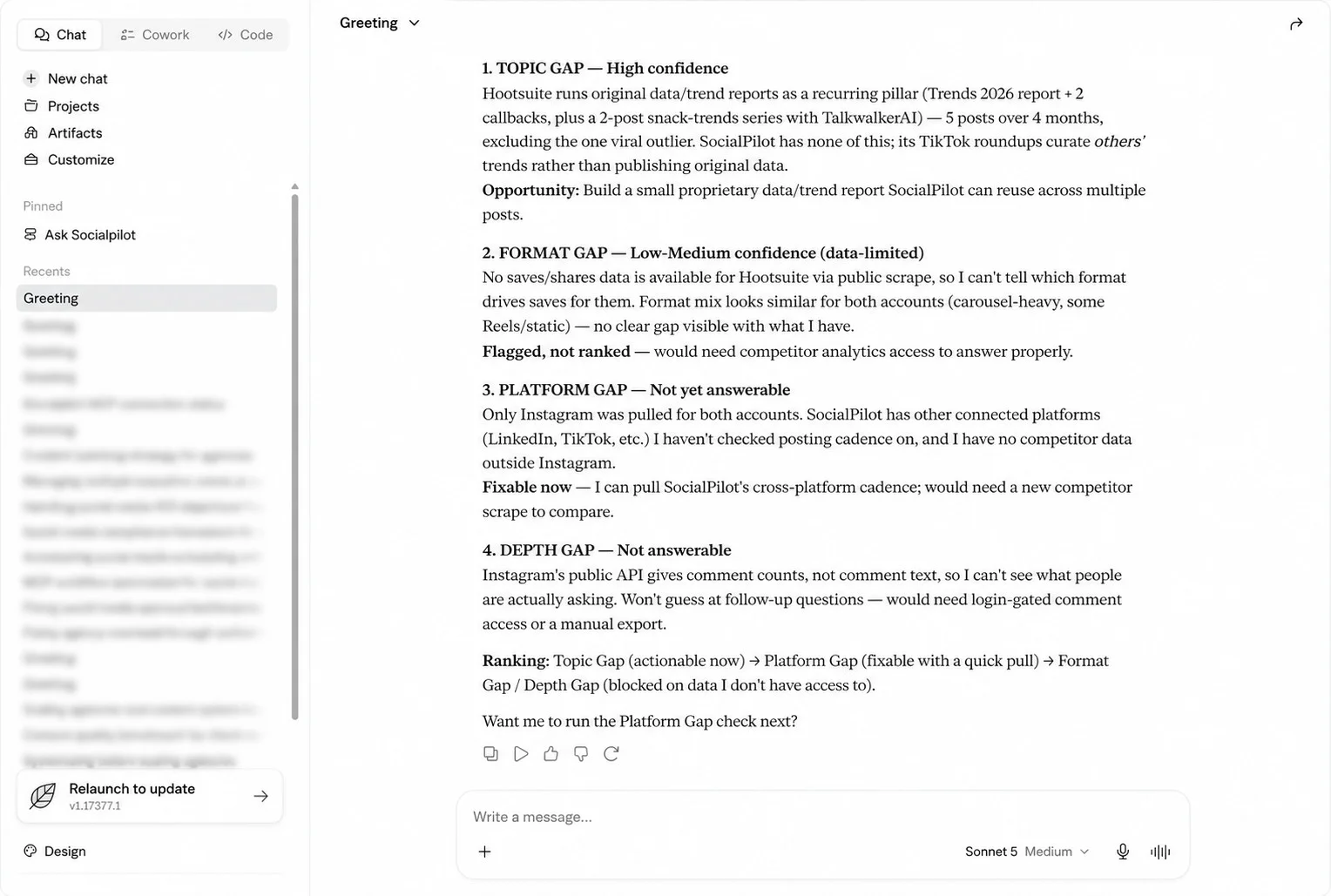
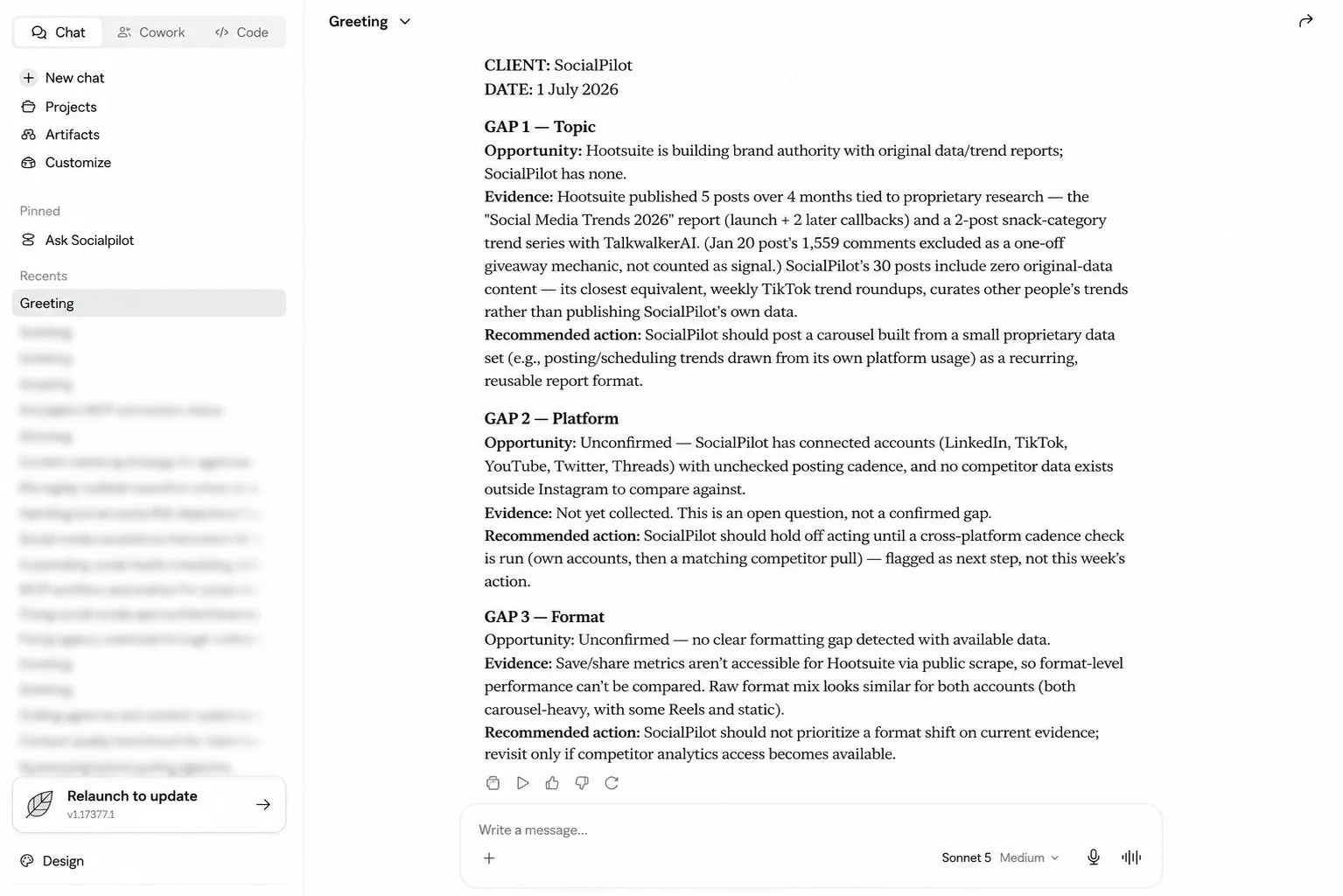
- Gap Analysis: Claude evaluates the findings across four dimensions: Topic Gaps (what competitors are discussing that the client is ignoring), Format Gaps (high-engagement formats like Carousels or Reels that the client is underutilizing), Platform Gaps (untapped channels), and Depth Gaps (surface-level competitor posts that ignore the "follow-up questions" frequently appearing in comments).
- Brief Generation: The system outputs a structured, ranked brief. This brief is pushed via Slack directly to the client or the internal account manager for a "go/no-go" decision.
Phase 2: Execution and Scheduling
Once a specific gap is selected by the team, the process moves into high-gear:
- Drafting: The AI generates a post draft tailored to the client’s brand voice, focusing on a scroll-stopping hook and a high-conversion Call to Action (CTA).
- Approval: Using SocialPilot’s "Approval on the Go" feature, the draft is pushed to the client’s dashboard. The client reviews the copy and visual assets in one place.
- Scheduling: Once approved, the AI executes the final command, placing the post into the client’s calendar at the optimal time.
Supporting Data: The Economics of Speed
The shift from manual to connected workflows fundamentally changes agency economics. By reducing human intervention to two primary decision points—choosing the gap and approving the final draft—the agency can scale its competitive monitoring capabilities without increasing headcount.
Data suggests that for a mid-sized agency, this workflow creates a 75-80% reduction in time-to-market for reactive content. More importantly, it removes the "context switching" tax. When a social media manager spends 20 minutes jumping between five different tabs to log a single insight, they lose focus. By centralizing the process, the cognitive load is reduced, leading to higher-quality, more creative outputs.
Implications for Agency Strategy
The adoption of this technology signals a shift in the value proposition of social media agencies. When the "mechanical" work of monitoring and drafting is handled by an AI-integrated system, the agency’s value shifts from doing the research to interpreting it.
Scalable Intelligence
By packaging this workflow as a "Skill"—a reusable set of instructions—agencies can standardize the quality of their competitive analysis across their entire roster. When a new client is signed, the agency simply triggers the /competitor-gap command. The system immediately applies the established research logic, ensuring that the agency delivers senior-level strategic output from the very first week of the engagement.
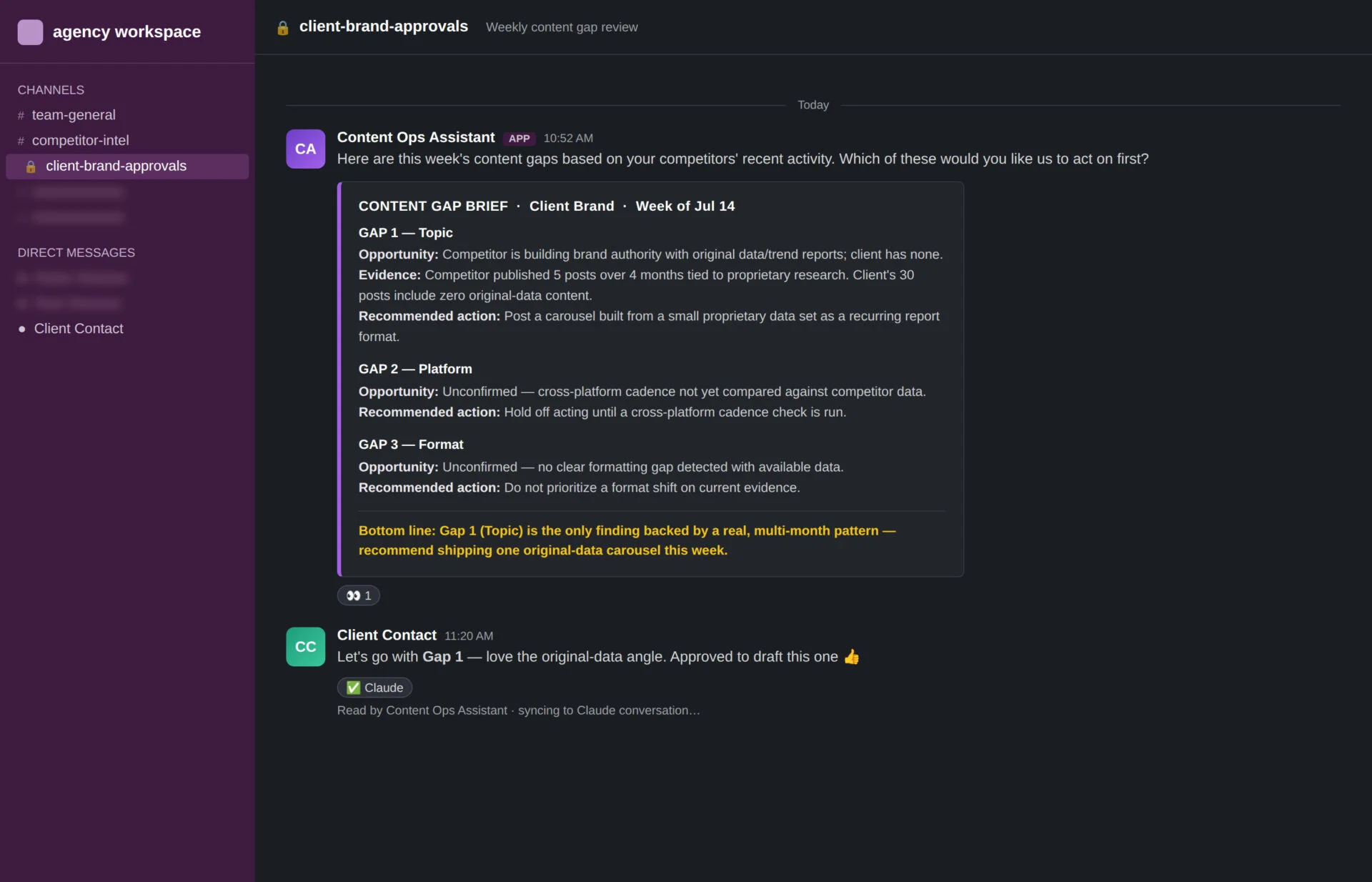
The Human-in-the-Loop Advantage
Critically, this system does not remove the human element; it elevates it. The agency maintains editorial control at every step. The AI acts as an tireless research analyst and copywriter, while the human strategist serves as the editor-in-chief. This division of labor allows the agency to focus on high-level brand storytelling and relationship management, rather than the minutiae of data entry and content scheduling.
Future-Proofing the Agency Model
The gap between the "spotted" opportunity and the "scheduled" post is a measure of an agency’s competitive advantage. Agencies that continue to rely on manual, fragmented processes will find themselves outpaced by firms that utilize connected AI systems to turn data into action in real-time.
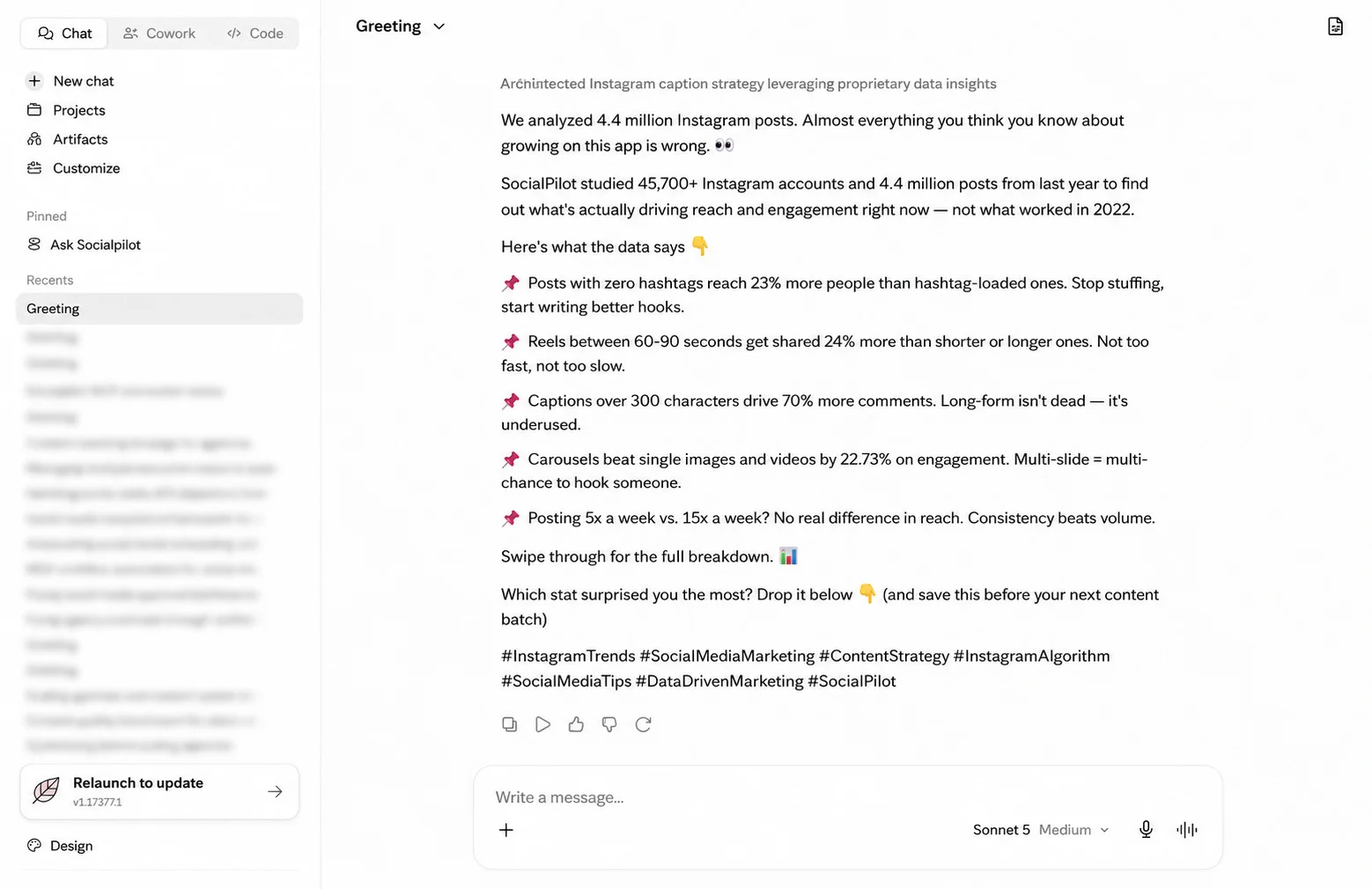
As we move deeper into an era of high-frequency social media marketing, the ability to rapidly identify and respond to competitor activity is becoming a prerequisite for client retention. By integrating tools like Apify and SocialPilot into the conversational interface of Claude, agencies are not just adopting a new tool; they are building a new operational infrastructure. The agencies that thrive in the coming years will be those that realize the true power of AI is not in the generation of content, but in the seamless orchestration of the systems that produce it.


 Evan Lee Salim
 Rifan Muazin