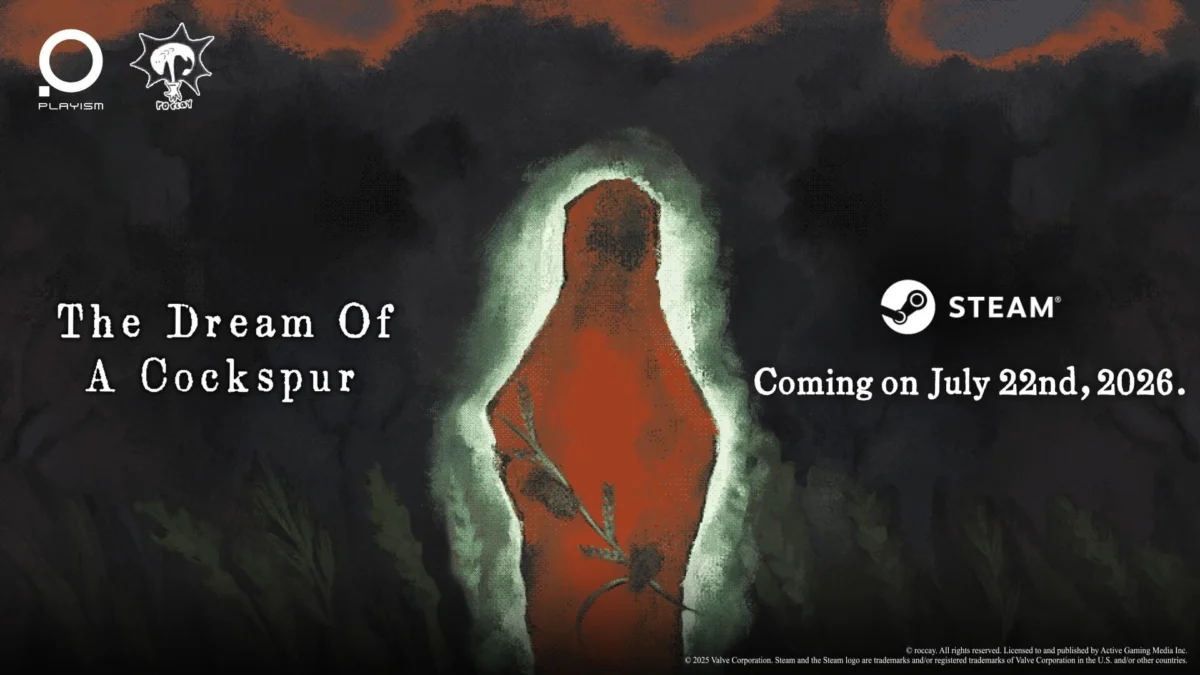
TOKYO, JAPAN – [Date of Article – e.g., July 15, 2026] – In a highly anticipated announcement that has sent ripples through the indie horror gaming community, publisher PLAYISM and developer roccay have officially dated their enigmatic surreal point-and-click cosmic horror title, The Dream Of A Cockspur. The game is slated for a global release on PC via Steam on July 22, 2026, priced at a competitive $6.99 USD or 790 yen. This revelation was accompanied by a new suite of trailers, offered in multiple languages, providing a deeper, albeit still unsettling, glimpse into the psychological labyrinth awaiting players.
The Dream Of A Cockspur promises a narrative experience steeped in existential dread and unreliable realities, a hallmark of the cosmic horror genre. Players will navigate a mysterious island setting, unraveling a story that blurs the lines between perception and madness, truth and illusion. With its distinct art style and a premise that defies straightforward explanation, the title is poised to be a significant entry in the burgeoning landscape of story-driven horror games.
Main Facts: A Descent into the Unknown
The core announcement confirms that The Dream Of A Cockspur, a game whose very title evokes a sense of the bizarre and the unsettling, will launch on July 22, 2026. This date marks the culmination of what appears to be a period of meticulous development by the relatively unknown studio roccay, brought to a global audience by the reputable indie publisher PLAYISM. The choice of PC as the initial platform, leveraging the widespread accessibility of Steam, ensures a broad reach for this unique experience.
The game’s genre – surreal point-and-click cosmic horror – is a deliberate fusion designed to maximize atmospheric tension and psychological unease. Point-and-click mechanics traditionally emphasize exploration, puzzle-solving, and deep narrative engagement, often at a slower, more deliberate pace. This pace is perfectly suited to the gradual build-up of dread intrinsic to cosmic horror, where the terror stems not from jump scares, but from the slow, creeping realization of humanity’s utter insignificance in the face of incomprehensible, ancient evils. The "surreal" element further suggests a departure from conventional reality, promising visuals and plot points that challenge player expectations and perceptions, forcing them to question everything they encounter.
At a price point of $6.99, The Dream Of A Cockspur positions itself as an accessible yet premium indie title, inviting curious players to delve into its depths without a substantial financial commitment. This strategy is common among independent developers aiming to build a reputation and reach a wide audience, relying on the game’s unique concept and critical reception to drive its success. The multi-language support for its release trailers—English, Japanese, Traditional Chinese, and Simplified Chinese—underscores PLAYISM’s commitment to a global audience, particularly acknowledging the strong gaming communities in East Asia.
The brief overview provided on the game’s Steam page is itself a masterclass in obfuscation, deliberately presenting conflicting narratives about the investigators’ fate on the island. This narrative strategy is not merely a tease but a fundamental aspect of the game’s identity, immediately signaling to players that they should expect an experience where nothing can be taken at face value. The direct biblical quote from Matthew 13:38 ("The field is the world, and the good seed represents the people of the Kingdom. The weeds are the people who belong to the evil one.") further layers the game with allegorical potential, hinting at themes of corruption, hidden malevolence, and perhaps a struggle between light and encroaching darkness. This initial information paints a picture of a game that is not just a horror experience, but a profound psychological journey into the heart of madness.
Chronology: From Concept to Cosmic Release
The journey of The Dream Of A Cockspur to its impending release date reflects a carefully orchestrated, albeit somewhat mysterious, development and publishing process.
Genesis of a Nightmare: roccay’s Vision
Information regarding developer roccay is scarce, suggesting the studio is either a nascent entity, perhaps a small team or even a solo developer, operating with a quiet intensity typical of many innovative indie creators. This enigmatic presence aligns perfectly with the game’s themes of mystery and the unknown. While direct interviews or detailed developer diaries are not widely available, the game’s highly specific genre and narrative ambition speak volumes about roccay’s artistic vision. The commitment to such a niche, psychologically dense horror experience indicates a passion for storytelling and a willingness to explore unconventional narrative structures, placing emphasis on atmosphere and thematic depth over mainstream appeal. This calculated obscurity in the developer’s public profile only serves to heighten the intrigue surrounding The Dream Of A Cockspur.
PLAYISM’s Role: Curating Unique Experiences
PLAYISM, a publisher known for its discerning taste in unique and often unconventional indie titles, particularly those emerging from the Japanese development scene, has thrown its weight behind The Dream Of A Cockspur. Their portfolio includes critically acclaimed games like Kero Blaster, Touhou Luna Nights, and the LA-MULANA series, all celebrated for their distinctiveness and quality. PLAYISM’s involvement signals a strong endorsement of roccay’s vision, suggesting that The Dream Of A Cockspur possesses the kind of artistic merit and innovative gameplay that aligns with their brand. Their expertise in localization and global distribution is crucial for bringing such a specialized title to an international audience, ensuring that the nuances of its horror and surrealism are effectively conveyed across different linguistic and cultural contexts.
The Announcement Trail: Building Anticipation
While the precise timeline of The Dream Of A Cockspur‘s initial reveal is not extensively detailed, the nature of its announcement points to a strategic build-up. Indie games often begin with quiet concept art reveals, cryptic teasers, or early Steam page listings to gauge interest. The recent formal announcement of the release date, accompanied by a polished series of trailers, indicates a transition from development secrecy to a focused marketing push. This timing is critical, allowing ample opportunity for media coverage and player wishlisting ahead of the July 22, 2026 launch. The multi-language trailers are a key part of this strategy, ensuring that the game’s eerie atmosphere and narrative hooks resonate with a global audience from the outset.
Pre-Release Buzz and Expectations
The unique elements of The Dream Of A Cockspur have already begun to generate considerable buzz. The game’s Steam page, with its conflicting and fragmented descriptions of the investigators’ plight, has sparked curiosity and discussion among players and critics alike. This deliberate narrative ambiguity is a powerful tool, encouraging potential players to speculate about the true nature of the island, the celestial body, and the sanity of the protagonists. Expectations are high for a game that promises to deliver a genuinely unsettling experience, challenging players not just with puzzles, but with fundamental questions about reality and perception. The point-and-click genre’s dedicated fanbase, coupled with the growing appreciation for cosmic horror, positions The Dream Of A Cockspur as a title that could capture significant attention upon its release.
Supporting Data: Deconstructing the Horror
The rich, albeit sparse, details provided about The Dream Of A Cockspur offer fertile ground for analysis, revealing the intricate layers that contribute to its distinctive identity as a cosmic horror game.
Unpacking the Narrative Intrigue: A Labyrinth of Lies
The most striking element of The Dream Of A Cockspur’s official overview is its deliberately contradictory narrative descriptions. The Steam page presents four distinct, progressively unsettling accounts of the investigators’ time on the island. Initially, they are stranded due to a damaged boat, forced to discover "new facts." This quickly devolves into claims of planting "special seeds" and harvesting, then a denial of any problems ("you had a great time"), only to conclude with a stark statement of "punishment" and "no more harvests." Finally, it reverts to a simple, unadorned statement of two weeks of work proceeding smoothly.
This narrative strategy is a powerful device for cosmic horror, deeply rooted in themes of unreliable narration and the descent into madness. It immediately tells the player that objective truth is elusive, and their own perceptions will be challenged. This technique mirrors the Lovecraftian tradition, where protagonists often grapple with sanity as they uncover truths too vast and terrifying for the human mind to comprehend. The conflicting accounts could represent:
- Progressive Delusion: The slow erosion of the investigators’ minds, with reality fracturing into increasingly bizarre and self-contradictory fragments.
- Multiple Realities: The existence of parallel dimensions or temporal anomalies, where different outcomes coexist or are experienced simultaneously.
- External Manipulation: An unknown entity actively altering memories, perceptions, or even the fabric of reality itself, to torment or mislead the protagonists.
- Symbolic Transformation: The "planting seeds" and "harvests" could be allegorical, perhaps representing the unwitting cultivation of something horrifying, or the consequences (the "punishment") of their investigation.
The biblical quote from Matthew 13:38—"The field is the world, and the good seed represents the people of the Kingdom. The weeds are the people who belong to the evil one."—lends a profound allegorical dimension. Within the context of the game’s conflicting narratives, this quote suggests that the island itself is a "field" where the line between good and evil, or perhaps humanity and an alien influence, has become blurred. Are the investigators the "good seed" being corrupted by "weeds," or have they, perhaps unwittingly, become the "weeds" themselves, planting something monstrous? This adds a layer of moral and spiritual ambiguity to the unfolding horror.
The Point-and-Click Revival: A Classic Genre for Modern Dread
The choice of a point-and-click adventure framework is a deliberate and effective one for The Dream Of A Cockspur. This genre, while sometimes perceived as niche, has experienced a significant renaissance in the indie space, particularly within horror. Unlike action-oriented horror games, point-and-click titles thrive on:
- Atmosphere and Immersion: The slower pace allows players to soak in environmental details, read lore, and experience the dread at a sustained, creeping level.
- Puzzle-Solving and Deduction: Players must actively engage with the environment, often requiring logical leaps or creative thinking to progress, which can make revelations more impactful.
- Story-Driven Focus: The mechanics inherently prioritize narrative over combat, allowing for complex plots, character development (or degradation), and deep world-building.
For cosmic horror, the point-and-click interface is ideal. It positions the player as an observer and investigator, meticulously piecing together fragments of a horrifying truth, much like a detective slowly descending into madness. It minimizes reliance on reflexes and instead demands intellectual and emotional engagement, making the psychological impact all the more potent.
Cosmic Horror: A Genre Analysis
The Dream Of A Cockspur firmly plants itself within the cosmic horror subgenre, popularized by H.P. Lovecraft. Key tenets of cosmic horror include:
- Existential Dread: The terrifying realization of humanity’s utter insignificance in the vast, indifferent cosmos.
- Incomprehensible Entities: Horrors that are not merely evil but fundamentally alien, existing beyond human understanding and morality.
- Madness as a Consequence: Exposure to these truths invariably leads to psychological breakdown, hallucination, or complete insanity.
- Forbidden Knowledge: The pursuit of certain truths is inherently dangerous and destructive.
The game’s premise—investigators examining a "mysterious celestial body" on an isolated island—is textbook cosmic horror. The celestial body itself is the direct conduit for the unknown, an alien presence that likely defies terrestrial physics and reason. The isolation of the island amplifies the sense of vulnerability and inescapable dread, cutting off the protagonists from familiar civilization and reinforcing their insignificance. The conflicting narrative accounts serve as a direct manifestation of the madness that ensues from encountering such profound alienness.
Visual and Auditory Aesthetics: Crafting the Unease
While the full scope of The Dream Of A Cockspur‘s visual and auditory design remains to be fully experienced, the trailers provide tantalizing clues. The art style appears distinct, leaning towards a slightly retro, perhaps 2.5D or highly stylized 3D aesthetic, characterized by muted, often unsettling color palettes that enhance the somber and eerie atmosphere. The environments shown are desolate and foreboding, hinting at abandoned structures, strange flora, and the omnipresent, menacing ocean. This deliberate artistic choice ensures that the visuals contribute directly to the game’s unsettling mood, rather than relying on hyper-realism.
The sound design, as evidenced in the trailers, features ambient, dissonant tones, unnerving effects, and a general lack of conventional music, emphasizing silence and sudden, jarring noises. This minimalist approach to audio is highly effective in horror, making every creak, whisper, or unsettling drone contribute to the player’s anxiety. The interplay between the visual desolation and the atmospheric soundscape promises a deeply immersive and psychologically taxing experience.
Pricing and Accessibility
The $6.99 price point for The Dream Of A Cockspur is strategically chosen. It makes the game highly accessible to a wide audience, including those who might be hesitant to invest heavily in an unknown indie title. This pricing often implies a concise, tightly-focused experience, perhaps a few hours of intense gameplay rather than dozens of hours. This aligns well with the psychological horror genre, where a concentrated, impactful experience can often be more potent than a sprawling one. It encourages impulse purchases and allows the game to find its audience based on its unique premise and positive word-of-mouth.
Official Responses: Voices from the Void
Understanding the motivations and philosophies behind The Dream Of A Cockspur requires an examination of the messages, both explicit and implicit, from its creators and supporters.
Developer’s Vision: roccay’s Enigmatic Artistry
While direct, extensive statements from developer roccay are not publicly prominent, the very design of The Dream Of A Cockspur speaks volumes about their artistic vision. The deliberate use of fragmented, contradictory narratives on the Steam page is not accidental; it is a core design choice intended to immediately immerse players in the game’s themes of uncertainty and psychological instability. This suggests roccay is less interested in linear storytelling and more in crafting an experiential horror that challenges the player’s understanding of reality. Their choice of cosmic horror, combined with surrealism, indicates a desire to explore profound philosophical questions about existence, sanity, and the limits of human perception. The game appears to be a deeply personal and artistic expression, prioritizing a unique atmosphere and narrative over commercial trends, embodying the spirit of independent game development. The title itself, The Dream Of A Cockspur, is laden with symbolism, inviting interpretation. A "cockspur" can refer to a sharp, defensive appendage on a rooster, or a type of thorny plant. Both evoke images of aggression, defense, or entanglement. Coupled with "The Dream Of," it suggests a subconscious, illusory, or even nightmarish experience centered around conflict, struggle, or being ensnared. This enigmatic title perfectly encapsulates the game’s promise of a disorienting journey.
Publisher’s Endorsement: PLAYISM’s Commitment to Uniqueness
PLAYISM’s decision to publish The Dream Of A Cockspur is a strong testament to the game’s potential. As a publisher with a track record of identifying and championing niche, high-quality indie titles, especially from Japan, PLAYISM’s involvement indicates a belief in roccay’s unique vision and the game’s ability to resonate with a specific audience. While explicit statements from PLAYISM regarding their specific reasons for picking up this title are limited in the announcement, their publishing philosophy consistently highlights games that offer distinct artistic styles, innovative gameplay mechanics, and compelling narratives that stand apart from mainstream offerings. For The Dream Of A Cockspur, PLAYISM likely saw a game that pushes the boundaries of narrative and genre, aligning perfectly with their mission to bring groundbreaking independent experiences to a global market. Their support extends beyond mere distribution, encompassing localization and marketing efforts that ensure the game reaches its intended players.
Implications: The Ripple Effect of Cosmic Dread
The release of The Dream Of A Cockspur carries several implications, not just for its creators, but for the broader landscape of indie horror gaming and player expectations.
Impact on the Indie Horror Scene: A New Narrative Benchmark
The Dream Of A Cockspur has the potential to set a new benchmark for narrative innovation within the indie horror genre. Its audacious approach to storytelling, using conflicting descriptions as a core mechanic, challenges traditional narrative structures. If successful, it could inspire other developers to experiment more boldly with unreliable narration, meta-commentary, and fragmented storytelling, pushing the boundaries of how stories are told in interactive media. In a market often saturated with formulaic jump-scare horror, a game that prioritizes psychological depth and intellectual engagement can stand out significantly. It reinforces the idea that true horror often lies in what is unseen, unknown, and fundamentally incomprehensible.
Player Engagement and Replayability: The Quest for Truth
The game’s inherent narrative ambiguity poses interesting questions about player engagement and replayability. Will players be driven to multiple playthroughs to try and piece together a definitive "truth" from the conflicting accounts? Or will the ambiguity itself be the intended "ending," leaving players to grapple with their own interpretations of what transpired? This open-ended approach could foster a vibrant community of players dissecting theories, sharing experiences, and debating the game’s meaning, extending its longevity beyond a single playthrough. The quest for understanding in a world designed to resist it could become the primary form of engagement.
Future Prospects for roccay: An Enigmatic Legacy
A successful launch of The Dream Of A Cockspur would be transformative for roccay. As a seemingly emerging or small studio, positive critical reception and strong sales would provide the necessary capital and recognition to pursue future projects. It would establish roccay as a developer capable of crafting deeply atmospheric, thought-provoking, and uniquely unsettling experiences, cementing their place in the indie horror landscape. This could lead to opportunities for larger-scale projects, collaborations, or simply the continued freedom to pursue their distinct artistic vision without external pressure. The enigmatic nature of the studio could evolve into a signature style, a brand recognized for its cerebral and surreal horror offerings.
Broader Themes and Philosophical Questions: Beyond the Scream
Beyond its immediate horror elements, The Dream Of A Cockspur is poised to delve into profound philosophical questions. The constant shifting of reality and truth prompts players to consider:
- The Nature of Reality: Is our perception of reality reliable? What happens when objective truth dissolves?
- Sanity and Identity: How fragile is the human mind when confronted with the truly alien? Can one maintain a sense of self when memories and experiences are fractured?
- Humanity’s Place in the Cosmos: The mysterious celestial body directly confronts humanity with its cosmic insignificance, a core tenet of Lovecraftian horror.
- Religious Allegory: The Matthew 13:38 quote suggests an underlying exploration of good vs. evil, corruption, and perhaps a divine (or anti-divine) judgment or influence. Are the "weeds" literal invaders or metaphorical aspects of human nature corrupted by the celestial body?
These deeper themes elevate The Dream Of A Cockspur beyond mere entertainment, positioning it as a piece of interactive art capable of provoking genuine thought and introspection long after the credits roll. As July 22, 2026 approaches, the gaming world watches with a mixture of anticipation and dread for the nightmare that roccay and PLAYISM are preparing to unleash.