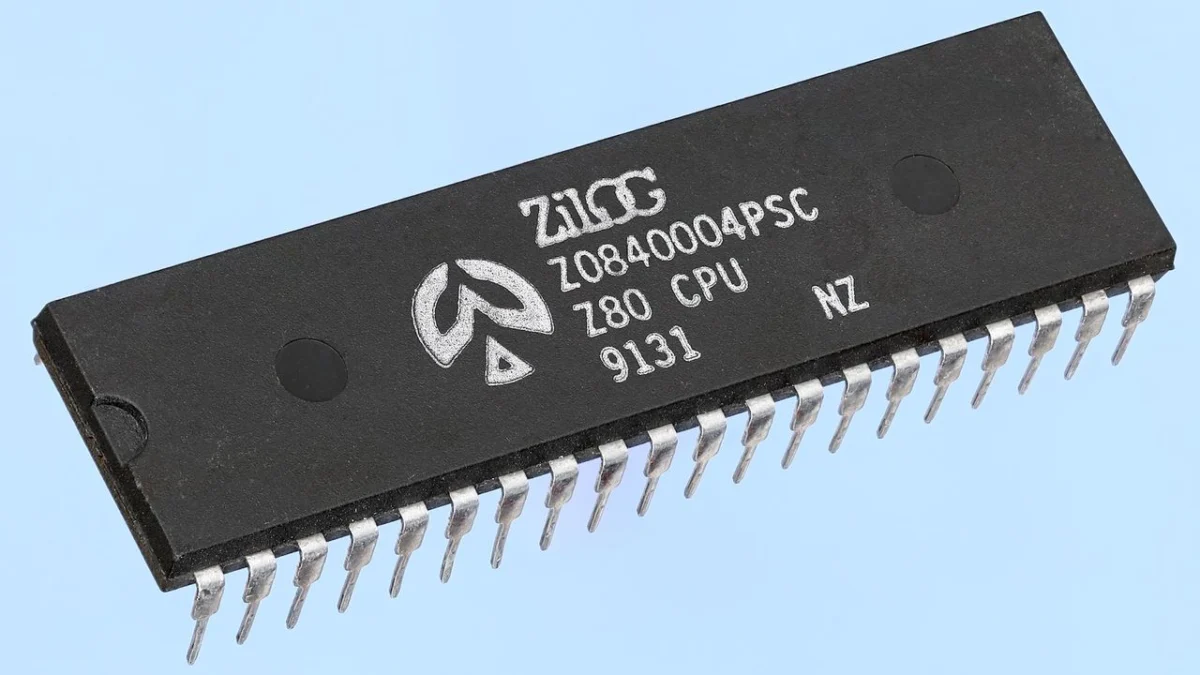
For nearly fifty years, the Zilog Z80 has been the invisible workhorse of the digital revolution. From the flickering green screens of early home computers to the iconic, blocky sprites of 1980s arcade cabinets, the Z80 was the heartbeat of a generation. However, as of June 2024, the era of official Zilog-manufactured Z80 production has come to a formal end. While the silicon giants have turned their backs on this venerable architecture, a dedicated community of engineers and retro-computing enthusiasts is ensuring that the Z80’s legacy does not vanish into the annals of history. Through open-source innovation, the "immortal" chip is being resurrected for a new era.
A Half-Century of Computing: The Main Facts
The Zilog Z80, introduced in July 1976, was not merely a processor; it was a masterclass in engineering efficiency. Designed by Federico Faggin—who had previously led the development of the Intel 4004 and 8080—the Z80 was intended to be an upgrade that could dominate the nascent microcomputing market.
At its core, the Z80 featured roughly 8,500 transistors manufactured on a 4µm process. While these numbers seem quaint by modern standards, the chip’s architecture was revolutionary. It offered binary compatibility with the Intel 8080, allowing it to immediately adopt the CP/M operating system, which served as the industry standard for business computing at the time. Perhaps most importantly, the Z80 included an integrated DRAM refresh counter, a feature that significantly reduced the number of support chips required for a system, thereby lowering costs for manufacturers. This balance of performance, compatibility, and affordability solidified its position as the de facto processor of the 8-bit era.
A Chronological Journey: From Silicon Valley to Modern FOSS
To understand the significance of the Z80’s "end of life," one must look at the timeline of its dominance:
- 1976: Zilog launches the Z80. With a starting clock speed of 2.5 MHz, it outperforms its primary rival, the Intel 8080, in both speed and hardware integration.
- 1980s: The "Golden Age." The Z80 becomes the engine behind the ZX Spectrum, the TRS-80, the MSX standard, the Sega Master System, and the Game Boy. It also powers the logic boards of legendary arcade machines like Pac-Man.
- 1990s–2000s: The transition to embedded systems. As PC architecture moves to 16-bit and 32-bit, the Z80 finds a permanent home in industrial controllers, calculators (such as the TI-84 series), and specialized embedded devices.
- April 15, 2024: Zilog (now a subsidiary of Littelfuse) issues a formal End-of-Life (EOL) notification for the Z84C00 family.
- June 2024: Final orders for the original Zilog-branded Z80 chips are closed, marking the end of nearly 48 years of continuous production.
- Late 2024–Present: The rise of the FOSS Z80. Developer Renaldas Zioma leads a community-driven effort to fabricate an open-source, drop-in replacement, successfully testing prototypes on modern nodes.
Technical Specifications and Performance Data
The longevity of the Z80 is largely due to its elegant simplicity. While the original NMOS (N-channel Metal-Oxide-Semiconductor) chips ran at a modest 2.5 MHz, later CMOS variants were pushed to 20 MHz. The design was so robust that it became the foundation for decades of educational and professional hardware.
The new, open-source project led by Renaldas Zioma leverages modern fabrication techniques to keep the architecture alive. By using the TV80 Verilog core—a synthesizable implementation of the Z80—the project is targeting significantly higher performance ceilings. While the original chips were limited by the manufacturing constraints of the 1970s, the new 130nm CMOS implementation is expected to support clock speeds up to 50 MHz.
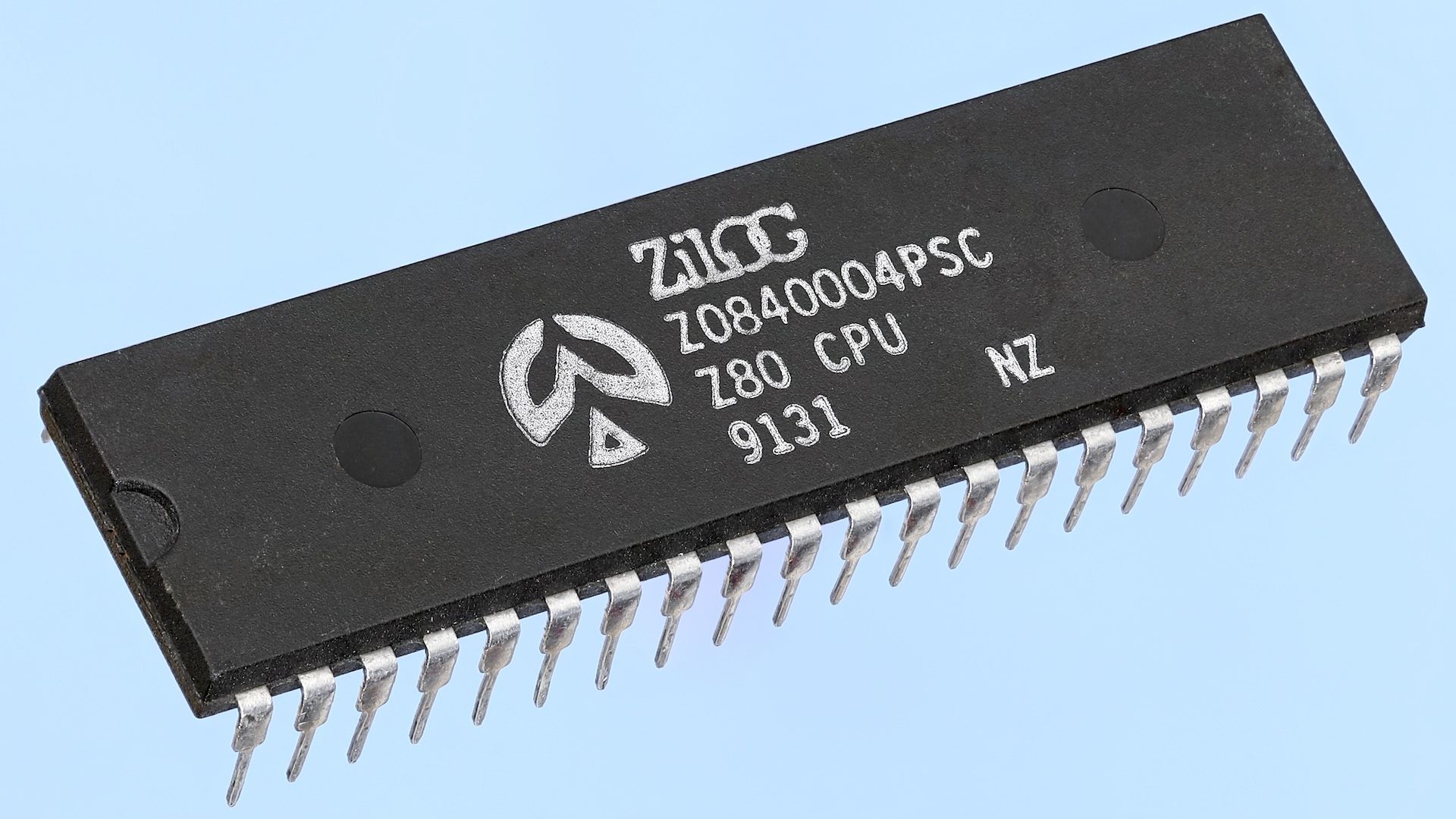
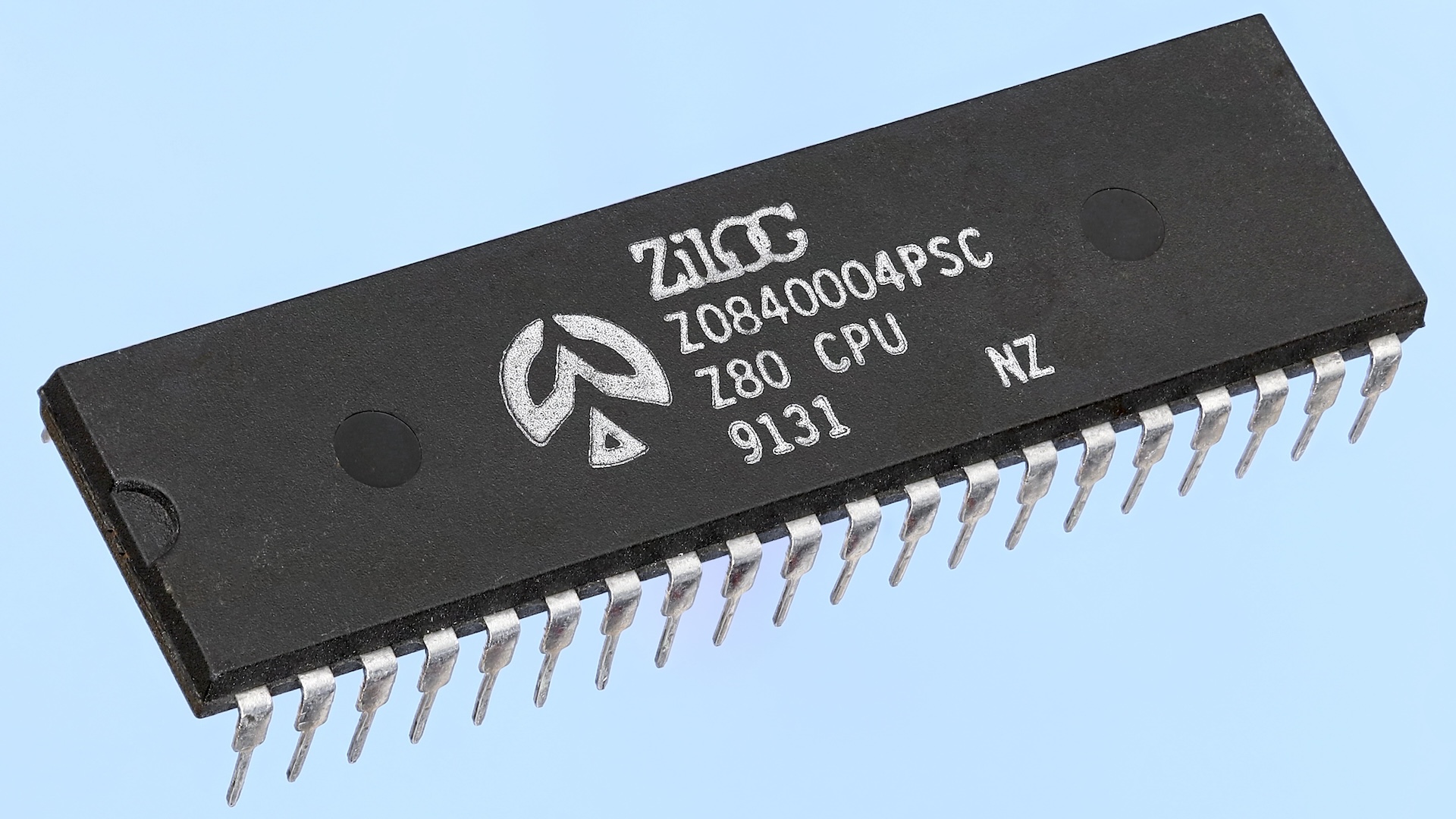
The project’s progress has been methodical. Through the Tiny Tapeout initiative, the team successfully fabricated a version on a die area of just 0.064mm². Subsequent iterations have moved through various shuttle programs (including Efabless and IHP), culminating in a design that targets the classic DIP40 (Dual In-line Package) form factor. This is critical for compatibility; by mimicking the original 40-pin layout, the new chips can be dropped directly into vintage motherboards like those of the ZX Spectrum or the RC2014 modular computer kit, allowing them to function without modification.
Official Responses and the Corporate View
The discontinuation of the Z80 was a purely economic decision. As semiconductor fabrication moves toward sub-10nm nodes and extreme ultraviolet (EUV) lithography, maintaining older, larger-node processes for legacy chips becomes increasingly expensive and inefficient for large corporations.
Zilog’s EOL notice was pragmatic, citing a lack of sustained demand for the Z84C00 family. Furthermore, the company has begun trimming its eZ80 line—the more advanced, pipelined successor to the original Z80. A product change notification from October 2023 signaled the end for the eZ80L92, again citing "little to no demand."
It is worth noting that while Zilog is distancing itself from its classic products, it has not abandoned the architecture entirely. The pipelined eZ80, introduced in 2001, remains in the company’s catalog, serving specialized industrial and educational markets. Nevertheless, the closure of the original Z80 line marks a symbolic shift: the transition of an industrial product into the realm of the hobbyist and the preservationist.
Implications for the Future: Preservation and Innovation
The decision to open-source the Z80 has profound implications for the world of retro-computing and embedded systems.
1. The Survival of Retro-Gaming
For collectors and enthusiasts, the availability of new, drop-in chips means that hardware failure is no longer a terminal diagnosis for classic machines. As original, "new old stock" (NOS) chips become rarer and more expensive, the FOSS Z80 will likely become the primary source for repairs, ensuring that machines like the ZX Spectrum remain functional for decades to come.
2. Educational Value
The Z80 remains one of the best platforms for teaching computer architecture. Its instruction set is straightforward, its documentation is vast, and its operation is transparent compared to the "black box" nature of modern multi-core processors. By creating an open-source version, the community is providing students and hobbyists with a path to understand how a CPU works from the transistor level up to the assembly code.
3. Unexpected Resilience
The continued relevance of the Z80 is highlighted by the sheer creativity of the developer community. Even in 2024, developers are pushing the boundaries of what the chip can do. A recent project demonstrated a functional, conversational AI chatbot running on a Z80 with only 64KB of RAM. This feat—impossible by the standards of 1976—shows that the limitation of the hardware is often secondary to the ingenuity of the programmer.
4. The Shift to FOSS Hardware
The Z80 project serves as a case study for the "Right to Repair" and the future of hardware longevity. By decoupling a design from a specific corporate foundry, the community has ensured that the architecture is immortal. As long as there is an interest in the instruction set, someone, somewhere, can use the open-source Verilog files to have a batch of chips manufactured. This represents a fundamental shift: hardware is no longer being "retired" by the manufacturer; it is being liberated by the user.
Conclusion
The Zilog Z80’s 50-year journey is a testament to the power of thoughtful, efficient design. While the silicon that defined an era may have stopped rolling off the production lines at Zilog, the architecture itself has transcended its corporate origins.
Through the efforts of engineers like Renaldas Zioma and the collaborative power of the open-source community, the Z80 is entering a second life. It is no longer just a piece of industrial legacy; it is now a community-maintained resource, a tool for education, and a badge of honor for those who refuse to let the history of computing be erased by the march of "planned obsolescence." The Z80 is dead; long live the Z80.