

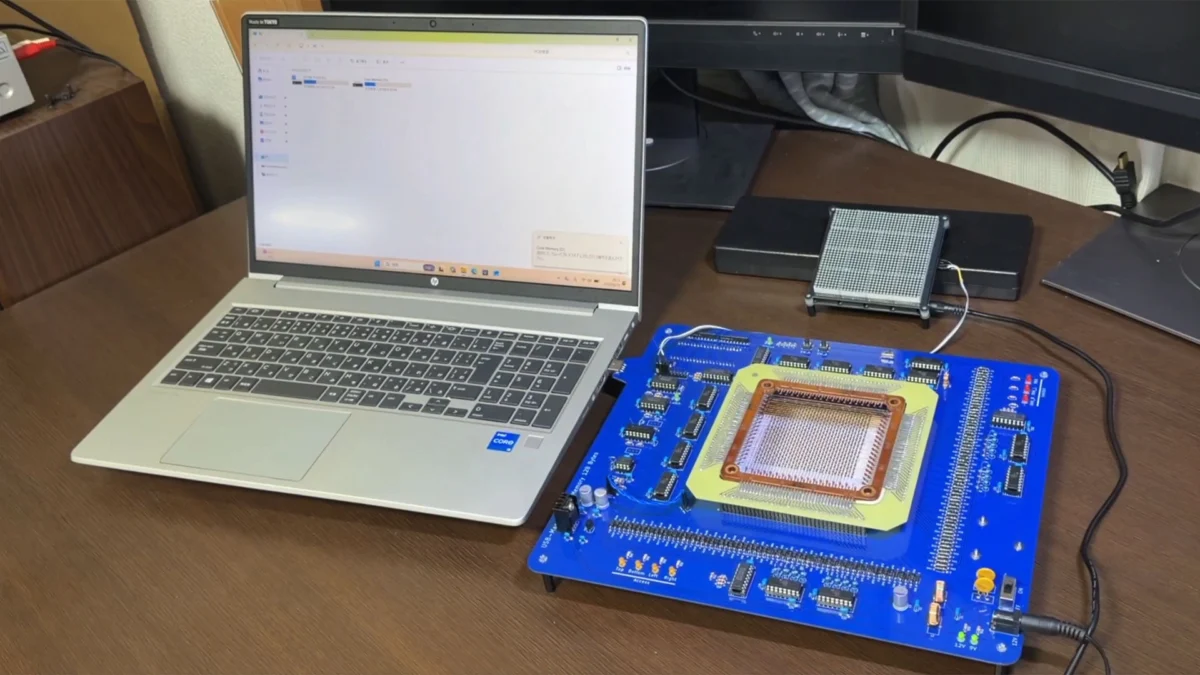
In an era defined by the microscopic density of NVMe SSDs and the invisible ubiquity of cloud storage, the concept of a storage device the size of a dinner plate capable of holding a mere 128 bytes seems like a deliberate act of technological rebellion. Yet, that is exactly what Japanese researcher @dydt_Nao has achieved. In a feat of engineering that bridges the gap between the mid-20th century and the modern era, the researcher has successfully utilized a custom-built, magnetic core memory-based USB device to perform a "sneakernet" file transfer between two personal computers.
This project, which debuted in preliminary form earlier this year, has now evolved from a laboratory curiosity into a functional piece of hardware, marking what is arguably the world’s first successful data transfer using this long-obsolete memory architecture in a contemporary USB interface.
Main Facts: The Dinner-Plate Drive
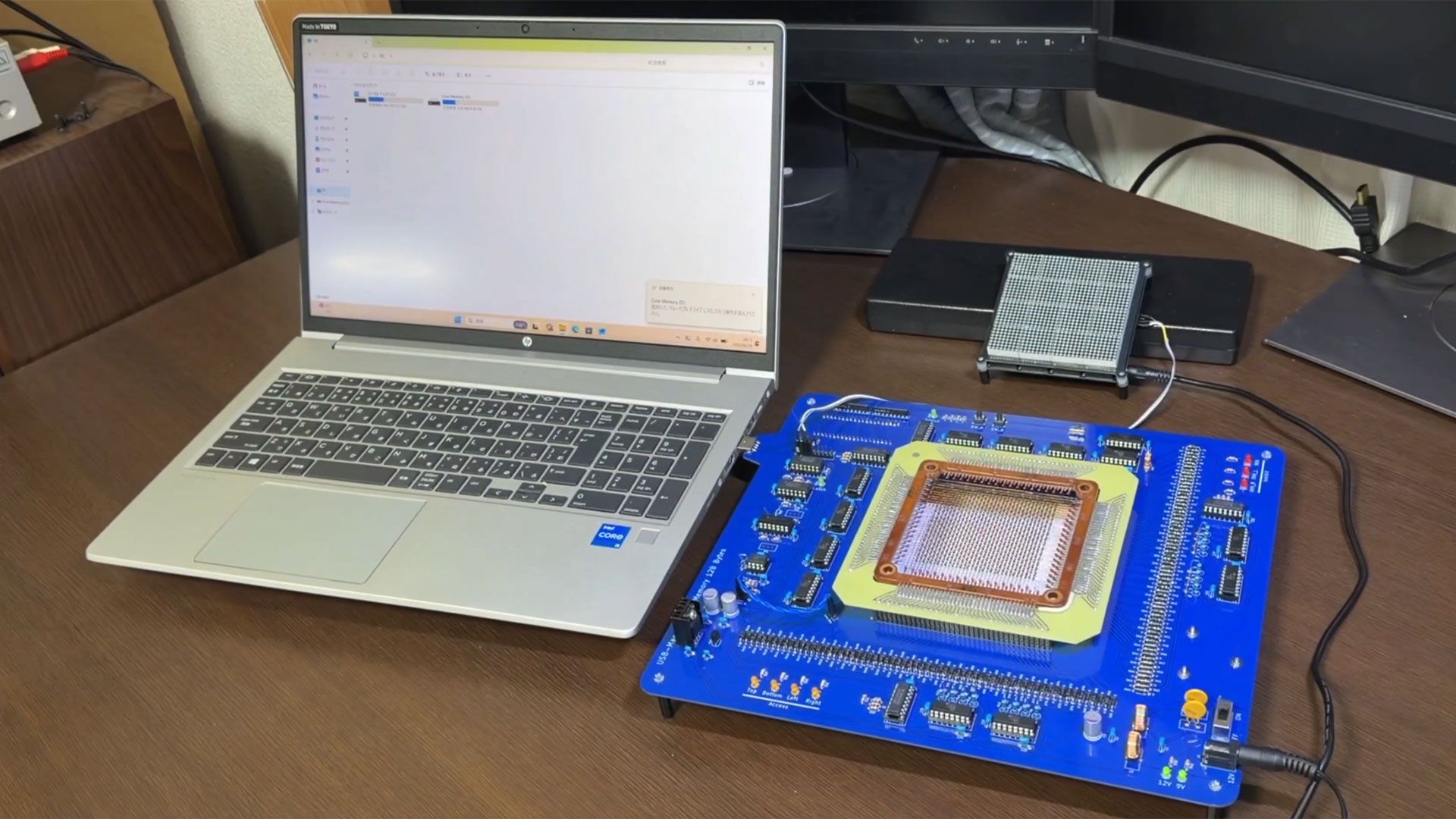
At first glance, the device is a spectacle of industrial aesthetics. Measuring roughly 30 centimeters (approximately one foot) square, the unit is an imposing slab of hardware that stands in stark contrast to the sleek, thumb-sized flash drives we carry on our keychains. At its heart, the device utilizes magnetic core memory—the primary form of random-access storage that powered the world’s most advanced computers from the mid-1950s through the early 1970s.
The technical specifications are, by modern standards, humorous:
- Storage Capacity: 128 bytes.
- Form Factor: 30cm x 30cm (approx. 12 inches square).
- Interface: USB Type-A (via an onboard Raspberry Pi Pico controller).
- Visual Feedback: A 32 x 32 array of red LEDs that illuminate to reflect the state of each individual magnetic core.
The device is not merely a static relic; it is an active, functioning bridge. During operation, as data is read from or written to the core memory, the LED array provides a mesmerizing visual representation of the bits flipping. The system relies on a Raspberry Pi Pico to translate the low-level electrical signals of the magnetic cores into a protocol compatible with modern USB 2.0/3.0 ports.
Chronology of an Engineering Obsession
The path to this achievement has been a steady progression of archival research and hardware hacking.
Early 2024: The Initial Resurgence
In February 2024, @dydt_Nao first garnered attention within the retro-computing community by unveiling the prototype of the magnetic core drive. At that time, the project was a proof-of-concept for the physical hardware. The primary challenges identified were the lack of a modern controller interface and the inherent "destructive read" nature of the technology. In magnetic core memory, reading a bit typically resets it to zero, necessitating a write-back cycle if the data is to be preserved.
Mid-2024: Refining the Controller
Between February and August, the focus shifted to bridging the protocol gap. Using a Raspberry Pi Pico as an intermediary controller, the researcher developed the firmware necessary to handle the volatile, destructive-read nature of the core memory while making it appear as a standard mass-storage device to a Windows operating system.
August 2026: The First Successful Transfer
In late August 2026, the researcher confirmed the milestone: a text file was successfully moved from one machine to another using the device. Following this initial success, the researcher expanded the capabilities, demonstrating the ability to transfer monochrome bitmap images. Specifically, the device can now hold 32 x 28 pixel monochrome images, effectively pushing the memory to its theoretical limits, with some overhead reserved for file headers.
Supporting Data: Understanding Core Memory
To appreciate the scale of this achievement, one must understand what magnetic core memory actually is. Before the advent of the integrated circuit and the semiconductor RAM we use today, computers stored information in tiny, doughnut-shaped ferrite rings.
The Physics of the "Doughnut"
Each core acts as a single bit of memory. A wire threaded through the center of the ring determines its magnetic polarity. By passing current through the wire in specific directions, the core can be magnetized either clockwise or counter-clockwise, representing a binary 1 or 0.
The Destructive Read Challenge
Unlike modern NAND flash or DRAM, which can be read indefinitely without altering the state of the cell, core memory is inherently "destructive." When you "read" the state of a core, you are essentially trying to flip it. If it flips, a pulse is detected on a sense wire, and the computer knows it was a ‘1’. However, because the act of reading flips the core, the controller must immediately rewrite the original value back into the core if the data is intended to be saved. This adds a layer of complexity to the controller logic, as every read operation must be followed by a write operation to maintain data integrity.
The Controller Bottleneck
The "6.5KB capacity" reported by Windows is a fascinating artifact of this setup. It does not reflect the actual storage capacity of the magnetic cores (which remains a strictly limited 128 bytes). Instead, it reflects the overhead of the Raspberry Pi Pico’s firmware, which simulates a FAT (File Allocation Table) filesystem to convince the PC that a valid storage device is connected.
Implications: Why Rebuild the Past?
The question often arises: Why invest such effort into a storage medium that was retired over 50 years ago? The answer lies not in utility, but in the preservation of digital history and the exploration of physical computing.
A Lesson in Tangible Computing
In our modern, software-defined world, storage is abstract. We save files to "the cloud," a nebulous concept that hides the reality of silicon transistors. Magnetic core memory is visceral. By scaling the memory up to a dinner-plate size, the researcher has made the invisible visible. The 32 x 32 LED array turns the abstract process of bit-flipping into a tangible, light-based performance. It is a pedagogical tool that reminds us of the raw, physical reality of computation.
The Future of "Retro-Modern" Tech
This project sits at the intersection of "Maker" culture and computer archaeology. It suggests a future where enthusiasts continue to rescue dead technologies not for their efficiency, but for their mechanical beauty. As we move toward quantum computing and biological storage, having a functional understanding of how memory was built in the 1960s keeps a vital link to the foundations of our current digital civilization.
Official Responses and Public Reception
The announcement, delivered via social media (specifically the researcher’s Twitter/X feed), has sparked significant debate and excitement within the engineering community.
Fellow researchers and retro-computing hobbyists have hailed the project as a masterclass in interface design. The "Maker Faire Tokyo 2026," where the device is scheduled to be displayed, is expected to be a focal point for those interested in seeing this relic in action.
The sentiment within the tech industry is one of respectful bewilderment. Industry analysts noted that while the device is "impractical by any metric of storage density or energy efficiency," it serves as a powerful reminder that computing is, at its core, a discipline of physics.
"We often forget that our current technology is just the latest layer of a very deep history," said one industry observer. "Seeing a Raspberry Pi—the pinnacle of modern hobbyist computing—talking to a magnetic core array from the Apollo Guidance Computer era is the kind of cross-generational handshake that defines the best of the maker movement."
Conclusion: The Endurance of Innovation
The work of @dydt_Nao is a testament to the fact that innovation is not always about moving forward. Sometimes, it is about looking back, understanding the machinery of our ancestors, and finding a way to make it speak the language of the present.
While you won’t be using this magnetic core USB drive to back up your photo library or carry your important documents, you will find that it fulfills a more important function: it keeps the history of computing alive. In a world where obsolescence is programmed into every device, there is something deeply satisfying about a machine that refuses to be forgotten, even if it requires a dinner-plate-sized board to hold a few bytes of data.
As the tech world prepares to see the device in person at the upcoming Maker Faire, one thing is certain: the fascination with the origins of the digital age is far from over. Whether it is 128 bytes or 128 terabytes, the thrill of data transfer remains the same—a signal sent, a bit flipped, and a connection made across the vast, ever-expanding timeline of human ingenuity.











