In an era defined by the rapid-fire evolution of solid-state drives (SSDs) and the ubiquitous reach of cloud storage, one might be forgiven for assuming that magnetic tape—the medium that defined data centers of the 20th century—was headed for the dustbin of history. Yet, as we navigate the mid-2020s, the Linear Tape-Open (LTO) format is not merely surviving; it is thriving with unprecedented momentum.
The LTO Program Technology Provider Companies (TPCs)—HPE, IBM, and Quantum Corp.—recently unveiled data for the first quarter of 2026, revealing a staggering 57% year-over-year (YOY) growth in capacity shipments. This surge confirms a pivotal shift in how modern enterprises, hyperscalers, and AI-driven data centers approach long-term data management. While critics once labeled tape as "archaic," it has proven to be the most resilient, cost-effective, and secure backbone for the modern data economy.
The Chronology of a Comeback: From Obsolescence to Essentiality
The narrative of tape storage has been one of repeated dismissal followed by consistent defiance. For years, skeptics pointed to the rise of high-capacity hard disk drives (HDDs) and the plummeting costs of flash memory as the death knell for magnetic tape.
The "DOGE" Crucible
In 2024, the debate over the future of storage reached a fever pitch. Amidst high-profile initiatives—most notably the U.S. government’s push to modernize infrastructure and the vocal "DOGE" (Department of Government Efficiency) crusade to eliminate legacy systems—tape was frequently targeted as an outdated inefficiency. Critics argued that the time and effort required to retrieve data from tape libraries were antithetical to the instant-access demands of the modern digital landscape.
A Record-Breaking 2024
Despite these criticisms, 2024 saw the LTO industry achieve a historic milestone: 176.5 exabytes of compressed LTO tape capacity were shipped worldwide. This represented a 15.4% increase over the previous year, marking the fourth consecutive year of growth. The data made it clear that while tape might not be the medium for your daily OS boot drive, it had become the undisputed champion of mass data archiving.

The 2025 "Weather" Dip and the 2026 Resurgence
The industry did see a minor contraction in 2025, with capacity shipments dipping by 9% to 160.3 exabytes. Industry representatives characterized this as a minor "weather" event—a temporary market fluctuation. However, the first quarter of 2026 has obliterated any notion of a sustained decline. With a 57% YOY increase, the industry is not just recovering; it is accelerating, fueled by the insatiable data appetite of the Artificial Intelligence boom.
Supporting Data: Why Tape Remains Unbeatable
To understand why tape is experiencing this resurgence, one must look past the "archaic" label and examine the metrics that matter to Chief Information Officers (CIOs) and data center architects.
The Economics of Scale
As data generation explodes, the cost per terabyte becomes the primary variable in data storage strategy. Tape remains significantly cheaper than disk-based systems, both in terms of upfront hardware acquisition and the hidden costs of electricity and cooling. While a hard drive must be constantly powered to keep its platters spinning, a tape cartridge sitting on a shelf consumes zero power. For an organization storing petabytes or exabytes of historical data, this energy efficiency is not just a budget preference; it is a sustainability mandate.
Capacity Projections: The Path to LTO-14
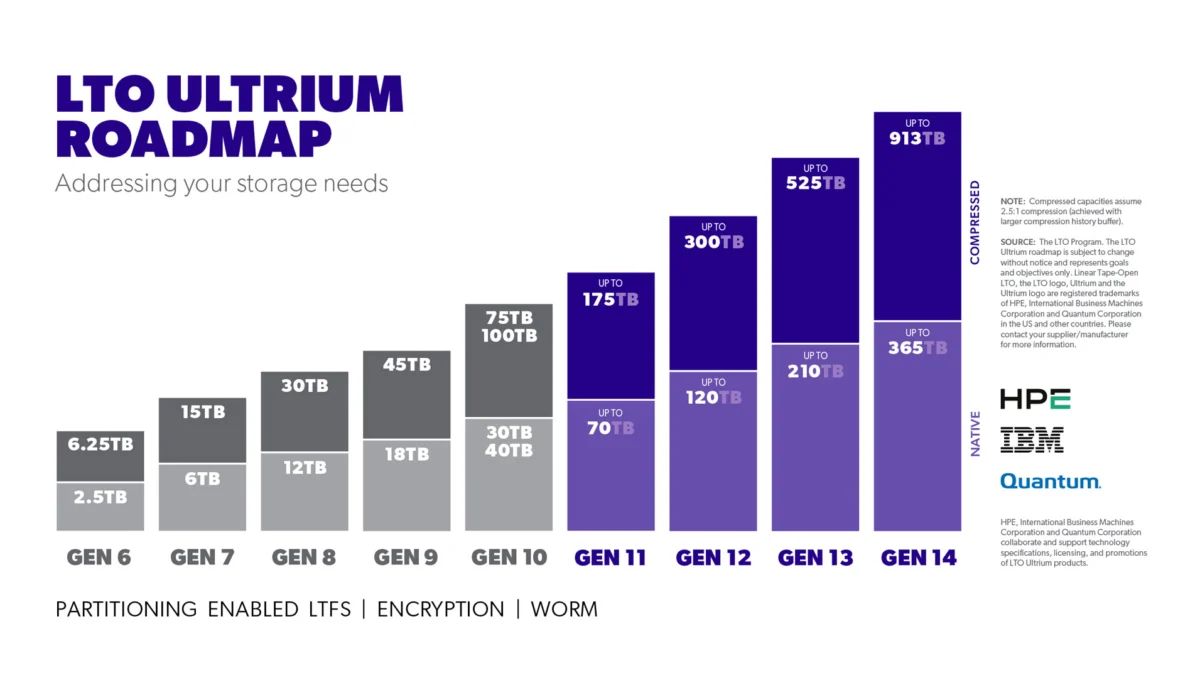
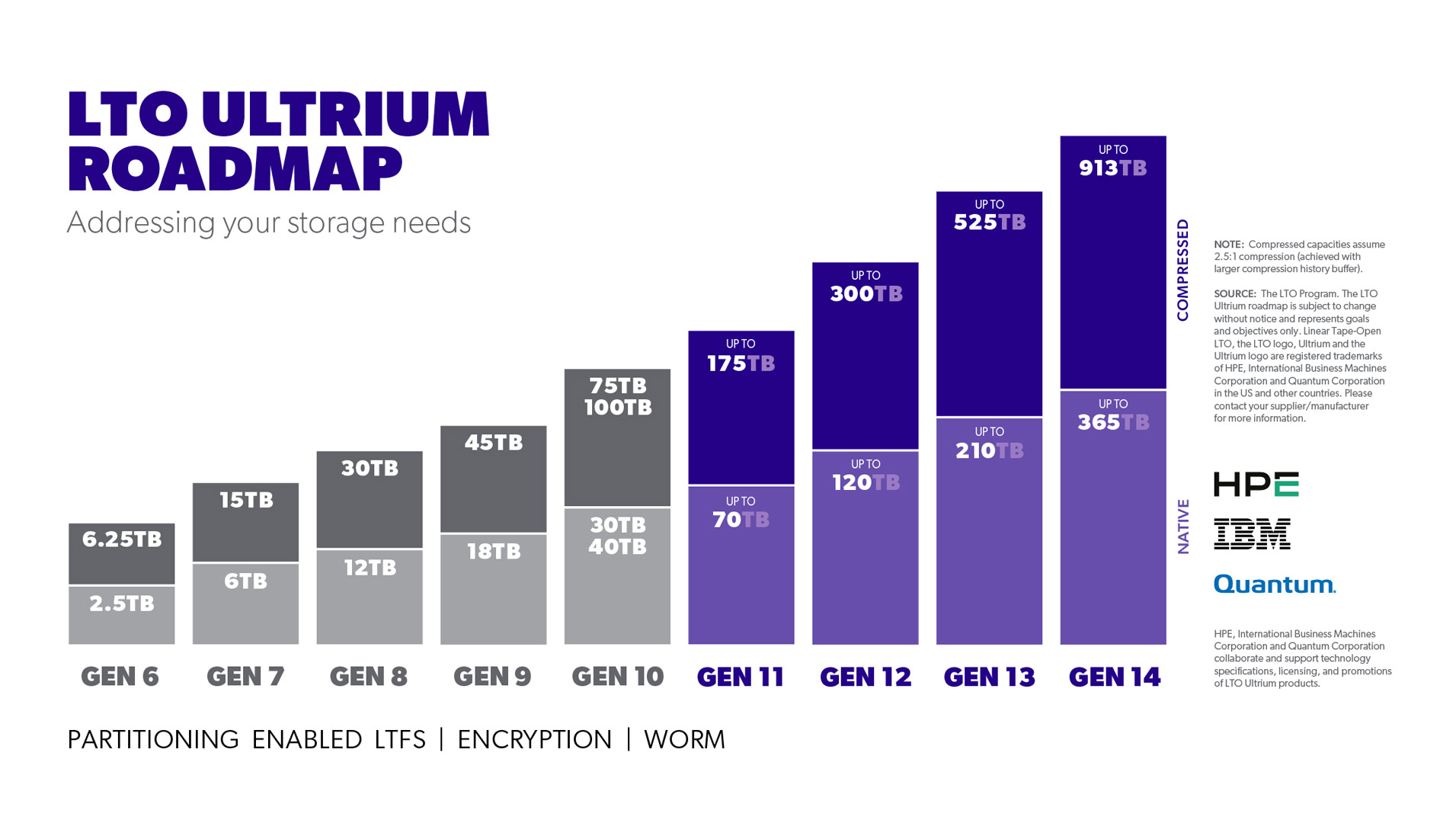
The technological roadmap for LTO is arguably more aggressive than many realize. We are currently in the transition phase of LTO-9 and the early adoption of LTO-10:
- LTO-9: Offers up to 18TB of native capacity (45TB compressed).
- LTO-10: Pushes the boundary to 40TB native capacity (100TB compressed).
Looking further ahead, the LTO consortium has outlined a roadmap extending to LTO-14. This generation is projected to reach an eye-watering 576TB of native capacity, with compressed figures potentially hitting 1,440TB per single cartridge. This capacity density ensures that tape will remain the only viable medium for the "cold storage" requirements of the next decade.

Official Responses: The Strategic Anchor
The industry leadership maintains a unified stance: tape is a vital "anchor" in a volatile world. Hugues Meyrath, CEO of Quantum, captured the sentiment during the Q1 2026 reporting cycle:
"We are seeing unprecedented data growth combined with increasing cost, energy, and cyber resilience pressures across the industry. As organizations adapt to this new reality, tape is increasingly viewed as a strategic component of modern data infrastructure, delivering predictable economics and resilient long-term data retention at scale."
This perspective highlights that the "modernization" of data centers doesn’t necessarily mean the removal of legacy media; it means the integration of the right media for the right task. Tape is no longer viewed as a "backup of last resort" but as an active, strategic layer of the data stack.
Implications: The AI-Driven Future
The current surge in tape demand is inextricably linked to the rise of Large Language Models (LLMs) and generative AI.
Cyber-Resilience and Air-Gapping
One of the most critical, yet often overlooked, aspects of tape is its inherent ability to provide an "air-gap." In an age where ransomware and sophisticated cyber-attacks are capable of encrypting entire online storage networks, a physical tape cartridge stored in a vault is immune to digital intrusion. As companies grapple with the risks associated with storing massive, high-value training datasets for AI, the air-gapped security of tape has transformed from a niche feature into a core requirement.
The "Storage Mix" Reality
The industry consensus is shifting toward a tiered storage architecture. Flash storage is reserved for performance-intensive AI training and inference; hard drives occupy the "warm" storage layer for frequent access; and LTO tape provides the massive, immutable "cold" storage layer for long-term archiving and regulatory compliance.
Environmental, Social, and Governance (ESG) Impact
Modern corporations are under immense pressure to reduce their carbon footprint. Data centers are among the most power-hungry facilities on the planet. By offloading massive volumes of inactive data from high-speed disk arrays to tape libraries, companies can drastically reduce the energy consumption of their storage infrastructure. This "green" shift is a major driver behind the renewed interest from enterprise-level IT procurement teams.
Conclusion: The Future is Taped
The premature reports of the death of tape storage have served to highlight just how misunderstood the technology was. By failing to look beyond the "old" label, critics missed the fundamental evolution of the format.
Tape has adapted. It has embraced high-density recording, robotic automation, and advanced security protocols, all while maintaining its core advantage: the best cost-per-terabyte profile in the industry. As the world continues to generate data at an exponential rate, the ability to store that information securely, sustainably, and affordably will define the winners of the next decade.
The LTO consortium’s roadmap suggests that for as long as we continue to value our digital history, we will continue to rely on the humble, yet incredibly powerful, magnetic tape. Far from being a relic, tape is a cornerstone of the future.