

In the world of extreme athletics, the boundary between a life-defining achievement and a tragic end is often thinner than a mountain ridge. Directors Elizabeth Chai Vasarhelyi and Jimmy Chin, the Academy Award-winning duo behind the vertigo-inducing Free Solo and the harrowing Meru, have long been the preeminent chroniclers of those who dance with death. Yet, their latest project, Everest: The Other Side, represents a departure from their previous work. It is not merely a film about a feat of endurance; it is an intimate, raw exploration of the human cost of obsession, love, and the insurmountable weight of loss.
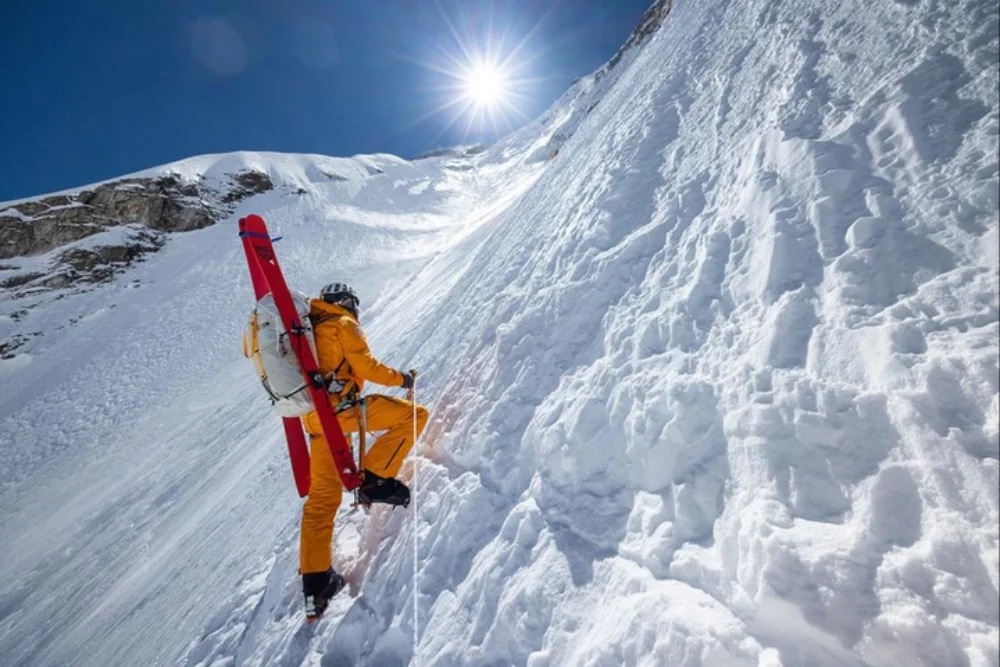
Premiering to significant anticipation at the Venice and Toronto film festivals, the documentary follows elite ski mountaineers Jim Morrison and Hilaree Nelson as they set their sights on a legendary, treacherous goal: to ski down the North Face of Mount Everest. What was envisioned as a testament to their shared passion and professional partnership, however, shifted into a profound meditation on grief when tragedy struck and Nelson was killed during the expedition.
A Chronology of Ambition and Catastrophe
The narrative trajectory of Everest: The Other Side is defined by a sharp, irreversible turn. For years, Jim Morrison and Hilaree Nelson were titans in the high-altitude mountaineering community. Their partnership was forged in the extreme conditions of the Himalayas, where they developed a bond that transcended the standard professional dynamic.
The expedition, which sought to conquer one of the most technical and lethal faces of the world’s highest peak, was designed to be a triumph of human spirit and athletic prowess. As the cameras rolled, the film initially captured the logistical intensity of such an undertaking—the planning, the isolation, and the deep, romantic connection that blossomed between the two athletes in the thin air of the mountain.
However, the film’s narrative arc changed forever when, during a fateful descent, Hilaree Nelson was lost in Nepal. This sudden, visceral shift forced Vasarhelyi and Chin to pivot from filming a record-breaking athletic achievement to documenting the immediate, shattering aftermath of a partner’s death. The resulting footage serves as a haunting, real-time capture of trauma, forcing both the filmmakers and the audience to reconcile with the reality that, in the world of extreme sports, the risks are never abstract.
The Professional and Personal Stakes
For directors Vasarhelyi and Chin, this project was deeply personal. Their history with the subjects was not limited to the camera lens; they were close friends with both Morrison and Nelson. Chin, a veteran of the climbing community who has spent decades on expeditions, noted the unique difficulty of filming people you love.
“When a friend entrusts you with telling their story, you want to get it right,” Chin explains. “I’ve known Hilaree for over 20 years, and we’ve been on many expeditions together. That’s how you really get to know people. She was an extraordinary human being, and so is Jim.”
Vasarhelyi echoes this sentiment, acknowledging that while their filmography is marked by personal projects, Everest stands alone in its emotional toll. “Jim and Hilaree were our dear friends. Seeing what happened to that family was very, very difficult,” she says. The director highlights the “blessing and the curse of nonfiction,” where the filmmaker is often a witness to events that no one—least of all the subjects—could have anticipated.
The Female Experience in Extreme Sports
A recurring theme in the work of Vasarhelyi is the examination of gender within the high-stakes world of elite performance. Having focused on the male-dominated spheres of Free Solo and Meru, Vasarhelyi felt a mounting curiosity about the female experience. This inquiry led to her directorial work on Nyad, the story of marathon swimmer Diana Nyad, and the documentary Love + War, centered on photojournalist Lynsey Addario.
In Everest: The Other Side, Vasarhelyi brings these questions to the forefront. She challenges the societal tendency to judge female athletes for the same ambition that is lauded in men. “Everyone always asks women: ‘How can you go to work and leave your kids at home?’ No one will ever ask a man that,” Vasarhelyi notes.
The film explores the paradox that defined Nelson’s life: the drive for global exploration and the deep, abiding commitment to her family. Vasarhelyi admired Nelson’s candor regarding these contradictions. “She was very committed to her responsibilities as a parent. In many ways, that’s why I was interested in making this film—to address the complexity of loving what you do and also being committed to your family.”
Cinematic Scope: The IMAX Experience
To do justice to the scale of the Himalayas and the gravity of the events that transpired, the production team partnered with IMAX. This technical decision was not merely for visual spectacle, but to provide a visceral, communal experience that mirrors the intensity of the environment.
“Free Solo was first conceived as an IMAX film, but it was not feasible with the size of the cameras at the time,” Vasarhelyi recalls. For Everest, the technology has finally caught up to the vision. The film offers a perspective of the North Face that few have ever witnessed, aiming to transport the audience directly into the environment that defined Morrison and Nelson’s lives.
For Chin, this is a full-circle moment. He was mentored by the legendary mountaineer David Breashears, whose 1998 film Everest set the benchmark for the IMAX format. “I climbed Everest with him,” Chin says. “But now, people are going to see Everest in a way they’ve never seen it before. And that’s why they should see it in IMAX.”
The Philosophy of the ‘Calling’
One of the most poignant aspects of the film is its attempt to answer the question that haunts every outsider to the climbing community: Why? Why risk everything for a sport that offers no tangible benefit to society at large?
Vasarhelyi, who does not climb, offers an empathetic perspective. “You couldn’t pay me to do what they do. But I really believe it’s a way of life. It’s something they have to do.” She reflects on a quote from Nelson: “I love my children every day like it’s my last.” It is a sentiment that encapsulates the precarious balance these athletes strike—the ability to live with a full, present heart while knowing the inherent dangers of their path.
Chin emphasizes that for people like Morrison and Nelson, the choice is not really a choice at all. “People forget that you don’t get to choose your calling. Your calling finds you,” he states. “You can’t hide anything when you are in those high-stakes moments. It creates another layer of understanding of your partner.”
Implications: Moving Forward Through Grief
Ultimately, Everest: The Other Side is not a film about the death of a mountaineer, but about the resilience of the human spirit in the wake of that death. It is an exploration of how one finds the strength to continue when the person who shared their deepest passions is gone.
“How can someone withstand so much grief? I don’t know,” Vasarhelyi admits. “But when I look at Jim, I find hope.”
Chin concludes that the film’s core message is one of perseverance. “That’s what the film is about. It’s a choice to move forward despite loss and the grief. You can let it take you down, or you can choose to live.”
By documenting the trajectory of Jim Morrison and Hilaree Nelson, Vasarhelyi and Chin have created a profound, heartbreaking, and ultimately hopeful piece of cinema. It serves as a reminder that while the mountains remain indifferent to human ambition, the people who climb them leave behind a legacy of love, commitment, and an indomitable will to find meaning even in the face of the ultimate loss. The film, produced by Little Monster Films and National Geographic Documentary Films, stands as a testament to the fact that while we may not always understand the call of the wild, we can learn from those who answer it—and from those who must learn to live after the echo fades.










