

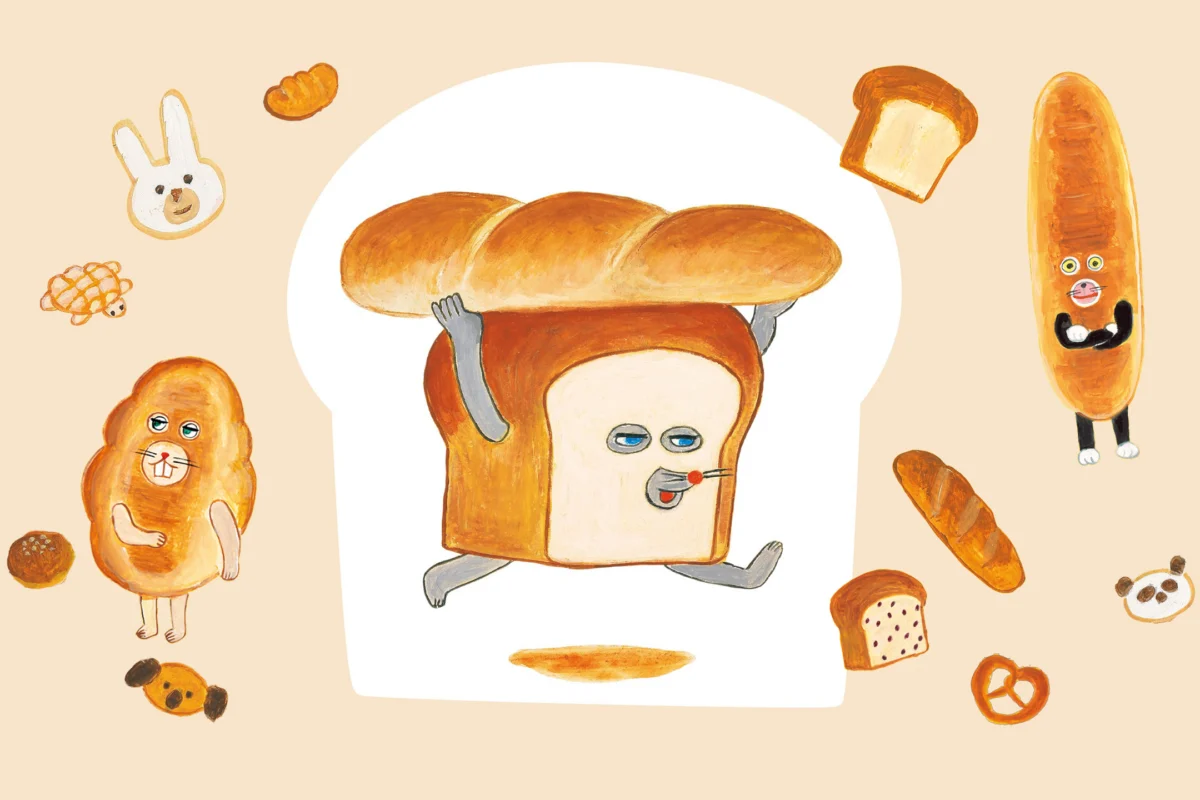
In a quiet, sun-drenched bakery, the air smells of yeast and toasted flour. A customer walks in, eyes scanning the rows of golden, crusty loaves. Everything appears normal, save for one curious detail: a single loaf of bread near the corner seems to have… limbs. It shifts, its doughy exterior twitching with nervous energy. Suddenly, the "bread" glances around with a pair of shifty, wide-set eyes, confirms the coast is clear, and bolts toward the exit, carrying its fellow pastries into the wild.
This is the opening act of Pan Dorobo (The Bread Thief), a sensation that has transcended the pages of children’s literature to become a bona fide cultural phenomenon in Japan. With an anime adaptation slated for release in October 2026—a trailer for which has already garnered over 320,000 views in its first four weeks—the "Bread Thief" has officially migrated from picture books to the center of the national zeitgeist. But how did a thieving rodent, draped in a crusty disguise, capture the hearts of a nation known for its reserve and rigid social etiquette?
The Anatomy of an Icon: Main Facts
At its core, Pan Dorobo is a deceptively simple story created by author Keiko Shibata. The protagonist is a mouse with an insatiable, almost pathological obsession with bread. To secure his fix, he dons a bread-shaped mask, allowing him to infiltrate bakeries and make off with the goods.
While the premise sounds like a standard fable of morality, the execution is anything but conventional. The series does not focus on the "criminality" of the act, but rather the sheer, unadulterated passion the character feels for his prize. The character design is a masterclass in modern minimalism: simple, emotive, and instantly recognizable. By framing the character’s theft as a pursuit of "love" rather than a malicious act of greed, Shibata has managed to create a mascot that resonates across demographics, blurring the lines between child-friendly entertainment and adult-oriented aesthetics.
A Chronological Rise to Stardom
The trajectory of the Pan Dorobo franchise is nothing short of meteoric, reflecting a rapid expansion that mirrors the best-selling manga juggernauts of the modern era.

- 2020: Kadokawa publishes the debut volume of Pan Dorobo. It is an immediate, word-of-mouth hit, praised for its whimsical illustrations and dry, comedic timing.
- 2020–2022: As the series releases subsequent volumes, it finds a captive audience among parents and educators, who appreciate the book’s ability to engage children without relying on didactic, preachy storytelling.
- 2023: The series reaches a significant milestone: 3 million copies sold. By this point, the character has begun to appear on merchandise, ranging from high-quality stationery to apparel.
- 2025: Sales figures surge to 4.5 million copies. The franchise is officially declared the best-selling Japanese children’s book series of the Reiwa period (2019–present).
- 2026: The announcement of the anime adaptation solidifies the franchise’s move into mass-market multimedia. The "Bread Thief" is no longer just a book character; he is a brand.
Supporting Data: The Economics of Cuteness
The success of Pan Dorobo is backed by hard numbers that underscore its financial dominance. Selling 4.5 million copies in less than six years is an extraordinary feat in the Japanese publishing market, where competition is fierce and the audience is notoriously fickle.
This success is intrinsically linked to the "neo-kawaii" movement. Unlike traditional kawaii (cuteness), which prioritizes innocence and purity, neo-kawaii incorporates elements of irony, subversion, and lifestyle branding. Products like Bearbrick figures and the Labubu dolls have shown that there is a massive market for "collectible cuteness" among adults. Pan Dorobo fits into this ecosystem perfectly. A tote bag featuring the Bread Thief isn’t just a children’s item; it serves as a subtle, tongue-in-cheek signal of the owner’s personality—someone who appreciates the absurd, the soft, and the slightly rebellious.
Furthermore, the Japanese bread market, valued at nearly ¥2 trillion, provides the perfect economic backdrop for the character’s popularity. With half of the Japanese population consuming bread almost daily, the character of the Bread Thief taps into a profound, shared culinary experience.
Official Responses and Creative Intent
In various interviews and fan club events across Tokyo, author Keiko Shibata has maintained a humble, albeit observant, perspective on her creation’s rise. While she admits that the character’s evolution was organic, she highlights the importance of keeping the stakes "cozy."
"I wanted to create a character who is flawed but deeply human in his desires," Shibata noted during a 2026 fan event. She emphasized that the Bread Thief’s primary motivator—his love for shokupan (milk bread)—is a universal emotion. By removing the "hunger" aspect—which would have turned the story into a grim survival tale—Shibata kept the narrative firmly in the realm of comedic fantasy.

Critics have pointed out that the series functions as a "social release valve." In a country like Japan, where societal expectations are strict and even minor infractions like failing to return lost property can lead to legal scrutiny, the Bread Thief’s antics offer a safe, virtual space for "rule-breaking." There is no real-world fallout, only the thrill of the chase and the satisfaction of a warm, fluffy loaf of bread.
The Implications of a Bread-Centric Culture
Why bread? The answer lies in the evolving relationship between Japan and its staple foods. While rice remains the backbone of the traditional Japanese diet, bread—specifically the soft, cloud-like shokupan—has become the ultimate comfort food.
The Bread Thief represents a specific kind of Japanese escapism. He is not a villain; he is a connoisseur. He represents the pursuit of pleasure in a world that often demands professional and social perfection. When adults purchase Pan Dorobo merchandise, they aren’t just buying a character; they are buying into an ethos that values the "small pleasures" of life.
The implications for the wider animation industry are also significant. The success of this series suggests a pivot toward "low-stakes" storytelling. In an era dominated by high-octane action and complex lore, the Pan Dorobo anime will likely lean into the "iyashikei" (healing) genre—a style of media designed to soothe the viewer.
Looking Ahead: The Future of the Thief
As we approach the October 2026 premiere, the anticipation is palpable. The Pan Dorobo franchise is expected to expand even further into the retail sector, with potential collaborations with major Japanese bakeries and high-end design houses.

What began as a quiet tale about a mouse in a crusty mask has blossomed into a multi-generational icon. The Bread Thief has managed to bridge the gap between the playground and the office cubicle, proving that in a world of complex problems, sometimes the most profound solution is simply to love something—or someone—enough to risk a little bit of mischief to get it.
Whether the anime will introduce new characters or expand on the lore of the "Nise Pan Dorobo" (Fake Bread Thief) remains to be seen. However, one thing is certain: Japan’s obsession with its favorite culinary criminal shows no sign of cooling down. Like the shokupan he loves so much, the Bread Thief is here to stay, soft, warm, and waiting for his next big heist.












No comments yet. Be the first to join the conversation!