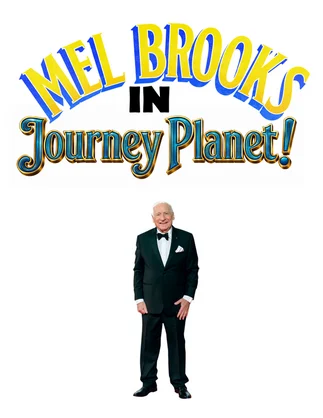
On June 28, 2026, the world celebrates the centennial of one of the most influential figures in the history of entertainment. Melvin Kaminsky—known to the world as Mel Brooks—turns 100 years old, marking a milestone that serves as both a personal triumph and a testament to a career that reshaped the landscape of comedy, cinema, and theater. To honor this legendary polymath, the long-running fanzine Journey Planet has released a massive, 150-page tribute in its 95th issue, guest-edited by Steven H. Silver alongside longtime editors James Bacon and Christopher J. Garcia.
The issue, a sprawling exploration of Brooks’s creative output, brings together nearly thirty contributors across 38 articles. It serves as a comprehensive deep dive into the psyche of a man who managed to make the world laugh at its darkest impulses, proving that satire is not merely a tool for humor, but a vital instrument for cultural survival.
The Master of Satire: An Overview of the Brooks Legacy
Mel Brooks’s career is defined by his uncanny ability to walk the tightrope between absurdity and genius. Whether he is skewering the Western in Blazing Saddles, dismantling the conventions of horror in Young Frankenstein, or taking on the grandeur of science fiction in Spaceballs, his work remains consistently grounded in character-driven comedy.
The Journey Planet tribute is notable for its breadth. It moves beyond the obvious hits, dedicating significant space to his early television writing for Sid Caesar, his innovative work in the Catskills, and his often-overlooked musical theater contributions. By analyzing his entire filmography—from the Oscar-winning debut of The Producers to his later forays into television animation—the editors have created a living document of a century of laughter.
Chronology: From Brooklyn to the Pantheon
The trajectory of Mel Brooks’s life reads like a classic mid-century American epic, characterized by grit, transition, and an unwavering commitment to the craft of comedy.
The Formative Years (1926–1945)
Born Melvin Kaminsky on June 28, 1926, in Brooklyn, New York, Brooks grew up in a world that would eventually fuel his comedic perspective. The transition from his humble beginnings to the front lines of World War II was a defining period. Serving as a combat engineer, Brooks was tasked with the perilous job of defusing land mines. He saw combat during the Battle of the Bulge, an experience that likely instilled in him the "laugh in the face of death" philosophy that permeates his most famous works.
The Rise of the Professional Humorist (1946–1967)
Post-war, Brooks entered the entertainment industry via the Catskills resort circuit, a crucible for Jewish-American comedy. His ability to read an audience led to a pivotal role as a writer for Sid Caesar’s Your Show of Shows. It was during this era that Brooks began to develop the frenetic, intellectual, and self-deprecating style that would become his trademark.
The Golden Age of Cinema (1968–1995)
The late 1960s saw Brooks pivot to film. His 1967 debut, The Producers, was an immediate sensation, earning him an Academy Award for Best Original Screenplay. Throughout the 70s and 80s, Brooks became a titan of the industry. He was not just a director; he was a brand. His films became synonymous with parody, yet they retained a warmth and structure that made them enduring classics.
Supporting Data: The Anatomy of an EGOT (and Beyond)
In the world of professional accolades, the "EGOT" (Emmy, Grammy, Oscar, Tony) is the gold standard. Mel Brooks reached this peak, but he famously went further. As enthusiasts often point out, Brooks is the sole recipient of the "NEGOTH"—a designation that includes the Nebula, Emmy, Grammy, Oscar, Tony, and Hugo.
This achievement speaks to his cross-platform mastery:
- The Oscar: For his screenplay for The Producers.
- The Emmy: Multiple awards for his work on The Sid Caesar Show and his guest appearances on Mad About You.
- The Grammy: For his spoken-word recordings, most notably The 2000 Year Old Man alongside Carl Reiner.
- The Tony: For the wildly successful Broadway adaptation of The Producers.
- The Hugo/Nebula: Recognized for his contributions to the genre of science fiction, most notably through his cult classic Spaceballs and his work on Get Smart.
The Journey Planet team emphasizes that these awards are not just trophies; they represent a body of work that transcended media boundaries. Whether he was on the Broadway stage, in the recording studio, or behind the camera, Brooks maintained a distinct voice that prioritized humanity over punchlines.
Official Responses and Editorial Reflection
The release of Journey Planet issue 95 was not without its lighthearted irony. The editorial team—Bacon, Garcia, and Silver—offered a formal apology for the issue number. "We had hoped to get it to be issue 100," the editors noted, "but Mel refused to move his birthday for our convenience."
This self-aware humor is exactly the kind of tribute Brooks would appreciate. In the articles contained within the issue, contributors reflect on what it means to be a "Mel Brooks fan" in the 21st century. The consensus is that his work has aged remarkably well because it targets the structures of power and pretension rather than the individuals themselves.
The Scholarly Contribution
The nearly thirty contributors to the issue include film critics, historians, and long-time fans who treat Brooks’s filmography with the same academic rigor usually reserved for directors like Hitchcock or Kubrick. Articles within the issue explore the "Brooksian" style: the use of breaking the fourth wall, the incorporation of Yiddishkeit into mainstream American culture, and the evolution of the spoof genre.
Implications: The Enduring Power of the 100-Year-Old Mind
Why does Mel Brooks remain relevant at 100? The answer lies in the nature of his satire. In an era where digital content is often ephemeral, Brooks’s films remain anchored in the human condition.
The Cultural Impact
Brooks taught generations that humor is a weapon of the oppressed. By mocking Hitler in The Producers or the institutionalized racism of the Old West in Blazing Saddles, he demonstrated that one could expose the absurdity of bigotry through the lens of comedy. His work has influenced every major comedy writer of the last fifty years, from the creators of Saturday Night Live to modern satirists like Jon Stewart and Seth MacFarlane.
The Future of the "Brooksian" Lens
As we celebrate his 100th year, the implications for the future of comedy are clear. The Journey Planet tribute argues that Brooks’s legacy is not a finished chapter. Rather, it is a foundation. The contributors suggest that as long as there is absurdity in politics, ego in the arts, and pomposity in social life, the "Brooksian" approach will be required.
The issue also serves as a reminder of the value of longevity in art. In a fast-paced industry that often discards its legends, Mel Brooks represents a bridge between the Vaudeville tradition and the modern digital age. His ability to adapt—from radio and live theater to television and blockbuster film—serves as a masterclass for any artist looking to build a career that spans decades.
Conclusion: A Centenarian’s Celebration
As Mel Brooks reaches his 100th birthday, the world looks back on a life that has been anything but quiet. From the battlefields of Europe to the stages of Broadway and the soundstages of Hollywood, he has remained a singular force.
Journey Planet issue 95 is more than just a fanzine; it is a monument to a man who proved that if you can make them laugh, you can make them think. As the contributors to this issue highlight, the "Mel Brooks movie" is a specific genre—one that demands honesty, pun-heavy dialogue, and, above all, a refusal to take life too seriously.
Happy Birthday, Mel. To quote the man himself: "It’s good to be the king." And for the last century, in the realm of comedy, he has undoubtedly been exactly that. For those interested in the full scope of this celebration, the complete 150-page issue of Journey Planet is available, offering a deep, laughter-filled retrospective on the man who taught us all that, in the face of life’s greatest challenges, the best response is always a well-timed punchline.