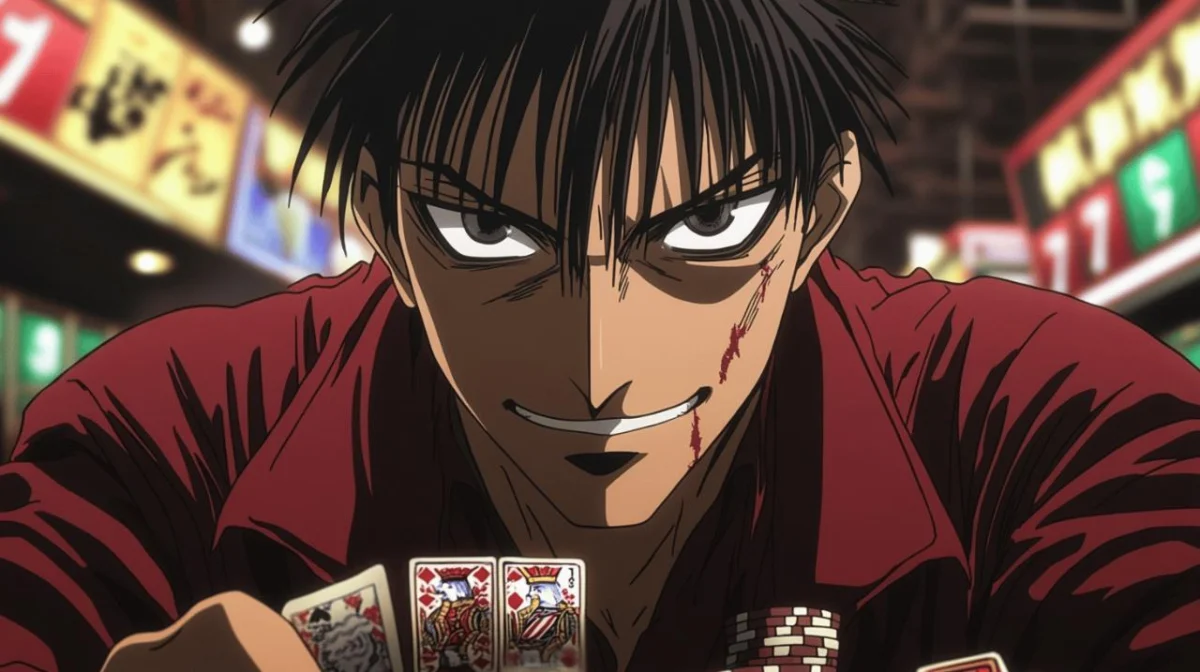
In the landscape of Japanese manga and anime, few titles capture the raw, visceral anxiety of the modern economic condition as effectively as Nobuyuki Fukumoto’s Kaiji: Ultimate Survivor (Tobaku Mokushiroku Kaiji). Since its debut in Kodansha’s Young Magazine in 1996, the series has transcended the medium of seinen manga to become a seminal psychological thriller, documenting the terrifying intersection of unchecked capitalism, desperation, and the human instinct for survival. With over 21.5 million copies in circulation, Kaiji serves not merely as entertainment, but as a scathing mirror held up to a society where the line between a citizen and a commodity is thinner than a playing card.
The Main Facts: A Descent into the Underworld
The narrative premise of Kaiji is deceptively simple yet profoundly bleak. We are introduced to Kaiji Itou, an aimless, down-on-his-luck youth drifting through a stagnant Japanese economy. Burdened by a crushing debt of 3,850,000 yen (approximately $28,705 USD at the time of the story’s initial publication context), Kaiji finds himself ensnared by the predatory tactics of loan sharks.
The story takes a dark turn when Kaiji is coerced into boarding the Espoir, a cruise ship where the indebted are offered a singular, horrific chance: participate in high-stakes, life-or-death games to wipe their slates clean. What follows is not a standard gambling story, but a brutal psychological war. Unlike traditional action-heavy series, Kaiji focuses on the interiority of the gambler—the rapid-fire calculations, the sweat-drenched panic, and the cold, calculated betrayals that occur when human life is reduced to a numeric value.
Chronology of a Masterpiece
The trajectory of the Kaiji franchise is marked by consistent growth and adaptation:
- 1996: The original manga, Tobaku Mokushiroku Kaiji, begins serialization in Young Magazine.
- 1998: The series receives the prestigious Kodansha Manga Award in the General category, cementing its status as a critical darling.
- 2007–2008: The first season of the anime adaptation, produced by Madhouse, introduces a global audience to the high-tension visuals and distinctive art style of Fukumoto.
- 2009: The first live-action film, Kaiji: Jinsei Gyakuten Gēmu, is released, bringing the series to a mainstream Japanese cinema audience.
- 2011: The second season of the anime, Kaiji: Against All Rules, continues the saga, followed by a second live-action sequel.
- 2020: The final film in the live-action trilogy, Kaiji: Final Game, is released, proving the enduring relevance of the character and his struggle.
Supporting Data: The Mechanics of Gambling and Debt
The brilliance of Kaiji lies in its commitment to the "mathematics of misery." Fukumoto does not rely on luck to move the plot forward; he utilizes complex game theory.
The Games of Death
Whether it is the "Restricted Rock-Paper-Scissors," which forces players to track resource scarcity in real-time, or the infamous "Human Derby," where contestants walk across high-voltage steel beams suspended hundreds of feet in the air, the stakes are always existential. The most prominent example is the "Pachinko SWAMP." With balls priced at 4,000 yen each and a potential jackpot of 700 million yen, the game is a masterclass in how institutionalized systems are rigged against the individual. The math is clear: the player is designed to lose, and the house is designed to thrive on that failure.
Psychological Profiling
The series is renowned for its intense focus on the "internal monologue." Each episode functions as a suspense-filled chamber piece. By dissecting the panic attacks and the moments of profound clarity that come under extreme duress, the audience is forced to empathize with the choices of the "degenerate gambler."
Official Perspectives: The Art of the Grotesque
Critics and fans often point to Nobuyuki Fukumoto’s unique art style as the primary driver of the series’ impact. Eschewing the polished, "pretty" aesthetics of mainstream shonen manga, Kaiji features sharp, angular lines, massive noses, and faces that contort into terrifying, grotesque expressions of agony.
This artistic choice is a deliberate narrative device. When a character’s face is distorted by sweat, blood, or the sheer terror of losing, it serves as a visual metaphor for their psychological breakdown. The art does not seek to glamorize the gambling world; it seeks to expose it. By stripping away the veneer of cool, calculated poker-faced protagonists, Fukumoto reveals the ugly truth of the human condition under extreme pressure.
Implications: A Social Critique of Modernity
Kaiji is more than a story about cards and dice; it is a profound social commentary on the failings of modern late-stage capitalism.
The Critique of Predatory Lending
The series functions as an exposé of the Japanese loan shark (yakuza-adjacent) industry. It illustrates how these organizations prey on the vulnerable, using the promise of a "quick fix" to lure them into a cycle of indentured servitude. The debt is never just about money; it is about the total erosion of the individual’s autonomy.
The Legacy of the "Survival Game" Genre
It is impossible to discuss the current cultural landscape of survival thrillers without acknowledging the influence of Kaiji. The surge of popularity in media like the South Korean hit Squid Game owes a clear debt to the path carved by Fukumoto. The tropes established in Kaiji—the debt-ridden protagonist, the wealthy elite watching from the shadows, the bizarre and lethal children’s games, and the total abandonment of morality—have become the blueprint for a sub-genre that defines our current era of economic anxiety.
The Universal Nature of Despair
Why has a story about a man in a basement in Tokyo resonated so strongly across the globe? It is because the feelings of hopelessness, the frustration of a rigged system, and the desperate, irrational hope that "the next gamble will change everything" are universal. Kaiji captures the feeling of being a "pawn" in a system that does not value one’s existence. As income inequality continues to widen on a global scale, the themes of Kaiji feel less like fiction and more like an uncomfortable reflection of reality.
Conclusion: Why Kaiji Remains Essential
Kaiji: Ultimate Survivor stands as a titan of the seinen genre because it refuses to provide easy answers. There is no moral victory in the world of Kaiji—only the question of whether you will survive to play another day. By blending high-stakes game theory with a brutal, honest depiction of human greed and despair, Nobuyuki Fukumoto created a work that challenges the reader to think, to fear, and to understand the fragility of the social safety net.
Whether through its original manga format, the hauntingly atmospheric anime, or its legacy in modern cinema, Kaiji serves as a sobering reminder: when the system is stacked against you, the only thing more dangerous than the game itself is the desperation that forces you to play it. As we look toward the future of media, the influence of this "masterpiece of misery" will undoubtedly continue to shape how we tell stories about power, money, and the indomitable, if flawed, spirit of human survival.