

The world of cinema is mourning the loss of a true giant. Sam Neill, the New Zealand actor whose career spanned over five decades and crossed every genre imaginable, has passed away at the age of 78. From the sun-drenched, prehistoric landscapes of Jurassic Park to the delicate, nuanced period dramas like The Piano, Neill was a chameleon of the highest order. Yet, among his most ardent admirers, it is his chilling, intellectual, and deeply disturbing work in the horror genre that stands as his most enduring legacy.
While many will celebrate him for his contributions to blockbuster tentpoles, film historians and genre enthusiasts are currently turning their attention to a masterpiece that remains criminally under-appreciated: John Carpenter’s 1994 existential nightmare, In the Mouth of Madness. It is in this film that Neill delivered perhaps the most harrowing performance of his career, anchoring a narrative that challenges the very fabric of reality.
The Life and Legacy of a Versatile Icon
Born in Omagh, Northern Ireland, and raised in New Zealand, Sam Neill brought an earthy, understated gravity to every role he inhabited. His career took flight in the late 1970s, but it was his work in the 1980s and 90s that solidified his status as an international star. He was never a performer who sought to dominate the screen with ego; rather, he possessed an uncanny ability to ground the most fantastical premises in human emotion.
His filmography reads like a history of modern cinema. He was the voice of reason amidst the chaos of Steven Spielberg’s Jurassic Park, the tortured soul in Jane Campion’s The Piano, and the face of psychological dread in Andrzej Żuławski’s Possession. However, it was his collaboration with the legendary horror director John Carpenter that revealed a side of Neill that few other actors could touch: the ability to portray a man unraveling in real-time, caught between the rational world and the encroaching void of madness.
Chronology: The Descent into Hobb’s End
To understand the magnitude of Neill’s performance in In the Mouth of Madness, one must understand the structure of the film—a narrative that acts as a meta-textual ouroboros.
The story begins in an asylum. Neill’s character, John Trent, is a cynical, sharp-witted insurance investigator who prides himself on his ability to sniff out a fraud. He is tasked with locating the missing horror novelist Sutter Cane, a man whose books are literally driving readers to acts of insanity and violence. Trent, ever the skeptic, views the disappearance as a marketing stunt, a desperate grab for publicity in an era where Cane’s books have become a cultural phenomenon.
As the chronology of the film unfolds, the audience follows Trent’s investigation into the fictional town of Hobb’s End. This is the crux of the narrative: the blurring of lines. As Trent peels back the layers of the mystery, he discovers that the town—and by extension, the entire world—is being rewritten by the hand of the author. Cane has become a god, and his prose is the chisel with which he carves a new, terrifying reality.
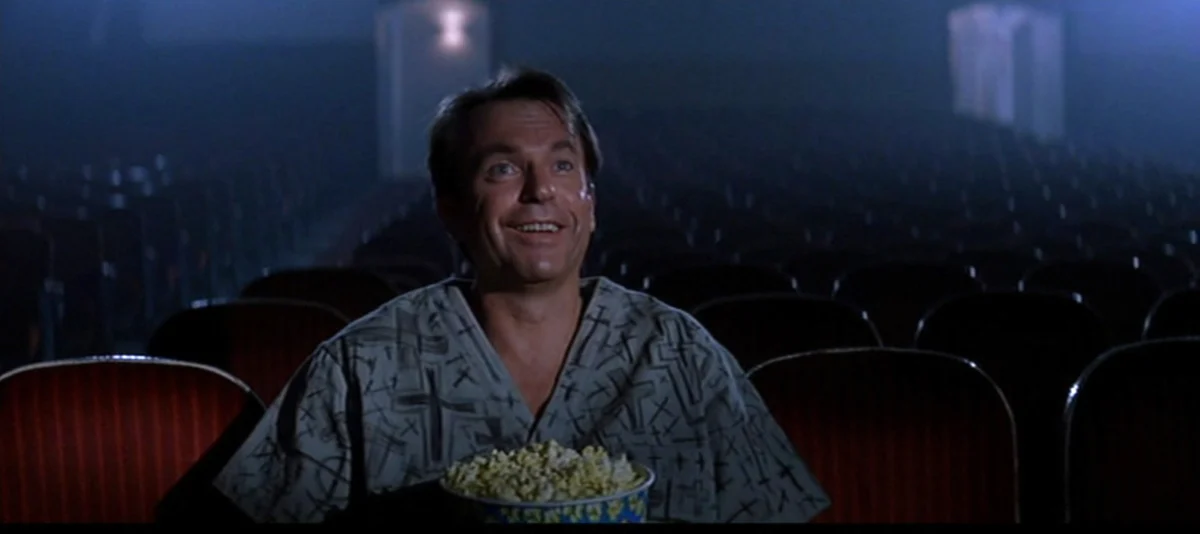
The film loops back to its opening sequence, where a broken Trent sits in his cell. The final act of the movie is not one of triumph or salvation, but of absolute, nihilistic surrender. Upon escaping the asylum, Trent enters a cinema. He watches a film—the very film we have just finished watching—and realizes that he is not a man, but a character, a puppet dancing on the strings of a cosmic author.
Supporting Data: The Anatomy of a Scream
The centerpiece of the film’s terror is not a jump scare or a grotesque creature effect, though those are present in abundance. The true horror of In the Mouth of Madness is found in the final scene: the laugh.
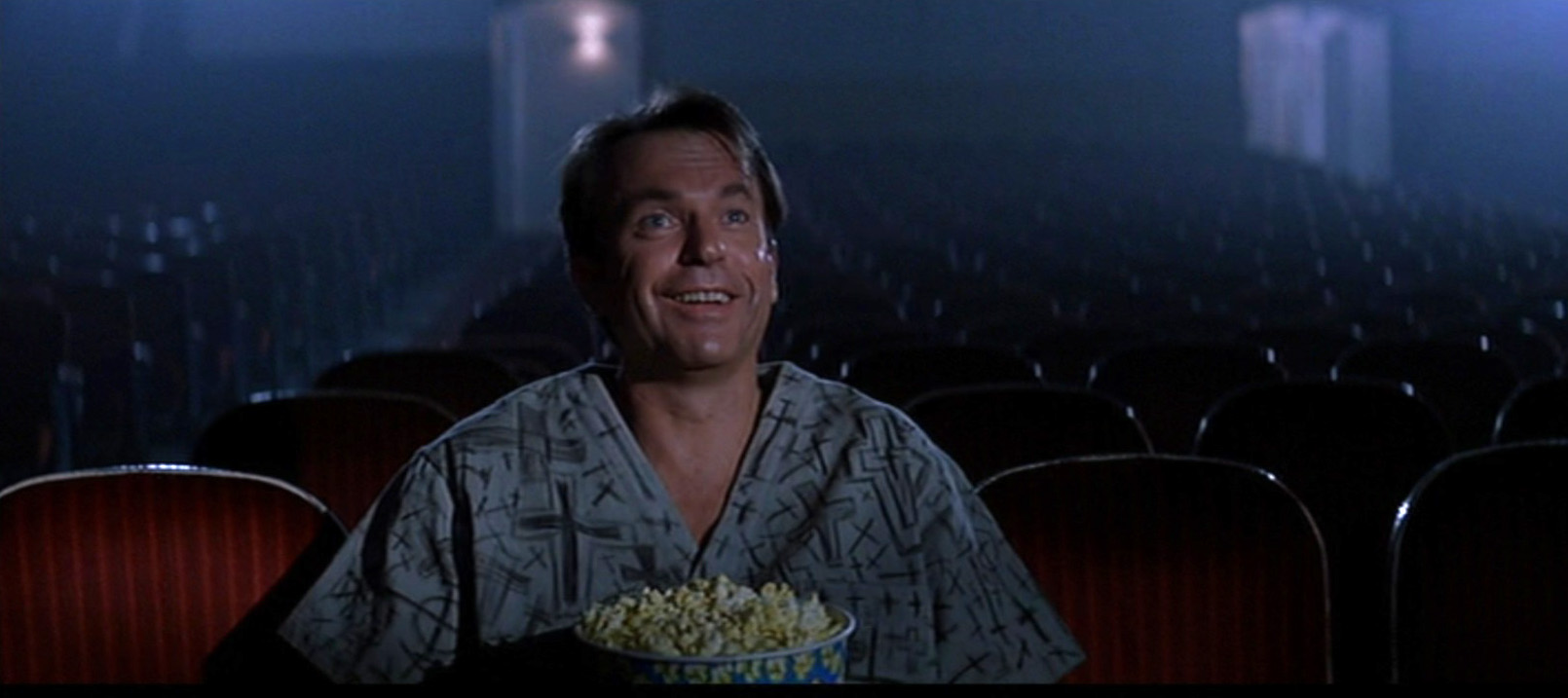
When John Trent realizes that his life, his pain, and his very existence are nothing more than a narrative device for a horror novel, he begins to laugh. This is not the laughter of a man finding humor in a joke; it is the laughter of a man whose psyche has completely shattered. Neill’s performance here is a masterclass in non-verbal storytelling. He cycles through confusion, rage, and profound, existential sorrow, all while maintaining the physical mechanics of a hearty, boisterous belly laugh.
This scene serves as the ultimate "meta-moment" in 90s cinema. By breaking the fourth wall in such a visceral way, Neill forces the audience to confront their own role as consumers of horror. We are watching a man suffer, and we find it entertaining—a realization that mirrors Trent’s own horrific epiphany.
Official Responses and Industry Impact
In the wake of his passing, industry peers and critics have been quick to highlight the quiet brilliance that Neill brought to his roles. Directors who worked with him often spoke of his "unflappable presence."
"Sam didn’t just act a role; he lived in the spaces between the lines," noted one longtime collaborator. "In In the Mouth of Madness, he had to be the anchor for a movie that was actively trying to destroy its own reality. If he had played it even a degree too campy, the whole thing would have fallen apart. Instead, he gave us a man whose skepticism was his armor, and watching that armor melt away was more terrifying than any monster John Carpenter could have put on screen."
The film, which was part of Carpenter’s informal "Apocalypse Trilogy" alongside The Thing and Prince of Darkness, has seen a massive surge in viewership since the news of Neill’s death. It stands as a testament to the fact that while Neill was capable of playing heroes, he was at his most compelling when he was playing victims of the unknown.
The Implications: Why We Need Neill’s Horror
The death of Sam Neill leaves a vacuum in the landscape of intelligent horror. In an era where modern horror often relies on heavy CGI or repetitive jump scares, Neill’s approach reminds us of the power of the human face and the voice. He understood that the most frightening thing in the universe is not the monster under the bed, but the realization that the world you inhabit is not what you thought it was.
His performance as John Trent serves as a blueprint for the modern "unreliable protagonist." By portraying a man who is both the detective and the victim, Neill elevated In the Mouth of Madness from a standard B-movie monster flick to a philosophical exploration of fate and free will.
As fans continue to revisit his filmography, they will undoubtedly find new depths in his work. Whether he was battling prehistoric beasts or navigating the eldritch horrors of Hobb’s End, Sam Neill brought an unmatched level of dignity and curiosity to his craft. He made us believe in the impossible, and in doing so, he made us look a little closer at the world around us.
Sam Neill may have left the stage, but the laughter—that cold, haunting, and unforgettable laugh from the end of the world—will echo in the halls of cinema history for generations to come. He taught us that even in the face of the apocalypse, there is a story to be told, and that sometimes, the only thing left to do is to laugh at the absurdity of it all.










