

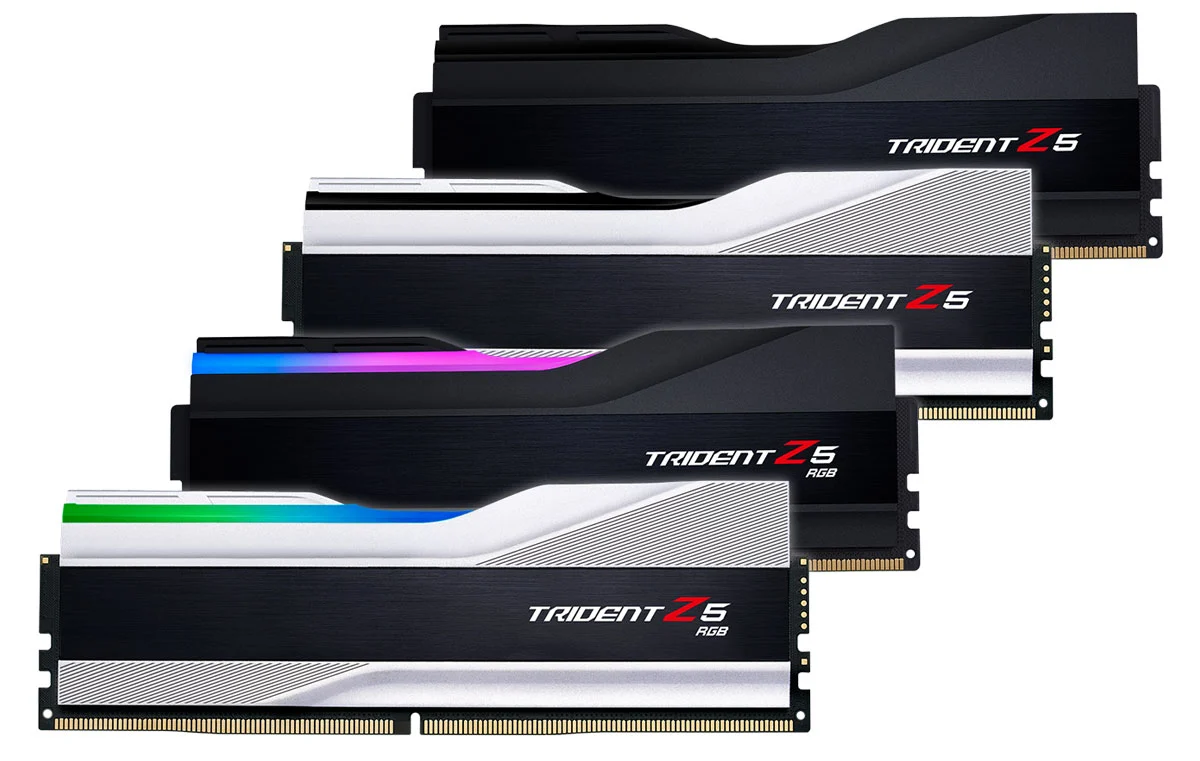
As the computing industry stands on the precipice of a generational shift in memory architecture, the race to dominate the DDR5 landscape has intensified. With consumer desktop platforms finally poised to embrace the new standard, memory manufacturers are locked in a high-stakes competition to deliver the highest frequencies and the tightest timings. While Corsair previously captured headlines with its teaser for DDR5-6400 modules, G.Skill has officially raised the stakes, announcing its new Trident Z5 memory kits, which push the envelope to a staggering DDR5-6600 speed.
Main Facts: The New King of Speed
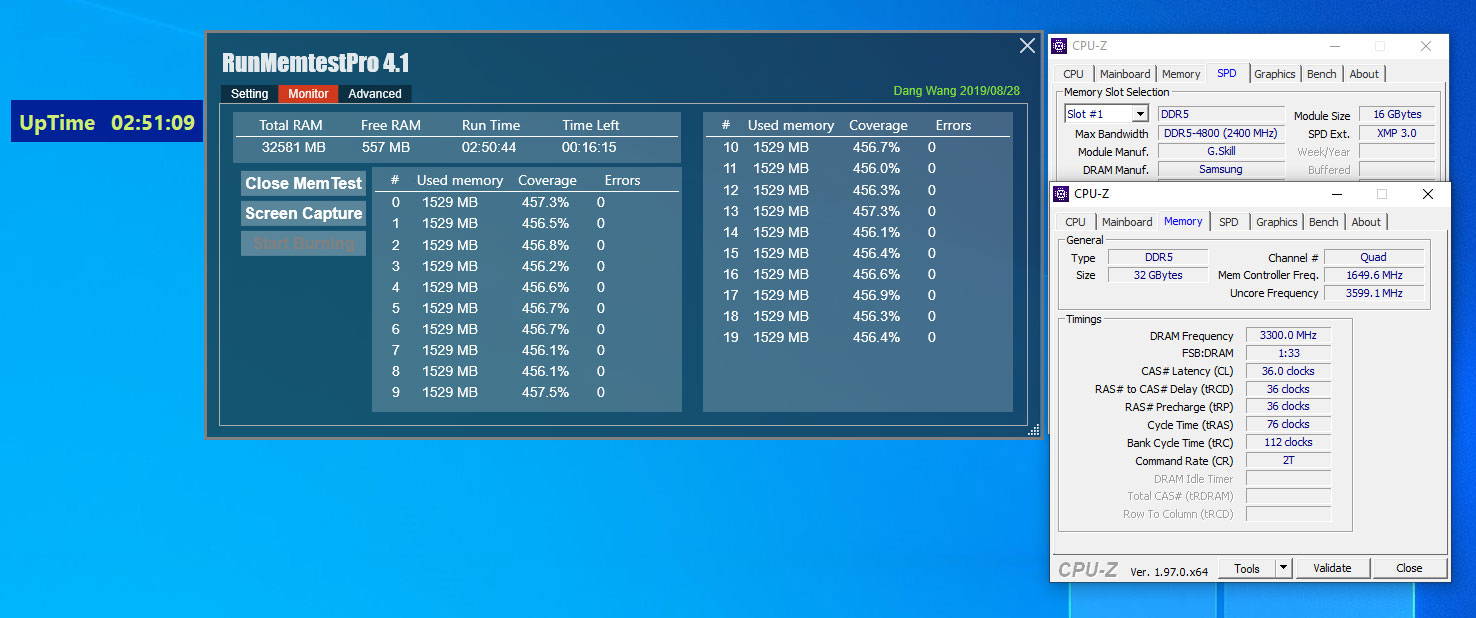
G.Skill’s latest announcement centers on the Trident Z5 series, specifically the 32GB (2x16GB) kits operating at an impressive DDR5-6600 frequency. What distinguishes this announcement from mere marketing hyperbole is the latency profile: CL36-36-36-76. In an industry where early DDR5 offerings are largely settling for CL40-40-40 timings, G.Skill’s ability to maintain tight latency at significantly higher clock speeds marks a substantial engineering milestone.
These modules are designed to bridge the gap between enthusiast-grade hardware and the theoretical limits of early DDR5 production. By utilizing hand-picked Samsung DDR5 Integrated Circuits (ICs), G.Skill aims to provide a "binning" advantage that separates its high-end Trident Z5 kits from standard retail offerings. The result is a memory solution aimed squarely at gamers, professional overclockers, and hardware enthusiasts who demand maximum performance from their next-generation workstations and gaming rigs.
Chronological Evolution: From DDR4 to the DDR5 Transition
The transition from DDR4 to DDR5 has been a long-gestating process, marked by years of development in JEDEC standards and silicon manufacturing.
- Mid-2021: Industry anticipation began to boil over as manufacturers started teasing their upcoming lines. Corsair led early efforts by showcasing DDR5-6400 sticks, effectively signaling to the market that the transition to the new standard would be performance-focused rather than merely a power-saving iteration.
- Late Q3 2021: As motherboard manufacturers finalized their Z690 and competing chipsets, memory vendors began finalizing their high-speed binning processes.
- October 2021: G.Skill officially unveiled the Trident Z5, effectively leapfrogging the 6400MHz threshold and setting the current industry gold standard at 6600MHz.
- Future Outlook: The industry expects a staggered release schedule, starting with performance-oriented kits and moving toward mainstream, JEDEC-standard modules as manufacturing yields for DDR5 increase over the coming 12 to 18 months.
Technical Analysis: Why 6600MHz Matters
To understand the significance of G.Skill’s announcement, one must look at the technical improvements inherent in the DDR5 standard. DDR5 provides doubled bank groups, improved power management on the DIMM itself (PMIC), and significantly higher data rates compared to its predecessor. However, high frequency often comes at the cost of "latency penalty"—the time it takes for the memory to respond to a request.
By achieving a CL36 timing at 6600MHz, G.Skill is mitigating this penalty. In real-world applications, this translates to faster frame delivery in CPU-bound gaming scenarios and snappier performance in heavy multi-threaded productivity tasks like video rendering or 3D modeling.
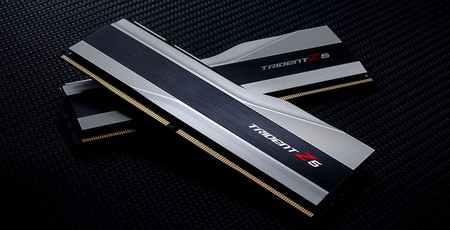
The Trident Z5 architecture also incorporates a refined heat spreader design. The non-RGB models feature a "piano black" top bar, emphasizing a sleek, professional aesthetic. For those who prioritize form as much as function, the upcoming Trident Z5 RGB series will feature a translucent light bar optimized for fluid, addressable RGB lighting, allowing users to synchronize their memory aesthetics with their broader system builds.
The Engineering Behind the Binning Process
G.Skill’s reputation in the enthusiast community is largely built on its rigorous binning process. Not all memory chips are created equal; during the manufacturing process, silicon wafers exhibit variations in thermal tolerance and electrical efficiency. G.Skill sources high-performance Samsung DDR5 ICs and subjects them to a series of stress tests to ensure they can maintain stability at high voltages and frequencies.
This "cherry-picking" process is why G.Skill can promise a 6600MHz XMP (Extreme Memory Profile) speed that remains stable. For the end-user, this translates to a plug-and-play experience that requires only a single toggle in the BIOS to achieve these extreme speeds, rather than requiring hours of manual voltage tweaking and trial-and-error stability testing.
Official Stance and Market Positioning
While G.Skill has been vocal about the performance of the Trident Z5, they have remained characteristically guarded regarding the MSRP of these kits. Market analysts suggest that the "early adopter tax" for DDR5 will be significant. Given that DDR5 requires new power management chips on the modules themselves and uses more complex fabrication processes, industry experts estimate that users should prepare for a price premium of up to 50% compared to equivalent-capacity DDR4 memory.
G.Skill’s marketing narrative emphasizes that this product is not intended for the budget-conscious user, but rather for the "ultimate performance seeker." By positioning the Trident Z5 as a premium tier, G.Skill is effectively insulating itself from the volatility of the entry-level DDR5 market, focusing instead on the high-margin enthusiast segment that is less sensitive to price fluctuations.
Implications for the PC Ecosystem
The arrival of DDR5-6600 memory has several profound implications for the wider PC hardware ecosystem:
- Platform Longevity: The adoption of DDR5 ensures that current motherboard platforms (such as Intel’s LGA 1700) have a clear upgrade path for the next several years. As higher-speed kits become the norm, users can simply swap out memory modules to breathe new life into their systems.
- Increased Power Efficiency vs. Performance: While DDR5 operates at a lower voltage (1.1V for standard JEDEC) than DDR4 (1.2V), the extreme performance kits like the Trident Z5 will require higher voltages to maintain stability at 6600MHz. This is a critical factor for overclockers to monitor, as thermals will become a more significant constraint in small-form-factor builds.
- The End of the DDR4 Era: With major manufacturers pushing DDR5 to 6600MHz and beyond, we are entering the final stage of the DDR4 lifecycle. While DDR4 will remain a viable, cost-effective solution for years to come, its ceiling has been reached, while DDR5 is only just beginning its ascent.
Conclusion: A New Frontier
G.Skill’s announcement of the Trident Z5 DDR5-6600 memory kits serves as a tangible manifestation of the industry’s progress. By successfully navigating the complexities of new silicon and tight timing profiles, the company has provided a glimpse into what the future of high-performance computing looks like.
While the lack of pricing and specific release dates remains a point of frustration for many, the technical achievement itself is undeniable. As we move closer to the widespread availability of these kits, the primary question for consumers will not be whether DDR5 is better, but whether they are prepared to invest in the hardware ecosystem required to support it. For the enthusiast, the answer is likely a resounding "yes." The Trident Z5 is not just a memory kit; it is an invitation to push the boundaries of what is possible on a desktop platform, setting the bar for all competitors to follow in the months to come.










No comments yet. Be the first to join the conversation!