The landscape of the DC "Absolute" Universe has consistently challenged long-standing reader expectations, stripping away layers of continuity to reveal the raw, unvarnished nerves of iconic characters. With the release of Absolute Batman #22, writer Scott Snyder and guest artist Werther Dell’Edera have turned their analytical lens toward one of the publisher’s most recognizable figures: Harley Quinn.
Moving away from the traditional "clown princess of crime" archetype, this issue presents a grounded, street-level iteration of Harley that feels less like a cartoon villain and more like a hardened survivor ripped from the gritty aesthetic of a 1970s urban thriller. This radical re-envisioning does more than just update her costume or origin; it fundamentally alters the dynamic of the Absolute Batman series.
Main Facts: A Shift in the Absolute Paradigm
Absolute Batman #22 serves as a pivotal character study. In this iteration, Harley Quinn is stripped of the colorful, manic artifice usually associated with the character. Instead, she is portrayed as a street-smart, resilient youth—a character archetype that echoes the survivalist energy of films like Walter Hill’s The Warriors.
The narrative structure of the issue is split between high-octane present-day conflict and intimate, claustrophobic flashbacks. As Harley and the enigmatic "Bamtan" evade and dismantle police forces, Harley narrates her own history. This is not merely exposition; it is a tactical attempt to bridge a gap with a Batman who is, at best, dismissive and, at worst, openly hostile toward her.
The primary takeaways from this issue include:
- A Revised Origin: Harley’s upbringing is framed through a lens of psychological trauma and the reality of "monsters" in the Absolute Universe.
- The Batman-Harley Dynamic: Their relationship is characterized by a one-sided attempt at connection, with Harley seeking an ally and Batman offering only detached, tactical annoyance.
- The Robin Factor: The issue provides a rare look into the fractured cohesion of the Robins, highlighting the volatile nature of the Bat-family in this reality.
The Chronology of Trauma: Unpacking the Flashbacks
To understand the current state of Harley Quinn, one must look at the shadows of her childhood. The narrative flow of Absolute Batman #22 is masterfully orchestrated by Snyder, utilizing a non-linear approach that mirrors Harley’s own fractured psyche.
Early Childhood: The Closet and the Shadow
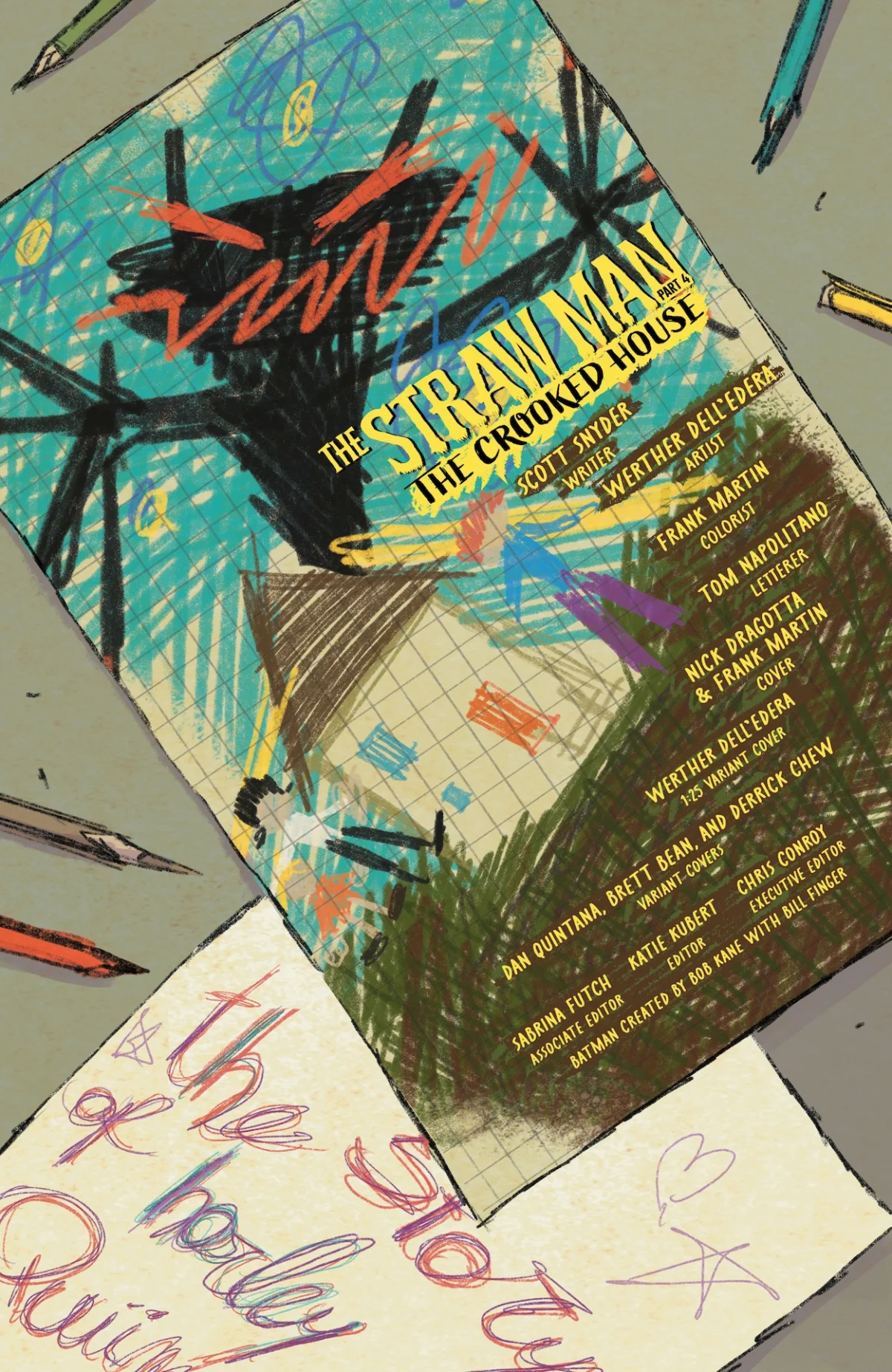
The issue begins with an unsettling visual—a child’s drawing of a shadowy, looming figure hovering over a house. Artist Werther Dell’Edera utilizes a childlike, whimsical art style that contrasts sharply with the sinister subject matter. This serves as a primary indicator of the "monsters" that inhabit the Absolute Universe. While Harley’s mother attempts to provide comfort by dismissing these fears as figments of a child’s imagination, the reader—aware of the terrifying reality of this universe’s Joker—understands that these monsters are not merely metaphors.
Adolescent Years: From Streets to Survival
As the flashbacks progress, we see the transition from a fearful child to a street-hardened teenager. This progression is seamlessly intercut with the present-day action. As Harley recounts her story to Batman while they engage in a running battle, the reader witnesses the formation of her survivalist philosophy. This is the crucial link: Harley is not just fighting the police; she is fighting to be heard, to be seen, and to explain why she is the way she is. The pacing of these flashbacks provides a sense of inevitability, as if the person she becomes was written into her DNA by the environments she had to navigate.
Supporting Data: Artistic Direction and Character Dynamics
The artistic contribution of Werther Dell’Edera is perhaps the most significant factor in the issue’s success. His ability to shift tones between the gritty, mechanical violence of the present and the melancholic, muted colors of the past provides a sensory guide for the reader.

The Art of Action
Dell’Edera’s choreography is dynamic and visceral. In a standout sequence, he employs a "Dragotta-style" layout—using small, rapid-fire panels to capture the speed and precision of Harley’s combat movements. When she swings her signature hammer, the art emphasizes the kinetic force of the impact, contrasting with panels where Batman acts as a gravitational center, drawing the police toward him with an almost effortless, magnetic intensity.
The Robin Subplot
While the focus remains on Harley, the inclusion of the Robins adds necessary texture to the world-building. Snyder uses brief, sharp dialogue to highlight the interpersonal tension within the group. Notably, Dick Grayson’s concern regarding Jason Todd’s increasing ferocity suggests a deeper, more systemic issue within the Batman legacy. Through the perspective of a mechanical HUD (Heads-Up Display) inside a helmet, Dell’Edera captures both the technical scale of their mechs and the underlying emotional distance between them.
Official Responses and Creative Intent
While official statements from DC editorial have been sparse, the creative team has framed this issue as a "necessary deconstruction." Scott Snyder’s writing in this issue signals a departure from the "jester" aesthetic, pushing Harley into the role of a tragic figure whose past informs her present volatility.
The editorial decision to bring in a guest artist like Dell’Edera indicates a desire to provide a distinct "vibe" for character-centric issues. By isolating Harley from the standard Absolute Batman visual language, the book forces the reader to focus on her internal world, treating her not as a supporting character, but as a protagonist in her own right.
Implications: A New Future for Harley Quinn
The implications of Absolute Batman #22 are vast. By grounding Harley in a more realistic, albeit bleak, origin story, the narrative establishes her as a "compelling figure" rather than a supporting antagonist.
The Scarecrow Connection
Perhaps the most significant takeaway is the integration of the Scarecrow’s master plan. The revelations regarding Harley’s past are not just for character depth; they serve as a catalyst for a major turn in the broader series arc. The "monsters" in her closet were not just individual traumas; they appear to be part of a larger, systemic threat that the series is building toward.
A Stubborn Protagonist
The most tragic element of this issue is the failure of connection. Despite Harley’s vulnerability and her attempts to bridge the gap with Batman, he remains stubbornly closed off. This sets a dangerous precedent for their future interactions. In the Absolute universe, where allies are scarce and the stakes are existential, Batman’s refusal to acknowledge the humanity of those around him—including someone as resilient as Harley—may prove to be his ultimate undoing.
Final Verdict
Despite minor pacing issues and a slightly predictable twist, Absolute Batman #22 succeeds because of its emotional intelligence. It does not demand that we love this version of Harley Quinn, but it demands that we respect her journey. By the time the final page is turned, the reader is left with the distinct impression that the Harley Quinn of the Absolute Universe is a powerhouse of character design, one whose survival is perhaps more important to the fate of this world than even the Caped Crusader realizes.
The "Absolute" branding has promised a complete reimagining of the DC mythos, and with this issue, it has delivered its most human, and perhaps most heartbreaking, chapter yet.