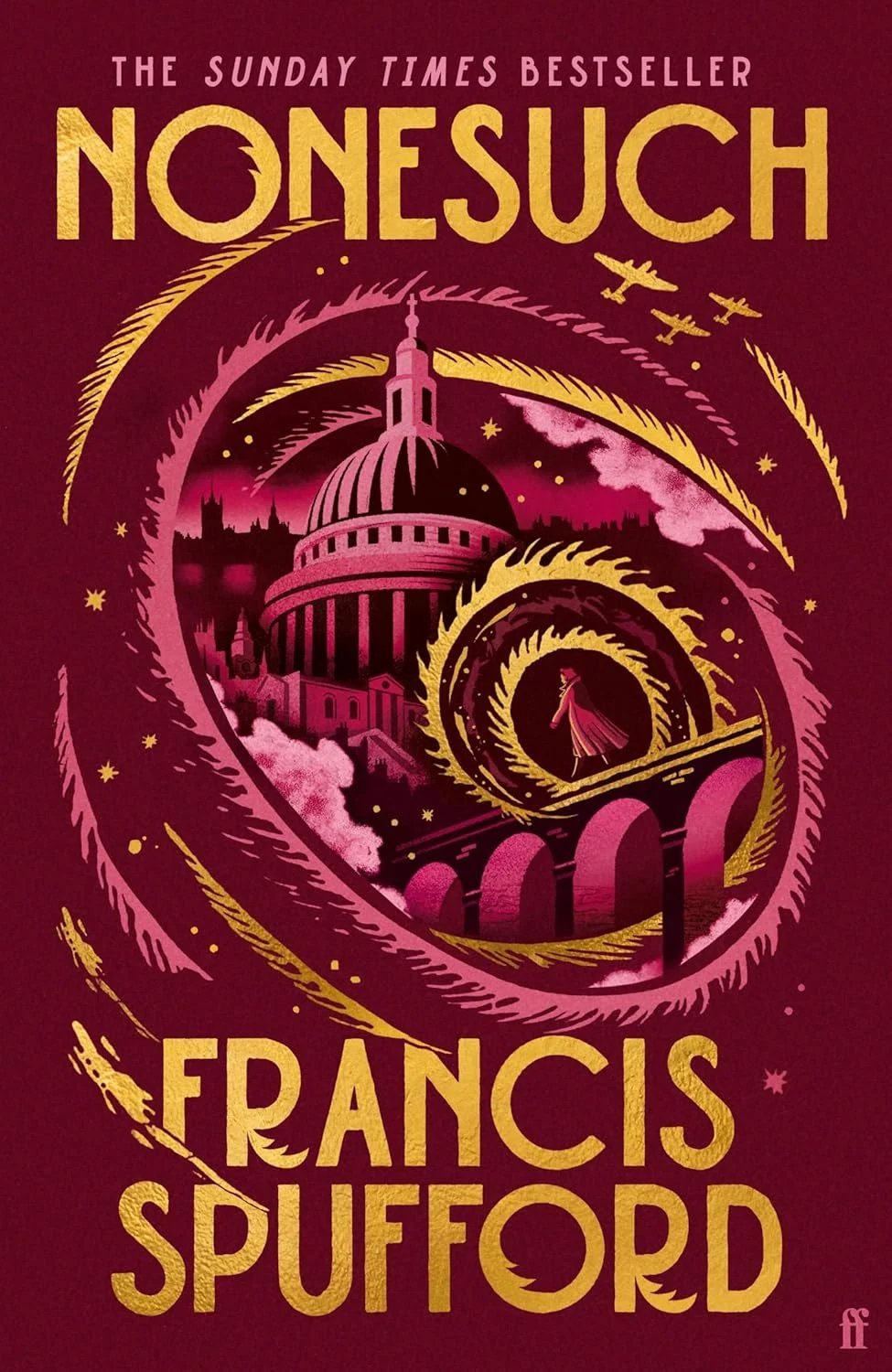
In his latest novel, Nonesuch, Francis Spufford—a Booker Prize-longlisted author celebrated for his ability to weave the granular textures of historical reality with speculative inquiry—attempts a daring, if polarizing, literary experiment. Following his acclaimed 2021 novel Light Perpetual, Spufford returns to the harrowing crucible of the London Blitz, this time infusing the soot-stained streets of 1940 with a volatile cocktail of occult fantasy and science-fictional intrigue.
The novel is a sprawling, ambitious endeavor that challenges the boundaries of genre, asking whether the rigid, trauma-hardened history of World War II can coexist with the ethereal, often whimsical, mechanics of high fantasy. As the first half of a duology—to be completed by the forthcoming Arcady—Nonesuch serves as both a love letter to the resilience of the wartime spirit and a complex interrogation of the "Great Man" theory of history.
The Chronology of Chaos: A Narrative Overview
Nonesuch unfolds across a meticulously paced timeline, spanning from the uneasy lull of August 1939 to the deepening darkness of December 1940. The narrative is dual-tracked, following Iris Hawkins, a sharp-witted, ambitious young woman working for the fictional stockbrokers Cornellis & Blome, and Geoff Hale, a BBC technician whose expertise in early television signals eventually leads him into the classified, shadow-laden world of Bletchley Park-style cryptanalysis.
Iris is a character forged in the furnace of wartime necessity. Much like the author’s own mother, who found herself managing a statistical department at Lloyds Bank at age 17, Iris is a survivor who navigates a landscape of "Hell’s Corner" (Kent and the City of London) with a mixture of pragmatism and suppressed desire. While her peers are conscripted or lost to the mechanical indifference of V1 and V2 rocket raids, Iris masters the teleprinter and the era’s massive, non-computerized calculating machines.
The plot pivots from social realism to the supernatural when Iris discovers a conspiracy rooted in the 17th century. A secret order, echoing the historical figure of John Dee, attempts to rewrite history by summoning angels trapped within stone statues across London. The goal: to alter the timeline, ensure Winston Churchill never rises to power, and facilitate a Nazi victory.
Supporting Data: The Literary DNA of Nonesuch
Spufford’s work is deeply intertextual, engaging in a high-stakes conversation with the ghosts of mid-century literature. References to Elizabeth Bowen’s The Heat of the Day provide a haunting, atmospheric anchor, capturing the "lightless middle of the tunnel" that defined the London Blitz.
However, Spufford diverges from Bowen’s somber realism by channeling the occult sensibilities of M.R. James. A particularly chilling set-piece involves a "Watcher"—an entity with a face of newsprint that recalls the "crumpled linen" horror of James’s Oh, Whistle, and I’ll Come to You, My Lad. This supernatural threat is set against the backdrop of the "furrowed" sky of London, described by Spufford as a landscape filled with invisible, vibrating signals—a nod to the neo-modernist preoccupations of writers like Tom McCarthy.
Furthermore, the novel acts as a bridge between two titans of fantasy: C.S. Lewis and Philip Pullman. Iris serves as an adult, morally complex evolution of characters like Pullman’s Lyra Belacqua, while simultaneously offering a rebuttal to the perceived misogyny found in Lewis’s exclusion of Susan Pevensie from Narnia. By casting Iris as a woman who pursues both sexual freedom and material success, Spufford challenges the traditional archetypes of the "tart with a heart" and the "heroine of destiny."
Implications: The Ethics of Historical Revisionism
The central tension of Nonesuch lies in its attempt to marry the mundane struggle for advancement with the cosmic stakes of saving the free world. Iris’s personal evolution—from an atomistic individualist seeking to better her station to a reluctant protagonist who recognizes her responsibility to the collective—is the novel’s strongest emotional arc.
However, the inclusion of supernatural elements raises questions regarding the novel’s cohesion. Critics may argue that the historical setting is so rich—the grueling shifts in banks, the constant threat of air raids, the social shift of women entering the workforce—that the addition of necromancers and trapped angels occasionally distracts from the lived experience of the period.
The portrayal of the antagonist, Lall, further complicates the narrative. Designed as a foil to Iris, Lall represents the "ice maiden" trope, yet her motivations remain somewhat opaque. While Spufford attempts to imbue her with a tragic, repressed queer identity, the execution invites unfavorable comparisons to his own past work, specifically the character of Mikey in Light Perpetual. By grounding villainy in the disavowal of one’s own desires, the narrative risks becoming repetitive, thereby diminishing the sense of menace required for a high-stakes fantasy.
Official Responses and Stylistic Critiques
The critical reception of Nonesuch reflects the inherent difficulty of its hybrid structure. On one hand, the prose is frequently dazzling, capturing the "tideless, hypnotic, futureless day-to-day" of the war with visceral clarity. The descriptions of the London skyline and the technological isolation of the era are masterful.
On the other hand, the novel’s whimsical tone—particularly in the dialogue between Iris, Geoff, and the angelic entity Raphael—often clashes with the stark, gritty reality of the bombings. This stylistic oscillation creates a sense of "languor" in the second half, where the narrative pace slows to accommodate lunar-cycle rituals and repetitive descriptions of the protagonists’ romantic entanglements.
Furthermore, the "Great Man" view of history, which centers the war’s outcome on the survival of Churchill and the actions of a few elite magicians, risks sidelining the vast, anonymous labor of millions. While Iris’s individual agency is a welcome addition, the reliance on established tropes—such as the secret, magical London found in works like Rivers of London or Doctor Who—suggests that Spufford is treading familiar ground rather than breaking entirely new earth.
The Road to Arcady: Future Outlook
Despite these reservations, Nonesuch is a triumph of imagination that refuses to play it safe. The "rabbit-out-of-the-hat" ending, which completely resets the stakes, signals that the sequel, Arcady, may move beyond the constraints of traditional historical fantasy.
For readers who appreciate a blend of rigorous historical research and bold, "generically wild" storytelling, Nonesuch is an essential, if uneven, read. It forces us to reconsider the membrane between "the this and the that"—between the brutal reality of a world under fire and the invisible, vibrating possibilities of a reality we cannot see. If Spufford can tighten the dramatic focus and resolve the tonal dissonance in the second installment, he may well elevate this duology into a seminal work of the 21st century.
As it stands, Nonesuch remains a provocative, ambitious, and deeply human exploration of what it means to be a person in history—and how much of our fate is truly our own to command. Whether one prefers the historical weight of the Blitz or the arcane pull of the occult, the novel demands that we pay attention to the "noises in the ether," for they are the echoes of a past that is never truly gone.