

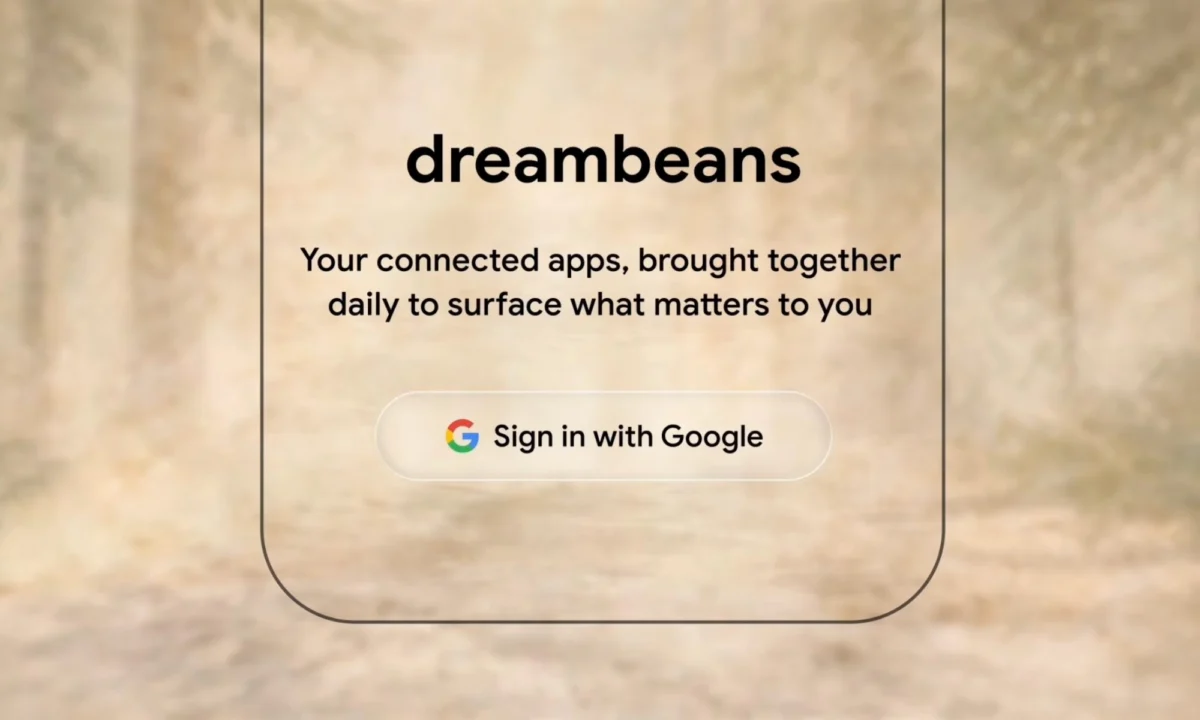
In an era defined by the "attention economy," where the primary business model of the internet is to keep users glued to their screens via algorithmic feeds and infinite scrolling, a new experiment from Google Labs is attempting to invert the paradigm. Dreambeans, the latest experimental application from the tech giant, poses a radical proposition: what if your digital assistant prioritized your real-world life over your time spent inside the app?
While most platforms are engineered to minimize "friction" and maximize session duration, Dreambeans is designed to do the opposite. By aggregating personal data to create a curated, finite morning briefing, the app aims to synthesize your digital footprint into actionable insights before sending you off to live your day. It is perhaps the most direct argument yet from Google that the problem with modern social media isn’t the quality of the content—it is the structure of the feed itself.
The Core Concept: Curation Over Consumption
The premise of Dreambeans is elegant in its simplicity. Instead of opening an app to find a bottomless pit of viral videos or curated envy-inducing photos, the user is presented with a fixed collection of 10 to 14 personalized, AI-illustrated stories each morning.

These stories are not sourced from strangers or influencers. They are derived from the user’s own digital ecosystem. By integrating data from Gmail, Google Calendar, Google Photos, YouTube, and search history, the application synthesizes a "storyboard" of the user’s upcoming day, interests, and potential social interactions.
How the Data Synthesis Works
While the user sleeps, the Dreambeans engine processes the previous day’s digital trails. This synthesis is highly personalized:
- Lifestyle Suggestions: If a user has been searching for local cafes or parks, the app may curate a suggestion for a coffee shop nearby, complete with an AI-generated artistic rendering of the location.
- Calendar Context: Upcoming vacations or appointments are transformed into narrative beats, helping the user visualize their schedule.
- Hobby Integration: If a user’s YouTube history reveals a budding interest in woodworking or classical music, the app surfaces relevant content or project ideas.
- Social Connectivity: Leveraging Google Photos’ face-grouping technology, the app populates these AI-illustrated scenes with the faces of the user’s friends and family, making the narrative feel deeply personal and grounded in real-world relationships.
By utilizing the "Nano Banana 2" rendering engine, these stories move beyond simple text-based notifications. They are presented as cohesive, visual experiences that bridge the gap between static data and engaging storytelling.

Chronology: From Infinite Feeds to Intentional Living
The trajectory of the mobile internet over the last decade has been one of relentless escalation. The 2010s saw the rise of the "Infinite Scroll," a design pattern popularized by social media giants to eliminate "stopping cues"—the natural points where a user would otherwise feel compelled to put their phone down.
The Shift Toward "Anti-Scroll"
- 2015–2020: The peak of algorithmic engagement, where apps like TikTok and Instagram refined the "For You" page to keep users in a state of passive consumption.
- 2023–2024: Growing public concern regarding the mental health impacts of social media usage led to a push for "digital wellbeing" features, such as screen time trackers and app limiters. However, these were largely passive tools.
- June 2026: Google Labs introduces Dreambeans. Unlike previous tools that merely track usage, Dreambeans actively curates the experience, placing a hard limit on content. By forcing a daily cap on what the user sees, the app serves as a psychological "off-ramp" rather than an engagement trap.
Supporting Data and Technical Architecture
The technical backbone of Dreambeans is built on Google’s advanced AI infrastructure, but the user-facing interface is remarkably stripped back.
Privacy and Control
One of the most significant concerns regarding an app that aggregates Gmail, Calendar, and Photos is privacy. Google has addressed this by implementing a granular permission system. Users can choose exactly which services the app accesses and, crucially, can delete their data from the application at any point.

Furthermore, Google has explicitly stated that Dreambeans operates within a silo. The data processed for the app does not bleed into the broader training sets for Gemini or the platform’s general AI models, ensuring that the personalized nature of the stories remains isolated to the user’s experience.
The "Ultra" Barrier
Currently, access to Dreambeans is restricted. It is available only to "Google AI Ultra" subscribers in the United States, aged 18 and older. This exclusivity is telling. With the AI Ultra tier costing $100 per month, the app is currently positioned as a premium, experimental tool for power users. This allows Google to iterate on the product with a smaller, more engaged audience before deciding whether to integrate it into the broader ecosystem of free Google services.
Official Responses and Industry Context
Google has remained relatively quiet regarding the long-term roadmap for Dreambeans, characterizing it strictly as an "experimental" project. However, the move is being closely watched by industry analysts who view it as a pivot in strategy for the tech giant.

"Google is effectively trying to solve the problem they helped create," says one tech analyst. "For years, they built the infrastructure that made information discovery addictive. Now, they are trying to prove that AI can be used to filter that information into something that serves the human, rather than the platform."
Critics, however, point to the $100/month price tag. There is a concern that "intentional digital living" is becoming a luxury service. If the solution to digital addiction is a premium subscription, it risks creating a two-tier digital society: one where the wealthy pay to have their technology curated for them, and one where the masses continue to be subjected to the ad-supported, infinite-scroll model.
Broader Implications: A New Era of UX?
The emergence of Dreambeans has far-reaching implications for the future of user experience (UX) design. If the app gains traction, it could signal a shift away from the "Feed" as the primary organizational structure of mobile apps.

The "Finite Content" Movement
The success of Dreambeans would provide empirical evidence that users are beginning to crave "stopping cues." If people are willing to pay a premium for an app that tells them when they are finished with their daily digital intake, it suggests that the market for "Digital Minimalism" is growing.
The Role of Generative AI
Dreambeans demonstrates a shift in how we use AI. Rather than using AI as a chatbot (like Gemini) or a search engine, Dreambeans uses AI as a curator. By weaving disparate threads of a user’s life into a narrative, it provides value that a standard feed cannot match. It isn’t just showing you what’s new; it’s showing you why your day matters.
The Competitive Landscape
This development puts pressure on other tech giants. If Google succeeds in branding its AI as a "life-simplifier" rather than a "content-delivery system," companies like Meta and ByteDance may find themselves on the defensive. They will be forced to ask: Can our platforms pivot to a finite, curated model without destroying our advertising revenue?

Conclusion
Dreambeans is a provocative experiment that forces us to confront our relationship with our devices. By turning the spotlight away from the infinite noise of the internet and back toward the specifics of our own lives, Google is testing a hypothesis: that users are ultimately looking for clarity, not more content.
While the current cost and limited availability prevent it from being a mass-market solution, the philosophy behind it is undeniable. As we move deeper into the age of generative AI, the most valuable tool in our pocket may not be the one that gives us the most information, but the one that knows when to stop. Whether the public is ready to embrace a "limited" internet remains the ultimate experiment, but for now, Dreambeans stands as a quiet, thoughtful challenge to the status quo of the digital world.












No comments yet. Be the first to join the conversation!