
 Sagoh
Sagoh
In the crowded landscape of language acquisition resources, few projects manage to bridge the gap between educational rigor and genuine entertainment. Frank and the Obaasan, a unique Japanese reader series, has emerged as a cult favorite for students of the Japanese language, offering a narrative-driven approach that turns the often-daunting task of studying a foreign language into a lighthearted intergalactic adventure. By combining beginner-friendly Japanese text with the eccentric antics of a stranded alien, the series has become a cornerstone for those looking to master hiragana and basic grammar without the tedium of traditional textbooks.
The Narrative Premise: An Alien Out of Water
The story centers on Frank, a visitor from another galaxy whose intergalactic spy mission comes to an abrupt and catastrophic end when he crash-lands in Fukui, Japan. With his spacecraft reduced to scrap metal and his supplies depleted, Frank finds himself in a position that would challenge any traveler: he is stranded on a planet he doesn’t understand, and his grasp of the local language is, at best, rudimentary.

The brilliance of the narrative lies in its simplicity. Frank’s primary objectives are to understand the mysterious creatures known as Earthlings, track down a peculiar, sticky delicacy called natto, and—if time permits—repair his ship before he inadvertently triggers a galactic conflict. His journey is facilitated by Obaasan, a no-nonsense Japanese grandmother whose wisdom is matched only by her cryptic behavior. Together, they form an unlikely duo, providing a backdrop for readers to engage with real-world Japanese etiquette, vocabulary, and sentence structures in a way that feels organic and, more importantly, fun.
A Chronology of Frank’s Terrestrial Education
The series unfolds across a series of episodes that serve as bite-sized lessons, carefully paced for the beginning learner.
Episode 1: The Encounter
The story begins with the initial meeting between the two protagonists. Obaasan discovers the disoriented alien, and the dialogue highlights basic greetings and the fundamental question of "Are you okay?" It introduces the reader to the rhythmic cadence of Japanese speech, setting the tone for the rest of the series.
Episode 2: Water, the Universal Drink
In the second installment, the focus shifts to basic needs. Frank learns about mizu (water), a concept he finds profoundly fascinating. This episode explores the "what is this?" and "I would like to drink" patterns, demonstrating how even the most mundane daily activities can be an opportunity for language immersion.
Episode 3: Sushi Is Not Human
Perhaps the most comedic entry, this episode explores Frank’s confusion regarding Japanese cuisine. When confronted with a plate of sushi, Frank mistakenly assumes the food is a fellow sentient being. His attempt to strike up a conversation with the sushi serves as a hilarious medium for teaching students about how to refer to people and objects correctly.
Episode 4: The Gastronomic Reality
Following the confusion of the previous episode, Episode Four clarifies the distinction between food and friends. It touches on the concept of tabemono (food) and reinforces grammar related to consumption and existence, providing a bridge between simple nouns and complex sentences.
Episode 5: Outer Space and Social Gossip
The final episode in this introductory arc involves a social visit to a neighbor, Mrs. Yamada. The dialogue dives into introductions and the social pressure of gossip, culminating in the revelation that Frank is, in fact, an alien. The shock of the two grandmothers provides a climactic moment that encourages readers to keep turning the pages.
Supporting Data: Why This Method Works
Language learning experts have long debated the efficacy of "input-based" learning versus rote memorization. Frank and the Obaasan leans heavily into the former. The series is specifically designed for beginner to upper-beginner students. The pedagogical structure is consistent throughout:
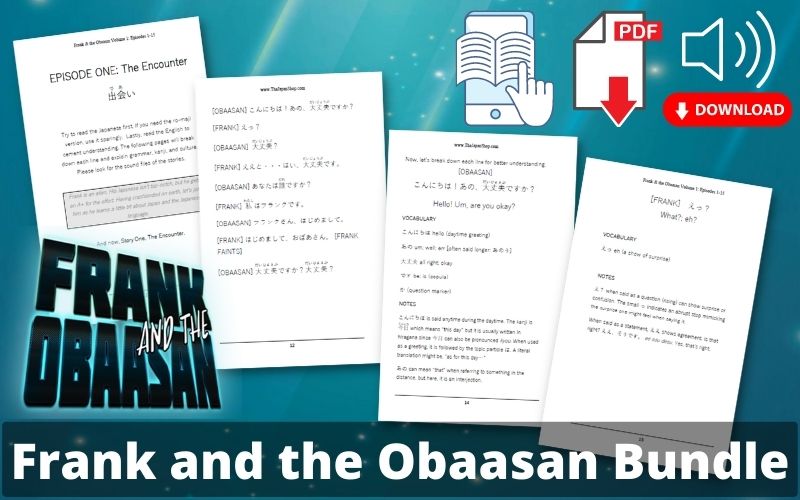
- Direct Exposure: The student is encouraged to read the original Japanese text, with a focus on hiragana proficiency.
- Scaffolding: For those who hit a roadblock, romaji is provided as a secondary tool, ensuring that the student is not left behind.
- Contextual Understanding: The English translation follows immediately, allowing the reader to check their comprehension.
- Linguistic Breakdown: Each line is dissected with grammar, kanji, and cultural notes written in plain English, ensuring that the student isn’t just reading, but understanding the "why" behind the language.
Furthermore, the integration with the "Makoto+ Sentence Explorer" adds a layer of modern technological support. Students can look up specific sentences and vocabulary from the stories, effectively turning the reader into a database of actionable linguistic information.
Official Perspective and Access
The publishers behind the series, The Japan Shop, have emphasized accessibility as a core tenet of their business model. Recognizing that different students have different budgetary and format preferences, they have established four distinct ways to access the Frank series:
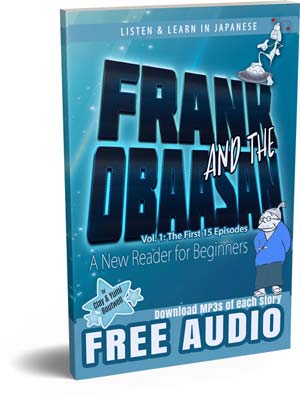
- The Membership Route: The "Makoto+ Shogun" membership provides instant access to all episodes, including audio files and full integration with the Sentence Explorer tool.
- The Digital Bundle: The "Beri- Beri- Shoshinsha" (Very, Very Beginner) bundle is tailored for those just starting their journey.
- The Focused Purchase: For those who only want the Frank story, a dedicated digital bundle exists, which includes a promise of future volumes at no additional cost.
- The Traditionalist Route: For those who prefer the tactile experience of paper, physical copies are available through their online store.
Implications for Language Learning
The success of Frank and the Obaasan carries broader implications for how we view language pedagogy. It challenges the "academic" model of language learning—which often relies on dry, repetitive drills—in favor of a "narrative" model. By giving students a character to root for, the emotional investment in the story acts as a motivator to continue studying.
When a student cares about whether Frank will ever fix his ship, or whether he will ever understand that sushi isn’t his peer, the barrier to entry for complex grammar points is significantly lowered. The laughter induced by the absurd premise acts as a stress-reliever, and as any linguist will attest, a student who is relaxed is a student who is better at absorbing new information.

Conclusion: A New Standard for Beginners
The Frank and the Obaasan series is more than just a collection of short stories; it is a carefully crafted tool that respects the intelligence of the beginner learner while providing the necessary structures to grow. Whether you are a student struggling to memorize hiragana or a lifelong learner looking for a refreshing way to practice your reading comprehension, the adventures of this stranded extraterrestrial offer a path that is as educational as it is entertaining.
As the series continues to expand, it stands as a testament to the idea that language is not just a set of rules to be memorized, but a living, breathing mechanism for storytelling—even when that story takes place on a planet far from the one where the language was born. For those ready to embark on this journey, the first five episodes are currently available to serve as a gateway into the rich, complex, and sometimes hilarious world of the Japanese language.


 Neng Nana
 Asro
Asro





