By Jonathan Cowie
For those of us who have spent decades traversing the landscapes of science fiction fandom, there is a recurring rhythm to life: the annual cycle of conventions, the informal gatherings, and the quiet, persistent reunions that anchor us to our past. Last week, I found myself participating in my third such gathering of the year. We were a small assembly, a cohort of "first generation" members of the Polytechnic Science Fiction and Fantasy Association (PSIFA), meeting in a quiet town just north of St Albans. As we sat among the clinking glasses and familiar laughter, it became impossible to ignore the weight of time. PSIFA, the legendary student group founded at Hatfield Polytechnic (now the University of Hertfordshire) in 1978, is approaching its half-century mark—a milestone that feels both impossible and inevitable.
The Genesis of an Institution: PSIFA’s Formative Years
Founded in the late 1970s, PSIFA was more than a student club; it was a crucible for a generation of science fiction enthusiasts. In an era before the ubiquity of the internet, when community was built through mimeographed fanzines and face-to-face discourse, PSIFA stood out as a beacon of intellectual curiosity.
The association was renowned for a programming schedule that often rivaled the institution’s own Film Appreciation Society. Beyond the screenings, PSIFA broke new ground in media. It was home to Radio Free Entropy, arguably the UK’s first student-run science fiction radio show. This spirit of innovation extended to the group’s active participation in the broader UK fan scene, with members regularly organizing field trips to major conventions like Novacon and Eastercon, as well as pilgrimages to London’s specialist SF bookstores, which at the time were the lifeblood of the genre’s retail landscape.
The physical heart of these gatherings was often the Elephant House, the Student’s Union building at Hatfield Polytechnic. With its architecture serving as an exact miniature of the iconic elephant house at London’s Regent’s Park Zoo, the venue provided a surreal and fittingly idiosyncratic backdrop for the formative years of our community.
Chronology: From Pub Talk to the Shoestringcon Legacy
The history of fandom is often written in the annals of conventions, but the true genesis of these events frequently occurs in the most mundane of settings. The story of "Shoestringcon" is a testament to this truth.

In 1979, the atmosphere within the UK SF community was electric, dominated by the anticipation of the Worldcon held in Brighton. During a post-term gathering at a pub near St Albans rail station, members of PSIFA were engaged in spirited debate with members of STAFFEN (the St Albans fan group). As the evening progressed, a member of the group—with a mixture of bravado and youthful optimism—suggested that PSIFA should host its own mini-convention.
The name "Shoestringcon" was chosen with intentional irony. Knowing that their modest endeavor would inevitably be compared to the grand scale of the Brighton Worldcon, the organizers wanted to preemptively signal that their event was built on passion and creativity rather than a bottomless budget.
The selection of a Chairperson for this inaugural event was decided in the most accidental fashion imaginable. As the group debated the logistics of the con, one potential candidate was temporarily absent, making a "watery offering to Bacchus" in the pub’s restroom. Upon his return, he found himself, without his consent or presence, unanimously elected to lead the project.
The event was a resounding success, featuring Guests of Honor (GoHs) such as the legendary Ken Bulmer and the renowned special effects artist Mat Irvine. It proved that a dedicated group of students, armed with little more than a vision and a tight budget, could contribute meaningfully to the cultural fabric of British science fiction.
Supporting Data: The Persistence of Memory and Community
The resilience of the PSIFA community is reflected in the continuity of these reunions. Decades may pass, and the faces in the room may bear the marks of time, but the underlying connections remain remarkably robust.
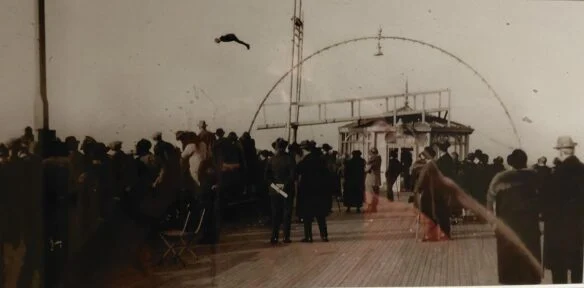
During our recent 2026 reunion, the irony of history repeated itself. The same individual who was volunteered for the chair of the original Shoestringcon while visiting the restroom found himself, once again, in the pub’s facilities. He returned to our table with an expression of delight, reporting that the establishment’s decor featured an unexpected homage to our past: a mural depicting a flying Victorian and a stargate.

This moment, while small, highlights the connective tissue of our fandom. We are a community that finds profound meaning in the artifacts of our culture, whether it is a vintage sweatshirt logo from 1978 or a piece of wall art in a modern-day pub. These symbols serve as anchors, ensuring that the "years and decades simply melt away," making the span of forty-eight years feel as thin as a week.
Official Status and Institutional Shifts
While PSIFA continues to exist today, its identity has undergone a significant transformation. The organization has, perhaps temporarily, pivoted away from its roots as a "broad church" science fiction society, having been—as some of us jokingly suggest—seduced by the dark side of the tabletop gaming hobby.
While the shift toward gaming is a testament to the evolving interests of the student body at the University of Hertfordshire, it has prompted a reflective response from the older guard. There is a palpable desire to preserve the legacy of the literary and media-focused roots of the club, even as it embraces new forms of engagement. The current iteration of the society serves as a reminder that student organizations are living entities, constantly adapting to the cultural zeitgeist of their members.
Implications: Why Fandom Matters
The story of PSIFA is, at its core, a case study in the longevity of community-based organizations. In a digital age where interaction is often mediated by screens and algorithms, the physical gatherings of the "first generation" fen offer a vital perspective.
- The Value of Institutional Memory: The history of PSIFA demonstrates how student-led initiatives can foster lifelong networks. The relationships forged over shared screenings and radio broadcasts in the 1970s have persisted well into the 2020s, providing a support structure that transcends professional and geographical boundaries.
- The Democratization of Event Planning: Shoestringcon remains a template for grassroots organizing. It highlights the potential for small groups to achieve significant cultural output by leveraging local networks—in this case, the collaboration between PSIFA and STAFFEN. It serves as a reminder that one does not need corporate backing to produce high-quality community events.
- Cultural Continuity: The "flying Victorian and stargate" discovery in a modern pub is more than a coincidence; it is a signal of the enduring relevance of science fiction imagery. The fact that these themes continue to resonate within the public consciousness underscores the success of the early fan movements in cementing SF as a foundational element of modern culture.
As we look toward the 50th anniversary of PSIFA, the implications for future generations of students are clear: the institutions you build today will define the communities of tomorrow. Whether through the medium of literature, radio, film, or tabletop gaming, the act of gathering to celebrate shared interests is the most powerful tool we have to combat the isolating effects of time.
In conclusion, the reunions of the PSIFA faithful are more than just nostalgic exercises. They are a reaffirmation of the bonds formed in the Elephant House nearly half a century ago. We may have aged, and our interests may have branched out into new territories, but the spirit of the original PSIFA—the curiosity, the humor, and the audacity to run a convention on a shoestring—remains a vibrant part of our identity. As we look forward to the next gathering, we do so with the knowledge that while the world changes, the heart of fandom remains, as ever, an open door to the stars.