Azzam Bilal Chamdy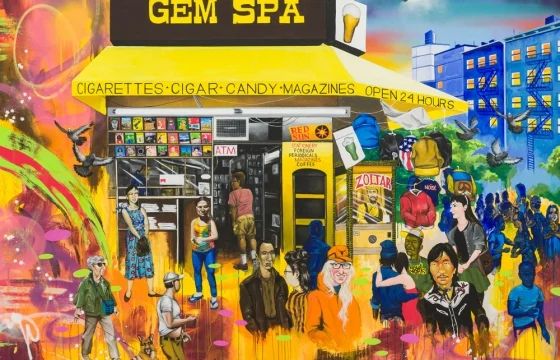
In the heart of New York City’s contemporary art scene, few names evoke the raw, kinetic energy of the late 20th century quite like Chris “Daze” Ellis. As the city continues to grapple with the relentless tides of gentrification and the sanitization of its cultural history, PPOW Gallery has unveiled a monumental exhibition that serves as both an excavation and a celebration. Orchid Rain on the Underground, Daze’s third solo exhibition at the gallery—running through April 25, 2026—is a masterful synthesis of the grit of 1970s graffiti and the refined sensibilities of a veteran fine artist.
The Pulse of the Exhibition: A Multimedia Time Capsule
Orchid Rain on the Underground is far from a static retrospective. It is a multisensory journey through the artist’s memory, incorporating a new series of large-scale paintings, a site-specific hallway mural, and a fully immersive multimedia installation.
The exhibition is anchored by the tension between Daze’s roots as a pioneer of the subway graffiti movement and his evolution into a studio-based painter. The gallery space has been transformed to reflect the duality of the artist’s career: the adrenaline-fueled spontaneity of the streets and the contemplative, deliberate practice he has honed over five decades. By bringing the outdoor ethos of muralism into the controlled environment of the gallery, Daze forces a dialogue between the "high art" world and the subterranean culture that once defined the city’s creative survival.
Chronology: From Subway Cars to Studio Canvases
To understand the weight of this exhibition, one must look back to the Brooklyn of 1962. A young Daze, enrolled in the High School of Art and Design in the mid-1970s, found himself at the epicenter of a cultural revolution. It was a time when the subway system was a rolling gallery, and the city’s walls were the only paper available to those who had something to say.
The Formative Years (1975–1980)
Daze’s early inspiration was drawn from the titans of the era: Blade, Lee Quiñones, and PHASE 2. These figures did more than write their names; they redefined typography and urban design. During this period, Daze was not merely an observer but a participant in the frantic, competitive, and exhilarating world of train writing.
The Nightlife Renaissance (1980–1985)
As the 1980s dawned, Daze’s sphere of influence expanded beyond the tunnels. He became a fixture at the legendary incubators of New York’s avant-garde: the Lit Lounge, Danceteria, and the Mudd Club. These venues were the intersectional hubs of the era, where artists, musicians, and club kids collided. These spaces were essential to his transition from the illegal act of tagging to the conceptual development of a studio practice. For Daze, the club was not just a place to dance; it was an experimental laboratory where social barriers dissolved, providing the raw material for his future paintings.
The Artistic Architecture: Influences and Techniques
The sophistication of Orchid Rain on the Underground lies in its visual vocabulary. Daze bridges the gap between the rough-edged aesthetic of the streets and the historical lineage of American urban realism.
The Ashcan School and Beyond
Daze’s work finds a spiritual home in the traditions of the early 20th-century urban realists. He shares a lineage with the Ashcan School’s John Sloan and the WPA-era painter Reginald Marsh. Like these predecessors, Daze views the street corner and the subway platform as sacred spaces of the American experience. He captures the rhythm of the city—the commuters, the candy store regulars, and the architectural decay—with a documentary eye that is simultaneously romantic and unflinching.
Lyrical Abstraction and Gesture
Yet, the exhibition is not merely representational. Daze synthesizes his urban subject matter with the lessons of Abstract Expressionism. The influence of Willem de Kooning and Joan Mitchell is evident in his application of paint. He employs sweeping, gestural swaths of acrylic and spray paint to create an atmospheric backdrop, against which he places meticulous, almost architectural renderings of train interiors and station tunnels. This layering allows him to capture the feeling of the city—its speed, its noise, and its beauty—rather than just its likeness.
Supporting Data: The Anatomy of a Masterpiece
The centerpiece of the exhibition, Gem Spa In the 80s (2025), is a poignant centerpiece that exemplifies Daze’s practice. Gem Spa, the legendary St. Mark’s Place newsstand that served as a “nerve center” for poets like Allen Ginsberg and Jack Kerouac, is rendered here not as a ghost of the past, but as a living, breathing entity.
In the composition, Daze populates the foreground with figures from his personal history, including the late, great artist Martin Wong and the critic/curator Carlo McCormick. By placing these cultural architects in the center of his work, Daze elevates the "everyday" location of a corner store to a site of profound historical significance.
Furthermore, the recurring motif of flowers in the exhibition—specifically tropical flora juxtaposed against urban rubble—serves as a powerful metaphor. These paintings represent the resilience of nature and the human spirit. The inclusion of flora from his current home in upstate New York highlights the artist’s personal journey from the concrete jungle of his youth to his current vantage point, where he can look back at the city with both nostalgia and a critical lens on what has been lost to progress.
The Multimedia Experience: A Return to the Disco Era
The final room of the gallery is arguably the most ambitious component of the exhibition. It is a full-scale immersive installation that recreates the sensory overload of a 1980s New York nightclub. Featuring an authentic light-up dance floor, vintage subway car seating, and a meticulously curated soundscape blending house, disco, and hip-hop, the installation serves as a testament to the freedom Daze found in his youth.
This is not merely an exercise in nostalgia; it is an interrogation of the social conditions that necessitated such creativity. By placing the viewer in this environment, Daze emphasizes that the "creative spirit" of New York was born from spaces where people were free to experiment, collide, and create without the weight of modern-day commercial pressures.
Implications: The Enduring Legacy of the Underground
The exhibition arrives at a time when the very nature of New York City is under constant debate. As the city faces rapid development, the "gritty" era that Daze inhabited is often reduced to a sanitized, marketable aesthetic. Orchid Rain on the Underground pushes back against this narrative.
By revitalizing the foundational energy of the 70s and 80s, Daze affirms that the influence of those early graffiti writers and nightlife provocateurs is not a relic; it is the bedrock of the city’s current cultural identity. The exhibition serves as a reminder that the beauty of New York is not found in its skyscrapers, but in the people, the subcultures, and the fleeting moments of connection that happen on the subway or at the corner candy store.
A Message to the Future
Daze’s work acts as a bridge. For those who lived through the era, it is an act of communal memory—a chance to see their own history reflected back with dignity and grandeur. For younger generations, the exhibition serves as a primer on the importance of artistic independence and the necessity of claiming space in an urban environment.
As the exhibition continues through April 2026, it stands as a defiant monument to the creative spirit. Chris “Daze” Ellis has managed to capture the rain of the underground and turn it into something that nourishes the present. He reminds us that even when the physical markers of the past are torn down, the spirit of a city—if captured with enough passion and precision—can remain immortal. In Orchid Rain on the Underground, we are invited not just to look, but to remember, to dance, and to recognize that the pulse of New York is still beating, just beneath the surface.

 Sagoh
Sagoh
 Dwi Wanna