

For enthusiasts who demand the absolute pinnacle of virtual reality, the barrier to entry has often been defined by a compromise: do you opt for the standalone convenience of mobile-powered headsets, or do you commit to the tethered, high-fidelity experience of a dedicated PCVR powerhouse? For those firmly in the latter camp, the answer has historically leaned toward the elite-tier hardware produced by Pimax.
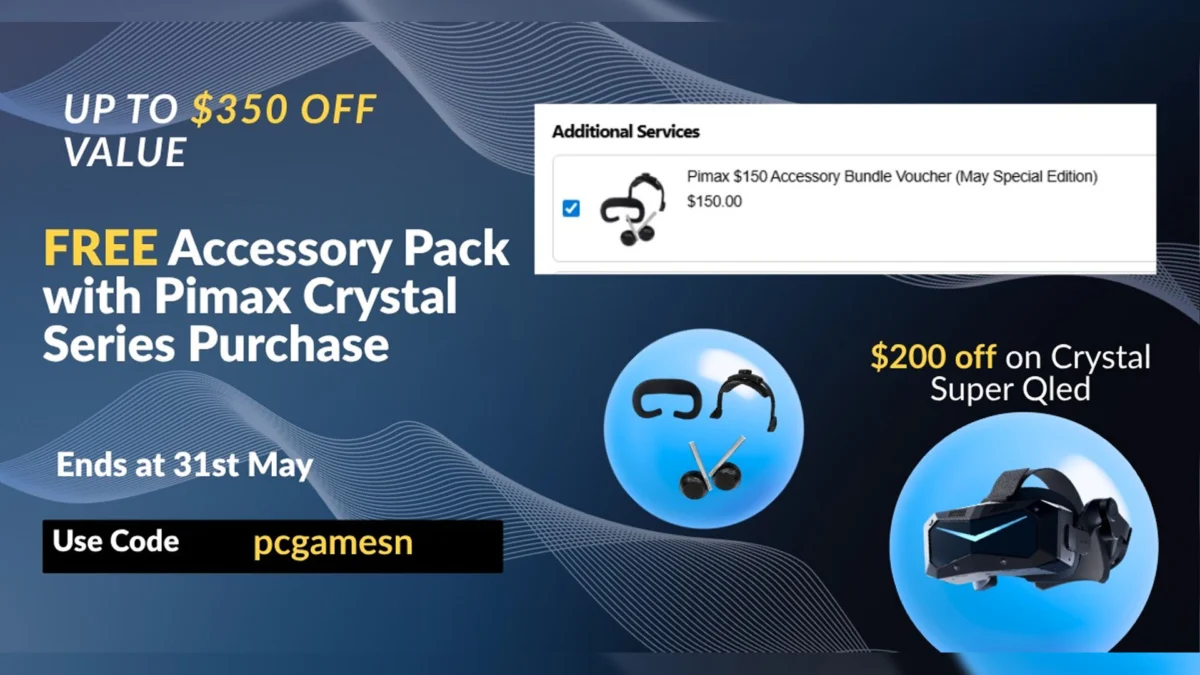
Today, we are excited to announce an exclusive collaboration with Pimax that significantly lowers the cost of entry for two of the most formidable VR headsets on the market. By utilizing the code pcgamesn at checkout, customers can secure a 2% discount on the Pimax Crystal Light and Crystal Super, alongside an exclusive $150 accessory bundle—entirely free of charge.
The Main Facts: What the Deal Includes
The promotion is designed to reward users who are ready to graduate from entry-level hardware to the "enthusiast grade" experience. By entering the discount code pcgamesn during the checkout process on the official Pimax store, buyers will trigger two distinct benefits:
- Direct Price Reduction: A 2% discount applied to the current retail price. While 2% may seem modest, when applied to high-end hardware, it represents meaningful savings. For the Crystal Super, currently priced at $1,599, the code shaves $32 off the total. For the Crystal Light, priced at $899, it provides an $18 reduction.
- The $150 Accessory Bundle: The true value of this offer lies in the "Pimax $150 Accessory Bundle Voucher (May Special Edition)." When added to your cart alongside your headset, this code unlocks a trio of premium upgrades: a comfort top strap for extended sessions, high-fidelity DMAS earphones, and an Ice Silk facial foam interface.
This promotion is a global initiative, meaning enthusiasts worldwide can access these terms, provided they act before the promotion concludes at the end of May.
Chronology: The Evolution of Pimax’s High-Fidelity Vision
To understand why this offer is significant, one must look at the trajectory of Pimax within the VR ecosystem. Pimax has long positioned itself as the "performance-first" alternative to the mass-market headsets dominated by Meta and Pico.
- The Early Days: Pimax gained notoriety for its ultra-wide field-of-view (FOV) headsets, which targeted flight simulator enthusiasts and hardcore sim-racers who required peripheral vision that mainstream headsets simply could not provide.
- The Crystal Era: The introduction of the original Pimax Crystal set a new benchmark for pixel density. By prioritizing high-resolution glass lenses and local dimming displays, Pimax successfully bridged the gap between consumer VR and professional-grade industrial simulation hardware.
- Refining the Lineup: In 2024 and 2025, Pimax bifurcated its offerings. The Crystal Light was introduced as a streamlined, PC-tethered iteration, removing the bulk of mobile processing to focus purely on display quality. The Crystal Super was launched as the flagship, pushing the absolute limits of display resolution and optical clarity, effectively rendering older headsets like the Valve Index obsolete in terms of raw visual fidelity.
- The Present: With this current promotion, Pimax is clearly aiming to capture the market segment currently using mid-tier headsets who are looking for a "generational leap" in visual sharpness without having to pay the full MSRP for the necessary comfort and audio accessories that make these devices truly usable for long sessions.
Supporting Data: Why Pixel Density Matters
The argument for upgrading to a Pimax headset is rooted firmly in the physics of light and resolution. When we compare the Crystal Super and the Crystal Light to current market leaders, the data reveals a stark disparity.
The Resolution Gap
The Meta Quest 3, widely considered the gold standard for consumer-grade VR, offers a resolution of 2,064 x 2,208 per eye. While this is a respectable figure for a standalone device, it pales in comparison to the Pimax Crystal Super, which delivers an staggering 3,840 x 3,840 resolution per eye.
This translates to a figure of 57 pixels per degree (PPD). In the world of optics, PPD is the ultimate metric for "clarity." It essentially measures how many pixels the eye sees in one degree of its field of vision. Anything approaching 60 PPD is widely considered "retina" resolution, where the human eye can no longer discern individual pixels. The Crystal Super is arguably the first consumer headset to reach this threshold, making text legibility and cockpit instrument reading in flight simulators feel as natural as reading a physical screen.
The Crystal Light Advantage
For those who do not require the absolute ceiling of the Crystal Super, the Crystal Light offers a 2,880 x 2,880 resolution per eye. While lower than the Super, it still vastly outperforms the industry standards, providing a level of sharpness that makes "screen-door effect"—the visible grid of pixels common in early VR—a thing of the past.
Official Responses and Strategic Positioning
In statements accompanying the launch of these new headsets, Pimax representatives have emphasized that their target audience is not the casual "pick-up-and-play" user, but the "prosumer."

"Our hardware is built for those who view VR as a primary platform, not a secondary novelty," a Pimax spokesperson noted during the launch phase of the Crystal Super. "By moving away from mobile chipsets and focusing entirely on DisplayPort-tethered PCVR, we remove the constraints of battery life and thermal throttling. The result is an uncompromised visual experience."
The inclusion of the $150 accessory bundle is a strategic response to user feedback. Early adopters of high-end headsets often noted that while the visual hardware was perfect, the out-of-box comfort and audio could be improved. By bundling the DMAS (Digital Master Audio System) earphones and the Ice Silk foam, Pimax is essentially "pre-tuning" the experience for the user, ensuring that the out-of-box experience meets the expectations set by the premium price tag.
Implications for the VR Industry
What does this promotion tell us about the current state of the VR industry?
The Shift Toward PC-Tethered Quality
While the industry at large has been obsessed with "standalone" VR (headsets that don’t need a computer), there has been a notable resurgence in the demand for tethered PCVR. As gaming PCs continue to grow in power, users are becoming increasingly frustrated by the compression artifacts and latency introduced by streaming wireless VR. Pimax’s focus on uncompressed, high-bandwidth PCVR signals that there is a growing, lucrative segment of the market that values quality over the freedom of movement.
The Accessory Ecosystem
The success of these headsets is becoming increasingly dependent on the ecosystem of accessories. Modern VR users treat their headsets like modular PCs; they want to swap out face plates, upgrade audio, and change head straps. By offering these as a "free bundle," Pimax is acknowledging that comfort is just as important as resolution. If a user can’t wear the headset for more than an hour due to weight distribution or heat, the resolution is irrelevant.
Competition and Market Pressure
This promotion puts significant pressure on other manufacturers. When a high-end headset like the Crystal Light is available with added value, it forces competitors to re-evaluate their pricing strategies. For the consumer, this is a win-win scenario. Whether you decide to invest in the Pimax ecosystem or stick with your current device, the presence of these high-performance options keeps the pressure on manufacturers to keep innovating.
Conclusion: Is the Upgrade Worth It?
If you are a casual user who plays VR once a week, the Crystal series might be overkill. However, if you spend your evenings in Microsoft Flight Simulator, DCS World, or iRacing, the leap from a standard headset to the 57 PPD clarity of a Pimax Crystal Super is not just an upgrade; it is a transformation.
The requirement for a powerful gaming PC is real—these headsets are not for the faint of heart or low-spec hardware—but for those who have already invested in a high-end GPU (such as an RTX 4080 or 4090), the Pimax Crystal series is the only way to fully unlock the potential of your machine.
With the current promotion running until the end of May, you have a limited window to secure the $150 accessory bundle and the 2% discount. By leveraging the code pcgamesn, you aren’t just buying a headset; you are investing in the most immersive visual experience currently available to the consumer market. Whether you choose the accessible brilliance of the Crystal Light or the retina-shattering resolution of the Crystal Super, you are positioning yourself at the very bleeding edge of virtual reality technology.
Don’t forget: The promotion expires at the end of May. For more detailed technical breakdowns, you can read our comprehensive reviews of the Pimax Crystal Super and the Pimax Crystal Light to ensure you make the right choice for your specific simulation needs.












No comments yet. Be the first to join the conversation!