Layla Zulfa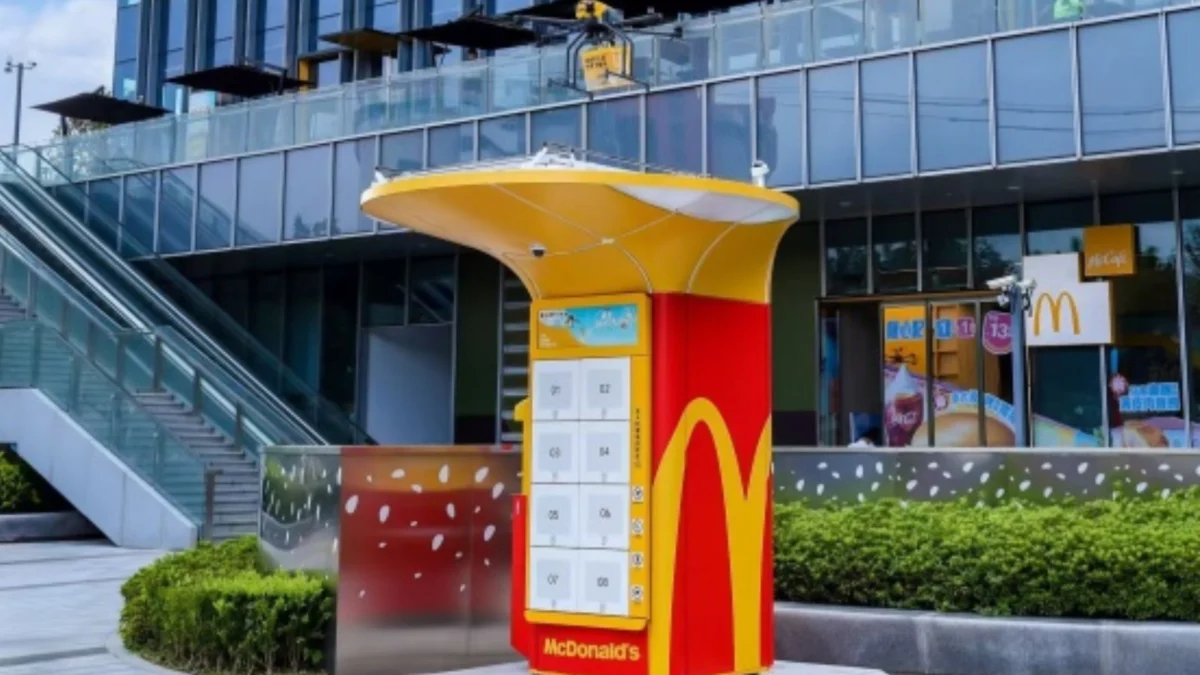
The future of fast food is no longer confined to the asphalt of urban streets or the backseats of delivery scooters. In a landmark development for the global quick-service restaurant (QSR) industry, McDonald’s has officially taken to the skies. As of September 10, 2026, the Golden Arches has launched its first dedicated drone delivery route in Shanghai, China, in partnership with the local tech giant Meituan. This move represents a paradigm shift in logistics, promising to slash delivery times to as little as 10 minutes and signaling a new era of automated urban convenience.
Main Facts: The Anatomy of a High-Speed Delivery
The service, which debuted in Shanghai’s bustling West Bund district, is the result of a strategic collaboration between McDonald’s China and the e-commerce titan Meituan. The inaugural flight—a symbolic mission carrying a Big Mac meal—traversed the distance between the Longteng Avenue restaurant and a specialized collection terminal at the West Bund Skatepark.
Unlike experimental drone projects that aim for doorstep delivery, this system utilizes a "hub-to-hub" model. Customers place their orders through the Meituan app, selecting from a curated menu of over 30 items, including signature burgers, sides, McCafé beverages, and the iconic McFlurry. Once an order is placed, it is prepared by kitchen staff and carried to an external "smart drone port." There, an automated robotic arm secures the cargo into the drone, which then executes a pre-programmed flight path to a secure collection station. To retrieve their meal, customers simply scan a QR code at the station, ensuring a seamless, touchless, and highly efficient handoff.
Chronology: From Concept to Takeoff
The journey to this milestone has been years in the making, reflecting the rapid maturation of autonomous aerial vehicle (AAV) technology in China.
- Pre-2026: Meituan spent years building its urban drone logistics network, refining safety protocols and navigating the complex regulatory landscapes of cities like Beijing, Shenzhen, and Guangzhou.
- Early 2026: McDonald’s China began evaluating the potential of aerial delivery to mitigate the "last-mile" challenges of dense urban environments, where traffic congestion often results in cold food and long wait times.
- September 10, 2026: The official launch date. The first successful commercial flight occurred in the West Bund district, marking the debut of the first drone route created specifically for a restaurant brand in China.
- Late 2026 (Projections): Meituan and McDonald’s have announced plans to scale the service, with expectations that the number of supported restaurant brands on the West Bund network will rise from 20 to over 40 by the end of the year.
Supporting Data: Efficiency and Technology
The technical backbone of this operation is Meituan’s fourth-generation drone fleet. These aircraft are designed not just for speed, but for the rigorous demands of urban safety and weather resilience.

Payload and Speed
Each drone is capable of carrying a payload of approximately 5.2 pounds (roughly 2.3 kilograms). While this may seem modest, it is meticulously calculated to handle the vast majority of consumer orders, including family-sized combinations of burgers, fries, and drinks. Under optimal flight conditions, the drones can complete their transit in roughly 10 minutes—a significant improvement over the average 25-to-40-minute wait times associated with traditional bicycle or scooter couriers in congested Shanghai.
Safety Protocols
The safety of pedestrians and the integrity of the food are paramount. The fourth-generation drones are equipped with:
- Nighttime Visual Positioning: Allowing for operation in low-light conditions.
- Advanced Obstacle Avoidance: Utilizing LiDAR and optical sensors to navigate around cranes, trees, and buildings.
- Emergency Landing Systems: Built-in safeguards that trigger in the event of a mechanical failure, ensuring the drone can descend safely away from public crowds.
To date, the Meituan network has completed over one million commercial drone orders across major metropolitan hubs, including Shanghai, Beijing, Guangzhou, Shenzhen, Hong Kong, and even international markets like Dubai.
Official Responses and Strategic Intent
McDonald’s has framed this initiative as a direct response to the evolving expectations of the modern consumer. In a statement released on their official Chinese corporate portal, the company emphasized that this partnership is part of a broader commitment to digital innovation and customer experience. By removing the unpredictability of road traffic, McDonald’s aims to ensure that their food arrives at the peak of freshness.
Meituan, for its part, views this as a validation of its "low-altitude economy" strategy. By integrating drone ports into the infrastructure of city districts, Meituan is positioning itself as the primary logistics provider for a future where the sky is as busy as the street. Industry analysts suggest that this partnership is a "win-win": McDonald’s gains a competitive edge in delivery speed and brand prestige, while Meituan secures a high-volume anchor tenant to prove the viability of its proprietary delivery ecosystem.

The Global Implications: A Crowded Sky
The move in Shanghai is part of a wider, global race toward automated logistics. As McDonald’s pushes boundaries in China, other major players are accelerating their own aerial strategies.
The Competitive Landscape
- The Pizza Wars: Papa Johns and Little Caesars have both recently entered the aerial fray, testing drone delivery to capture the "hot-and-ready" market.
- Chipotle’s "Zipotle": In Texas, Chipotle has experimented with its "Zipotle" program, utilizing drones to bypass suburban sprawl, proving that the tech is applicable in lower-density environments as well.
- The Delivery Giants: DoorDash has launched "DoorDash Air," a direct challenge to the logistics dominance of Amazon and Walmart. By building infrastructure that can be used by various merchants, these platforms are shifting the power dynamic of food delivery away from the restaurants themselves and toward the tech companies that control the sky.
Challenges to Mass Adoption
Despite the excitement, several hurdles remain. The most significant is the regulatory landscape. While China has been proactive in creating "low-altitude" flight corridors, other nations are moving more cautiously. Concerns regarding noise pollution, privacy, air traffic management, and the potential for mid-air collisions remain at the forefront of policy debates in the United States and Europe.
Furthermore, there is the question of the "human element." While drones provide speed, they lack the personal service of a human courier. The reliance on centralized collection points rather than doorstep delivery also limits the convenience factor for some consumers, particularly those with limited mobility or those living in high-rise buildings where a trip to a "collection point" might be as time-consuming as walking to a nearby kiosk.
Conclusion: The Horizon of Convenience
The successful deployment of McDonald’s drone route in Shanghai is more than just a tech-forward publicity stunt; it is a proof-of-concept that will likely influence urban planning for the next decade. As the world becomes increasingly urbanized, the traditional model of delivery—relying on a human on a scooter—is hitting its limits.
The "10-minute" promise is the new gold standard. Whether this model can scale to cover entire megalopolises or whether it remains a niche luxury for dense, tech-savvy districts remains to be seen. However, as of September 2026, the message is clear: the path to your next meal is no longer just down the road—it is directly overhead. As more brands join the Meituan network and as other global logistics giants refine their own aerial fleets, we are witnessing the birth of a third dimension in retail logistics. The future of dining is not just on the table; it is in the air.


 Sagoh
Sagoh
 Evan Lee Salim