Pevita Pearce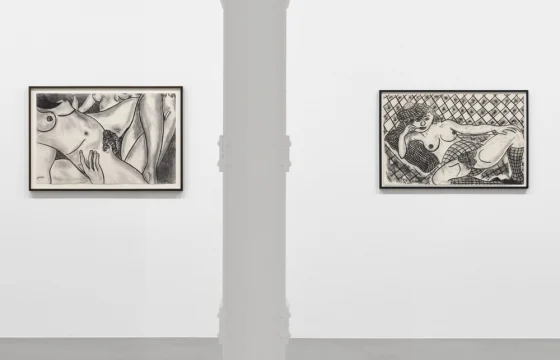
Galerie Max Hetzler in Berlin has unveiled X-Rated (1972–1974), a definitive solo exhibition dedicated to the provocative paintings and works on paper by William N. Copley. Marking the gallery’s fourth major presentation of the artist’s oeuvre, the exhibition will remain open to the public through April 22, 2026. This retrospective serves as a timely reappraisal of one of the 20th century’s most unconventional artists—a man who navigated the elite circles of Surrealism, the gritty reality of underground pornography, and the burgeoning aesthetic of Pop Art to forge a singular, subversive visual language.
A Life of Surrealist Proximity: The Evolution of CPLY
To understand the X-Rated series, one must first understand the man behind the pseudonym. Born into a world of traditional expectations, William N. Copley—who would later sign his work simply as "CPLY"—approached the canvas not as a trained technician, but as a literary-minded observer of the human condition.
Before his brush touched the canvas in earnest, Copley’s ambitions were rooted in the written word. However, his trajectory shifted dramatically in the late 1940s when he co-founded the Copley Galleries in Beverly Hills alongside his brother-in-law, the artist John Ployardt. This brief but seismic venture placed Copley at the epicenter of the avant-garde. The gallery became a sanctuary for European Surrealists fleeing the ravages of World War II. Copley found himself in the company of titans: Man Ray, Max Ernst, and Marcel Duchamp.
It was the dealer Alexander Iolas who famously encouraged Copley to transition from a facilitator of art to a practitioner. By 1951, as his gallery shuttered, Copley moved to France, fully embracing his new identity. Though he was a generation younger than the Surrealist masters, he adopted their ethos of humor, psychological depth, and, crucially, an uninhibited engagement with eroticism. While his peers utilized symbolism to veil desire, Copley would eventually strip away the veil entirely.
Chronology of a Controversial Series
The X-Rated series, produced between 1972 and 1975, stands as the crowning achievement of this trajectory.
- 1972–1974: The genesis of the series. During an era when hardcore pornography remained legally precarious in the United States, Copley began sourcing imagery from "adult" magazines, purchased under the counter. He sought, as he famously articulated, to "break through the barrier of pornography into the area of joy."
- 1974: The series makes its public debut at the New York Cultural Center. Under the progressive directorship of Mario Amaya, the exhibition defied the moralistic headwinds of the decade.
- 1975: Finalization of the series’ themes and compositions.
- Present Day: Galerie Max Hetzler facilitates a comprehensive survey of these works, re-contextualizing them for a 21st-century audience accustomed to a digital saturation of sexual imagery.
The Anatomy of the “X-Rated” Aesthetic
The visual language of the X-Rated works is a deliberate tension between the crude and the calculated. Copley’s process was rigorous despite the "slapdash" appearance of the finished products. He typically executed two stages of preparatory drawings: a small, foundational study followed by a larger, dynamic refinement.
The exhibition at Galerie Max Hetzler masterfully highlights this process, pairing finished paintings—such as the vibrant Calcutta (1973)—with their corresponding preparatory sketches. This juxtaposition allows viewers to witness how Copley moved from initial observation to the final, expressive composition.
Critics have long noted the "Matisse-like" quality of these works—the attenuated limbs, the bold black outlines, and the flat, brightly colored backgrounds that eschew traditional depth. However, while Matisse used the female nude as a vessel for classical beauty, Copley used it as a narrative device for slapstick humor and existential questioning. As critic James R. Mellow astutely observed, the backgrounds are often so decorative and geometrically vibrant that they render the sexual acts depicted "too artful to be libidinous."
Supporting Data: The Power of Context
A defining feature of the X-Rated series is its use of irony. Copley titled his paintings after popular Hollywood films, such as The Exorcist, Tobacco Road, and Les Quatre Cent Coups. This choice was a classic Surrealist "disjunction"—the titles rarely, if ever, describe the content of the image. Instead, they force the viewer into a state of cognitive dissonance, setting off a cascade of associations between the "high art" of cinema and the "low art" of adult magazines.
The term "X-Rated" itself—a film classification used in the US for adult-only features until the 1990s—acts as a framing device. It warned of the content but, in the hands of Copley, the warning was a gateway to a playful, if subversive, investigation of sexual politics.
Official Responses and Historical Reception
When the X-Rated collection first debuted at the New York Cultural Center in 1974, the atmosphere was fraught with potential for public outcry. Yet, the critical reception was surprisingly, and notably, positive.
Peter Schjeldahl, writing for Art in America, praised the show as "uniformly gorgeous," characterizing it as a significant and satisfying evolution in the artist’s career. The success of the show was largely attributed to the curatorial courage of Mario Amaya, who shielded the work from the conservative gatekeepers of the time. By elevating the work into the institutional sphere, Amaya and Copley proved that the "pornographic" could, through the lens of a sophisticated painter, be transformed into a legitimate subject of fine art.
Implications: The Subversive Charge Today
In our current era—where the internet has made explicit imagery ubiquitous and the boundaries of "appropriate" content are constantly being redrawn—one might ask if Copley’s work retains its sting.
The answer provided by the Galerie Max Hetzler exhibition is an emphatic "yes." The subversive charge of Copley’s work does not stem from the shock of the sexual act itself, but from his rejection of moralistic constraints. By stripping away the shame often associated with the pornographic, Copley championed the "endless possibilities for originality" that he believed characterized human sexuality.
Copley’s work remains a reminder that the artist’s role is not to maintain a neutral or "safe" space, but to challenge the cultural barriers that dictate what is "fit to be seen." By blending the grit of the newsstand with the elegance of the easel, Copley forced his audience to confront the absurdity of their own inhibitions.
As visitors walk through the Berlin exhibition, they are not merely looking at historical artifacts of the 1970s. They are engaging with a manifesto on freedom. Copley’s X-Rated series serves as a testament to the idea that joy, humor, and curiosity are the ultimate antidotes to the rigidity of cultural dogma. In a world that is increasingly polarized and sensitive, Copley’s unabashedly direct and humor-filled exploration of the human form feels not only relevant but necessary. The exhibition at Galerie Max Hetzler stands as a vital bridge, connecting the underground experiments of the past to the complex, image-saturated reality of the future.


 Asro
Asro
 Reynand Wu