

Main Facts: The Final Docking
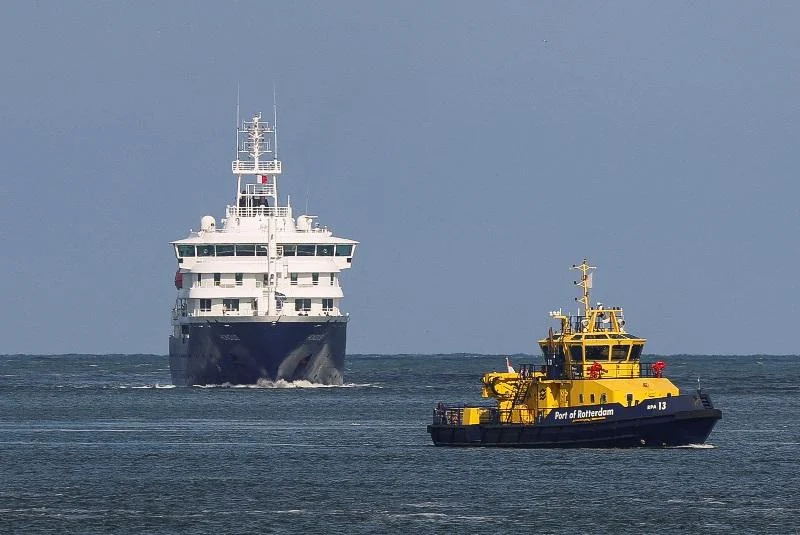
The MV Hondius, a luxury expedition cruise vessel at the epicenter of a rare and lethal hantavirus outbreak, finally reached the Dutch port of Rotterdam this Monday. The arrival marks the end of a harrowing weeks-long ordeal that left three passengers dead and dozens of others under intense medical scrutiny.
As the ship docked at the isolated Landtong peninsula—a 10-kilometer stretch of industrial port infrastructure far removed from the Rotterdam city center—authorities commenced a controlled, phased disembarkation of the final 27 individuals on board. This group included the skeleton crew of 25 staff and two specialized medical personnel who had been tending to the sick during the vessel’s journey.
The vessel, operated by Oceanwide Expeditions, is now slated for a rigorous, week-long deep-cleaning process. Specialized decontamination teams, clad in full-body hazardous material suits, will meticulously scrub every surface of the ship, with particular attention paid to the ventilation systems and the cabins previously occupied by those who tested positive for the Andes virus—a rare, virulent strain of hantavirus.
Chronology of the Crisis
The tragedy began to unfold in early May, as the MV Hondius navigated waters toward Cape Verde. On May 2, the ship’s medical staff alerted the World Health Organization (WHO) to a cluster of severe respiratory illnesses manifesting among the 150 passengers and crew, who hailed from 23 different nations.
- May 2: Initial reports of a respiratory outbreak were transmitted to the WHO.
- Early May: The vessel was denied entry at its intended final destination, Cape Verde, leaving the ship and its passengers effectively stranded in international waters.
- Mid-May: Following urgent intervention by the WHO and European Union authorities, the Spanish government facilitated a partial evacuation of passengers at the Canary Islands.
- Late May: The MV Hondius, now operating with a skeleton crew and bolstered by two additional medical professionals, departed for the Netherlands.
- Monday: The ship docked in Rotterdam, where the final personnel were offloaded into mobile quarantine units.
The human toll of this outbreak has been sobering. Three individuals have succumbed to the virus. While the remains of two Dutch nationals have already been repatriated to their families, the body of a German victim remains in the Netherlands, awaiting cremation. Her ashes are expected to be returned to Germany in the coming days.
Supporting Data: Understanding the Andes Virus
The outbreak aboard the MV Hondius has been identified by health authorities as the "Andes virus," a specific and dangerous strain of hantavirus that has historically circulated in parts of Argentina and Chile. Unlike more common strains of the virus, the Andes virus is recognized for its potential—though rare—to be transmitted from person to person.
Transmission and Incubation
Hantaviruses are primarily zoonotic, typically spread through contact with the excreta of infected rodents. However, the Andes strain is the only member of the hantavirus family known to possess the ability to jump between humans, particularly following prolonged, close contact in confined spaces—a reality that exacerbated the situation on a cruise ship.
The incubation period for the virus is notoriously long, lasting approximately six weeks. This latency period has forced health agencies across the globe to implement wide-reaching quarantine measures, as individuals who appeared healthy upon leaving the ship could still potentially develop symptoms.
According to the WHO, the current tally stands at eight confirmed cases and two "probable" cases, in addition to the three confirmed fatalities. The Dutch National Institute for Public Health and the Environment (RIVM) has emphasized that as of the ship’s arrival in Rotterdam, none of the remaining crew members were symptomatic.
Official Responses and Public Safety
The arrival of the MV Hondius in Rotterdam was managed with extreme caution. The Landtong peninsula, where the ship docked, was cordoned off with high fencing, and a series of white trailers were established to serve as isolation quarters for the crew.
The RIVM Stance
Tjalling Leenstra, head of the Dutch coordination center for communicable disease control at RIVM, sought to calm public fears. "There is no risk for Rotterdam and no risk in that sense," Leenstra stated during a press briefing. He was firm in his assertion that the current situation bears no resemblance to the COVID-19 pandemic, emphasizing that hantavirus transmission requires a level of physical proximity that is easily mitigated through standard quarantine protocols.
Yvonne van Duijnhoven, director of the GGD Rotterdam-Rijnmond municipal health service, outlined the logistical plan for the crew. Two Dutch crew members were cleared to return to their homes under strict self-isolation, while the majority of the staff—many of whom are Filipino nationals—were relocated to the mobile housing units on the peninsula. These units are designed to monitor the health of the staff throughout the remainder of the six-week incubation window.
WHO’s Assessment
The World Health Organization has maintained a consistent message: the wider threat to public health remains low. The organization’s response has focused on containment and contact tracing, ensuring that anyone who interacted with the ship’s occupants in recent weeks is accounted for and monitored. The WHO continues to coordinate with health ministries in the various countries where passengers disembarked, ensuring a unified global response to prevent further transmission.
Implications: The Future of Expedition Cruises
The grounding of the MV Hondius raises significant questions regarding the safety protocols of remote expedition cruising. As companies push further into isolated territories, the logistical challenges of managing a medical crisis hundreds of miles from a hospital are becoming increasingly apparent.
Decontamination Protocols
The cleaning process, which could take upwards of a week, serves as a grim reminder of the environmental persistence of the virus. RIVM spokesperson Coen Berends explained that the operation is highly specialized. "They wear protective clothing and clean all surfaces in the ship, including the ventilation systems, and each room is assessed individually," Berends said. Cabins where the Andes virus was confirmed are being treated as high-risk bio-hazard zones.
Economic and Legal Repercussions
For Oceanwide Expeditions, the incident carries significant legal and financial weight. The firm is now tasked with managing the repatriation of the remaining crew, the costs of the quarantine facilities, and the massive bill for the industrial-grade decontamination of their vessel. Furthermore, the incident will likely trigger a review by international maritime bodies regarding health and sanitation requirements for small-vessel expedition operators.
A Global Watch
While the situation in Rotterdam appears to be under control, the global health community remains on high alert. The unique characteristics of the Andes virus mean that until the final quarantine period expires for every individual associated with the MV Hondius, the risk of a late-onset case cannot be entirely dismissed.
As the ship sits quietly in the industrial expanse of the Rotterdam port, the focus has shifted from containment to recovery. The tragedy of the MV Hondius serves as a stark reminder of the unpredictable nature of viral outbreaks and the vital importance of international cooperation in the face of rare, high-stakes medical emergencies. For now, the world waits for the final, silent period of incubation to pass, hoping that the death toll on the Hondius does not rise beyond the three souls already lost to the sea.
© Thomson Reuters 2026.












No comments yet. Be the first to join the conversation!