Lina Hope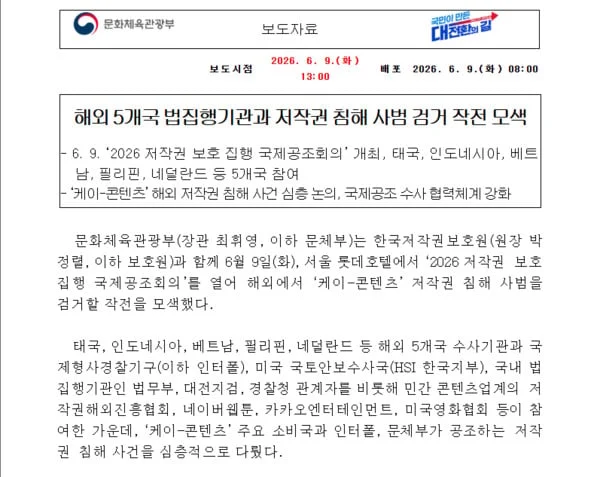
Seoul, South Korea – June 19, 2026 – In a decisive move to safeguard the burgeoning global popularity of South Korean entertainment, the Ministry of Culture, Sports and Tourism (MCST) hosted a pivotal international enforcement conference in Seoul on June 9, 2026. The "2026 International Copyright Protection Enforcement Conference" brought together a formidable coalition of law enforcement agencies from five key Asian nations, the international policing organization Interpol, and representatives from U.S. Homeland Security Investigations (HSI) to forge a united front against the escalating tide of K-content piracy.
The high-stakes meeting, held at the prestigious Lotte Hotel Seoul, underscored the critical need for enhanced global cooperation in combating sophisticated, cross-border copyright infringement that threatens the economic viability and creative integrity of South Korea’s cultural exports. The conference’s agenda was robust, focusing on the strategic exchange of intelligence, the coordination of joint operational efforts, and the amplification of ongoing international investigations, particularly those under Interpol’s critical "Stop Online Piracy" (I-SOP) initiative.
The Growing Threat to K-Content
South Korean popular culture, broadly known as K-content, has experienced an unprecedented surge in global demand over the past decade. From the captivating narratives of K-dramas and the infectious beats of K-pop to the visually stunning worlds of webtoons and the innovative gameplay of K-games, these cultural products have captivated audiences worldwide. However, this meteoric rise has also made K-content a prime target for copyright infringement, with illegal streaming sites, unauthorized download platforms, and the illicit distribution of digital assets costing the industry billions of dollars annually.
The economic implications of piracy extend far beyond lost revenue. It undermines the investment made by creators and production companies, potentially stifling future innovation and the development of new talent. Furthermore, it erodes the perceived value of legitimate content, making it harder for artists and rights holders to monetize their work and sustain their careers. The MCST, recognizing these profound threats, has prioritized the establishment of a robust international framework to protect its cultural assets.
A Unified Front: Participants and Objectives
The "2026 International Copyright Protection Enforcement Conference" was a testament to the seriousness with which this issue is being treated on a global scale. The gathering saw key representatives from law enforcement agencies of Thailand, Indonesia, Vietnam, the Philippines, and the Netherlands, alongside delegates from Interpol and the U.S. Homeland Security Investigations (HSI) Korea office. This diverse group of international law enforcement bodies was joined by crucial Korean authorities, including officials from the Ministry of Justice, prosecutors, and the national police force.
The presence of major private-sector stakeholders, such as Naver WEBTOON and Kakao Entertainment, was equally significant. These industry leaders, at the forefront of K-content creation and distribution, brought invaluable insights into the evolving tactics of pirates and the practical challenges faced by rights holders. Their participation ensured that the discussions were grounded in real-world experiences and that the proposed solutions were actionable and impactful.
The primary objectives of the conference were multifaceted:
- Sharing Enforcement Strategies: Delegates exchanged best practices and innovative strategies employed by their respective agencies in identifying, investigating, and prosecuting copyright infringers. This included discussions on digital forensics, intelligence gathering, and the legal frameworks necessary for effective enforcement.
- Coordinating Joint Operations: The conference served as a crucial platform for planning and coordinating collaborative operations aimed at dismantling pirate networks operating across national borders. The aim was to move beyond individual efforts and towards synchronized, impactful actions that could disrupt the entire supply chain of illegal K-content.
- Strengthening International Investigations: A significant focus was placed on the ongoing international investigations under Interpol’s "Stop Online Piracy" (I-SOP) initiative. This initiative provides a vital framework for cross-border collaboration, enabling law enforcement agencies to share information and resources more effectively in their pursuit of online pirates.
- Fostering Public-Private Collaboration: Recognizing that effective copyright protection requires a united front, the conference emphasized the importance of seamless collaboration between government agencies and the private sector. This partnership is essential for sharing intelligence, developing technological solutions, and raising public awareness about the consequences of piracy.
Chronology of Engagement
The MCST’s commitment to combating K-content piracy is not a new development. This conference represents a culmination of years of increasing engagement and recognition of the global nature of the problem.

- Early Recognition (Pre-2020s): As K-content began its ascent, initial efforts to combat piracy were largely national and reactive. While some international cooperation existed, it lacked the strategic coordination seen today.
- Growing Urgency (Early 2020s): The exponential growth of K-content’s global reach, coupled with the proliferation of sophisticated online piracy methods, led to a more urgent call for international action. Governments and industry bodies began to highlight the economic and cultural impact of unchecked infringement.
- Initiation of Formal Dialogues (Mid-2020s): Bilateral and multilateral discussions on copyright protection became more frequent. The MCST, in particular, began actively seeking stronger partnerships with countries that were both significant markets for K-content and important transit or operational hubs for piracy networks.
- The "Stop Online Piracy" Initiative (Ongoing): Interpol’s I-SOP initiative has provided a crucial, ongoing framework for international cooperation. The Seoul conference served as a critical in-person reinforcement of the principles and operational objectives of I-SOP.
- The 2026 Seoul Conference (June 9, 2026): This landmark event solidified existing partnerships and forged new commitments, marking a significant step forward in the organized, global fight against K-content piracy.
Supporting Data and Evidence
The urgency of the MCST’s initiative is underscored by mounting evidence of the pervasive nature of K-content piracy. While precise global figures are challenging to quantify definitively due to the clandestine nature of illicit operations, various reports and industry analyses paint a stark picture:
- Lost Revenue Estimates: Industry estimates suggest that global piracy of K-content results in billions of dollars in lost revenue annually. This figure encompasses not only direct sales but also advertising revenue, licensing fees, and the economic impact on related industries such as tourism and merchandise.
- Prevalence of Illicit Platforms: A significant number of illegal streaming and download websites continue to operate, often masked by domain name changes and server hopping. Many of these platforms are hosted in regions with less stringent copyright enforcement, making them difficult to shut down.
- Impact on Specific Content Types: Webtoons, in particular, have been heavily targeted, with entire series being illegally translated and distributed, depriving creators and publishers of legitimate readership and revenue. Similarly, unauthorized streams of K-dramas and K-pop concerts remain a persistent problem.
- Technological Sophistication: Pirates are increasingly using advanced technologies, including sophisticated encryption and content delivery networks, to evade detection and distribution. This necessitates an equally sophisticated and collaborative response from law enforcement.
- The Role of Social Media: Social media platforms, while vital for legitimate promotion, are also exploited for the unauthorized sharing and promotion of pirated content, further complicating enforcement efforts.
Official Responses and Commitments
The Ministry of Culture, Sports and Tourism reiterated its unwavering commitment to protecting the rights of its creative industries. In a statement following the conference, an MCST representative emphasized:
"Cross-border copyright crimes are a complex and evolving challenge that demands a coordinated and robust global response. The success of K-content is a source of national pride and a significant economic driver. We cannot afford to let piracy undermine the hard work and creativity of our artists and industries. This conference marks a crucial step in strengthening our investigative network and operational capabilities with our international partners. We are committed to sustained collaboration and decisive action to ensure a fair and protected environment for the global dissemination of Korean cultural products."
Interpol officials present at the conference highlighted the importance of such high-level engagements in fostering trust and facilitating practical cooperation. The U.S. HSI Korea office reaffirmed its dedication to working with its international counterparts to disrupt criminal organizations involved in intellectual property theft.
The participating countries, through their law enforcement delegates, expressed their commitment to:
- Enhanced Information Sharing: Establishing more direct and efficient channels for sharing intelligence on pirate networks and illegal activities.
- Joint Investigations and Operations: Committing resources and personnel to planned and executed joint operations targeting transnational piracy rings.
- Legal and Policy Harmonization: Exploring opportunities to align legal frameworks and enforcement procedures where possible to streamline cross-border investigations.
- Capacity Building: Supporting initiatives that enhance the technical and investigative capabilities of partner agencies in combating digital piracy.
Implications and Future Outlook
The "2026 International Copyright Protection Enforcement Conference" is more than just a meeting; it signifies a pivotal shift towards a more proactive and globally integrated approach to copyright protection for K-content. The implications of this strengthened alliance are far-reaching:
- Deterrence of Piracy: A more coordinated and visible international effort is expected to act as a significant deterrent to potential pirates, increasing the risk of apprehension and prosecution.
- Increased Revenue for Creators: By mitigating the economic losses caused by piracy, creators and content companies will be better positioned to reinvest in new productions, fostering a more sustainable and vibrant K-content ecosystem.
- Enhanced Global Reputation: The successful protection of K-content will further solidify South Korea’s reputation as a global leader in creative industries, encouraging further international investment and collaboration.
- Strengthened International Relations: The collaborative nature of this initiative fosters stronger diplomatic ties and mutual understanding between participating nations, extending beyond the realm of copyright protection.
- A Blueprint for Other Industries: The strategies and partnerships forged in the fight against K-content piracy could serve as a valuable blueprint for other creative industries facing similar challenges.
Looking ahead, the MCST and its international partners are expected to focus on the operationalization of the commitments made at the Seoul conference. This will likely involve regular follow-up meetings, joint training exercises, and the establishment of dedicated task forces to address emerging piracy threats. The ongoing success of K-content hinges on the continued vigilance and collaborative spirit of this burgeoning global alliance. The fight against piracy is a marathon, not a sprint, and the 2026 Seoul conference has undoubtedly provided a significant boost to the runners.


 Pevita Pearce
 Nana Wu