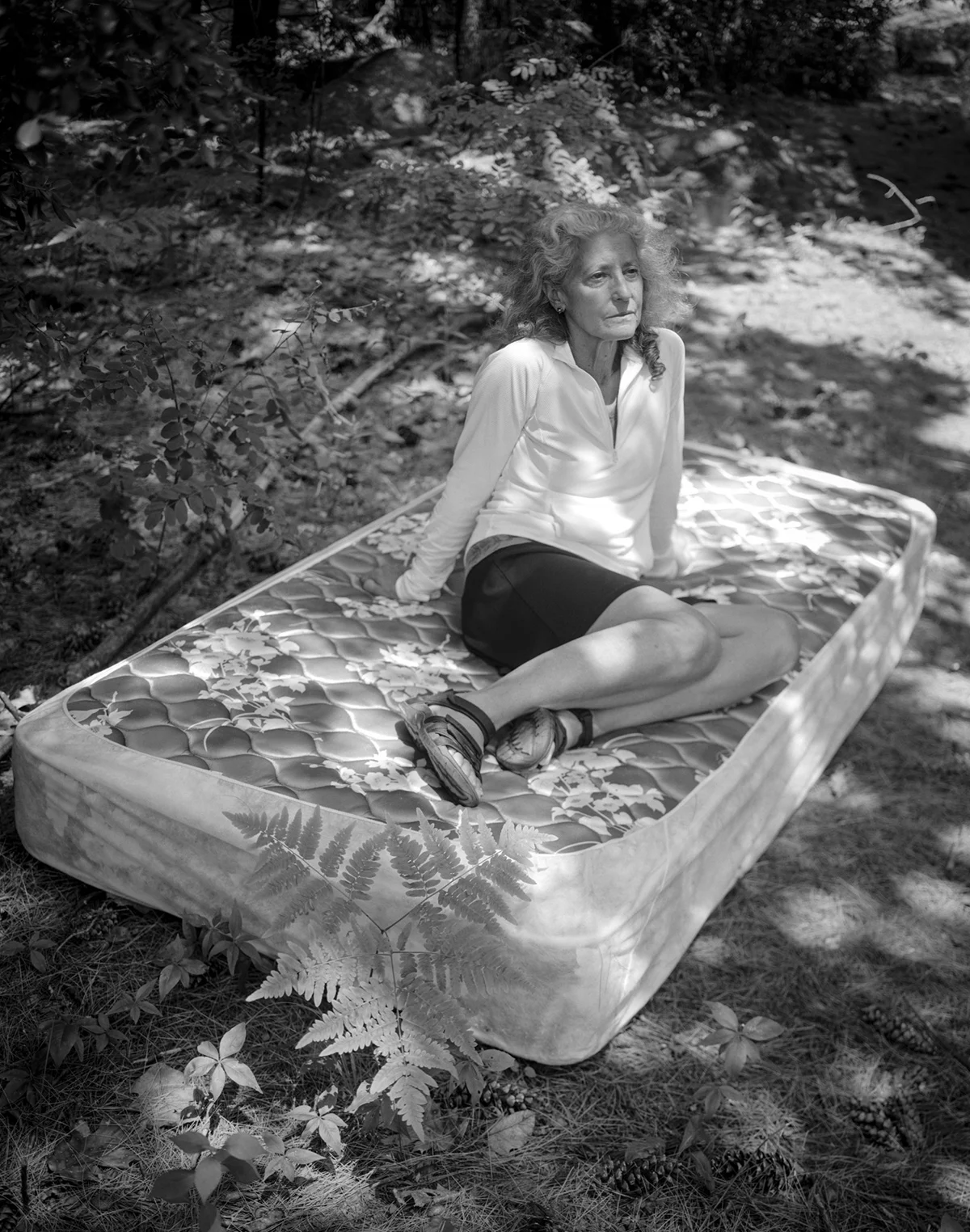
In the landscape of contemporary lens-based art, few projects bridge the gap between clinical diagnosis and emotional intimacy as poignantly as Rachel Jump’s latest body of work, Everyone is Icarus. A visual meditation on the fragility of the human body and the strength of the familial bond, the project serves as an evocative exploration of how we process the "biological maps" we are born with. Through a series of stark, black-and-white photographs, Jump documents her family’s journey following her father’s revelation of a hereditary disorder—a genetic predisposition that casts a long, inevitable shadow over their future.
The Genesis of a Narrative: Main Facts
Rachel Jump, a Chicago-born artist whose academic pedigree includes a BFA from the Rhode Island School of Design (2014) and current MFA candidacy at the University of New Mexico, has long utilized the camera as a performance tool. Her work is rarely purely documentary; rather, it is a constructed performance of memory and metaphor.
Everyone is Icarus represents a departure from her previous investigations into interpersonal relationships, grounding itself instead in the visceral reality of genetic inheritance. When her father received medical results confirming a hereditary disorder—a condition that heightens susceptibility to a range of severe illnesses—the family unit was forced to confront an existential crossroads. The project is not merely a record of this diagnosis; it is an active, collaborative performance of resilience. By turning the lens on her family, Jump attempts to visualize the invisible: the weight of DNA, the anxiety of anticipation, and the quiet defiance found in daily domestic rituals.
A Chronology of Discovery and Creation
The evolution of Everyone is Icarus follows the trajectory of a family processing a life-altering medical reality.
- Pre-Diagnosis: Before the medical intervention, Jump’s practice focused on the broader strokes of memory and the abstraction of relationships. The family dynamic was defined by conventional roles and the standard, unspoken assumptions of longevity and health.
- The Diagnosis: The catalyst for the work was the receipt of her father’s genetic test results. This moment of "newfound clarity" acted as a rupture in the family’s linear understanding of time. It transformed the family from passive participants in their lives to individuals acutely aware of their biological vulnerability.
- Development of the Series: Following the diagnosis, Jump began the iterative process of photographing her family members. This was not a passive observation; it was a deliberate, collaborative engagement. She invited her family to participate in the construction of scenes that represent their psychological states.
- The MFA Synthesis: Currently, as she pursues her MFA at the University of New Mexico, Jump has refined this body of work into a cohesive narrative, integrating theoretical frameworks of medical humanities with the aesthetic traditions of black-and-white performance photography.
The Weight of Inheritance: Supporting Data and Context
To understand the gravity of Everyone is Icarus, one must consider the intersection of genetic science and sociology. According to the National Institutes of Health (NIH), genetic testing has become a transformative, yet anxiety-inducing, cornerstone of modern medicine. While these tests provide life-saving information, they also create a "patient-in-waiting" phenomenon—a state of existence where individuals live with the psychological burden of a potential future illness.
Jump’s work functions as a visual data point in this sociological trend. By choosing black-and-white photography, she strips away the distraction of color, forcing the viewer to focus on the textures of the skin, the tension in a gesture, and the starkness of the domestic environment. The "Icarus" metaphor is deliberate: like the mythological figure who flew too close to the sun, the family members are acutely aware of the limits placed upon them by their own biological architecture.
In her own words, Jump notes: "My photographs reveal not only the physical and psychological traits we inherit but also how we decide to reconcile with those truths." This is the crux of the project: the tension between the biological blueprint (what we are) and the human agency (how we respond to what we are).
Perspectives and Official Responses
The reception of Everyone is Icarus within the academic and artistic community has been marked by praise for its vulnerability and its technical rigor. Critics have noted that Jump’s ability to turn a private, medical trauma into a universal visual language is a testament to her maturity as an artist.
In a recent critique regarding her work at the University of New Mexico, peers and mentors highlighted the "collaborative" nature of the project. Unlike many documentary photographers who act as observers, Jump’s subjects are co-authors of the imagery. This feedback loop—where the artist and the family members discuss the emotional labor of the shoot—is what gives the images their profound sense of authenticity.
Furthermore, medical humanities scholars have pointed to the series as a prime example of "narrative medicine" in practice. By externalizing the internal struggle of genetic risk, Jump provides a model for how families can process the "weight of newfound clarity." It is an official acknowledgment that art can serve as a therapeutic, or at the very least, a clarifying force in the face of medical uncertainty.
Implications: The Intersection of Identity and Biology
The implications of Everyone is Icarus extend far beyond the personal. In an era where genetic sequencing is becoming increasingly accessible, the question of "What aspects of ourselves do we choose to inherit?" becomes a universal concern.
The Agency of Acceptance
Jump’s project poses a fundamental challenge to the viewer: how much of our identity is dictated by our genes, and how much is forged through our choices? The defiance she captures—the way her family leans into their shared experiences—suggests that identity is not a static result of biology, but a dynamic, ongoing negotiation.
The Ethics of the Lens
From a professional standpoint, Jump navigates the ethical minefield of photographing vulnerable family members with a high degree of transparency. The project does not exploit the tragedy of the diagnosis; rather, it elevates it. The images act as a documentation of care. Every frame is saturated with the intention to support, a visual testament to the idea that while we cannot change our genetic lineage, we can alter the narrative of how we inhabit that lineage.
A New Canon of Resilience
Everyone is Icarus positions Rachel Jump at the forefront of a movement of artists who are reclaiming the clinical experience. As the boundaries between medicine and art blur, her work serves as a necessary intervention. It reminds us that behind every "genetic risk factor" is a human being with a story, a family, and a complex web of connections that no sequence of nucleotides can fully define.
Conclusion: Looking Toward the Horizon
As Rachel Jump continues her studies and expands her practice, Everyone is Icarus remains a seminal chapter in her development. It is a work that demands we look at our own lives and ask: What have I inherited, and what have I built in spite of it?
By documenting the aftermath of a genetic revelation with such surgical precision and tender empathy, Jump has created more than just a photography series. She has created a mirror for the viewer. In her black-and-white frames, we see the fragility of the human condition, but we also see the enduring power of the family unit to navigate the darkest of skies. The project stands as a tribute to the human spirit—not because it denies the reality of the genetic disorder, but because it confronts it, frames it, and ultimately, finds a way to exist alongside it.
The legacy of the project is not in the diagnosis itself, but in the decision to document the process of living in the face of that diagnosis. As Jump herself reflects, it is an exploration of the balance between acceptance and agency, a balance she masters with every click of the shutter. In doing so, she ensures that even if we are all, in some way, Icarus, we do not have to fall alone.