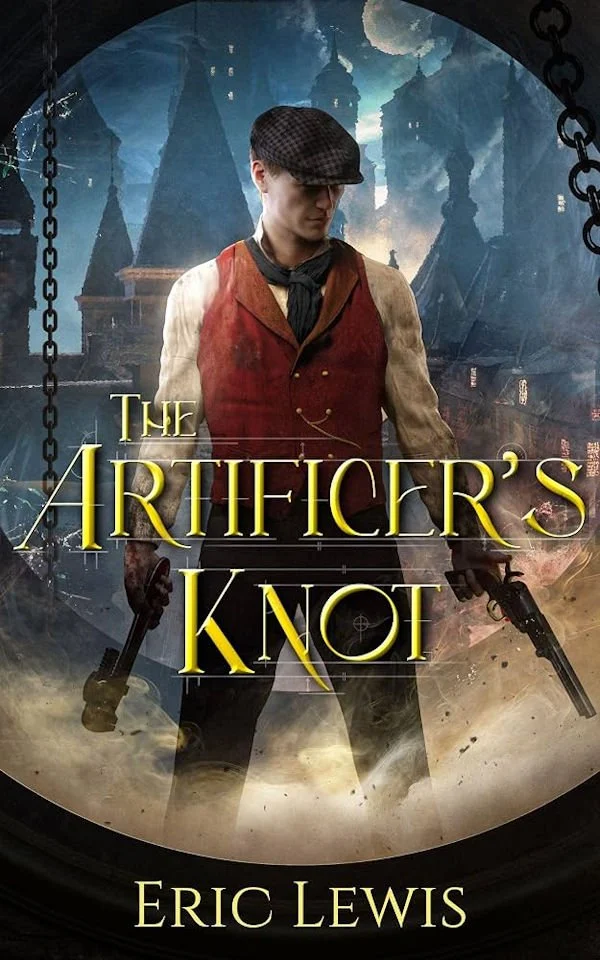
In the competitive landscape of independent publishing, few arenas are as rigorous or as prestigious as the Self-Published Fantasy Blog-Off (SPFBO). As the 11th annual competition reaches its critical juncture, one title has emerged as a lightning rod for debate and acclaim: The Artificer’s Knot. Blending the aesthetic grit of gaslamp fantasy with the high-stakes tension of a syndicate crime thriller, the novel has successfully navigated the gauntlet of the first round, securing its place as a semi-finalist.
The story follows Randyll “Ran” Tephius, a brilliant but disgraced university student whose groundbreaking research into petroleum deposits threatens the monopolistic hegemony of the city’s elite Alchemists—the masters of the mystical energy source known as Vril. Cast out of academia and into the gutter, Ran finds an unlikely patron in Gouger Nebb, an aging mob boss seeking a transition into “legitimate” enterprise. As Ran navigates a treacherous underworld of rival gangs, aristocratic saboteurs, and corrupt law enforcement, he is forced to confront a haunting moral dilemma: accept a corrupt, lucrative offer from the very Alchemists who ruined his life, or remain loyal to the criminal underworld that saved him.
Chronology of a Contender: From Disgrace to Semi-Finalist
The narrative arc of The Artificer’s Knot mirrors the protagonist’s own trajectory—marked by rapid escalation and complex maneuvering.
- The Academic Fall: The inciting incident finds Ran expelled for his radical thesis, a direct challenge to the energy status quo controlled by the Alchemist elite.
- The Syndicate Alliance: Homeless and desperate, Ran is recruited by Gouger Nebb. The symbiotic relationship—utilizing Ran’s inventive genius to launder the mob’s reputation through new technology—serves as the catalyst for the novel’s central conflict.
- The Escalation: As Ran’s inventions begin to disrupt the market, the narrative shifts from a survival story to a high-stakes corporate and criminal war.
- The Moral Precipice: The novel culminates in a choice between redemption via the establishment (the Alchemists) or the murky, albeit personal, loyalty to his mentor, Nebb.
The novel’s progression has sparked intense discussion among the SPFBO judging panel, which consists of a diverse group of genre critics, authors, and enthusiasts.
Critical Analysis: A Divided Panel
The reception of The Artificer’s Knot has been nuanced, with judges praising its stylistic execution while expressing reservations regarding its pacing and character arc consistency.
Stylistic Mastery and World-Building
A consensus exists among the judges that the author possesses a high degree of prose proficiency. Eva Geraghty (EG) noted, “The prose in this book is excellent. The writing is smooth and draws you along so you almost don’t feel like you’re reading.” This sentiment is echoed by Julia, who lauded the book’s “fast, clever, and confident” blend of genres. The world-building—particularly the uncomfortable parallel between the discovery of oil and real-world industrial exploitation—has been identified as a key strength. The book avoids the "fantasy trap" of easy moral resolutions, choosing instead to lean into the ambiguity of progress and the cost of innovation.
Pacing and Character Concerns
Not all feedback was celebratory. A primary critique, voiced by EG, concerns the predictability of the narrative’s escalation. "It got to the point that at about 60% of the way through the book, I started skimming," she observed, noting that the constant cycle of catastrophe and regrouping eventually lost its impact.
Adawia raised concerns regarding character archetypes, specifically the portrayal of Gouger Nebb. Initially finding him a "try-hard" iteration of cinematic mob tropes, Adawia noted that his character eventually gained depth through his "brutal common sense." However, the tension between Ran’s high intelligence and the frequency of his successes led some judges, such as Julia, to note that the protagonist occasionally feels "over-competent," which can inadvertently lower the stakes for the reader.
Supporting Data: The SPFBO Framework
The SPFBO is designed to elevate quality self-published works that might otherwise go unnoticed by mainstream traditional publishing houses. The criteria for advancement in this contest are stringent, focusing on:
- Prose Quality: Does the writing invite immersion?
- Originality: Does the narrative offer a fresh perspective on established tropes?
- Pacing: Is the story’s momentum sustained?
- World-Building: Is the setting internally consistent and engaging?
The Artificer’s Knot has scored consistently high in prose and world-building, though its "dramatic escalation" has been a point of contention. As a semi-finalist, the book represents a "gaslamp crime" niche that the judges have identified as "uncomfortably relevant." It is not a straightforward fantasy, and that refusal to conform to genre expectations is arguably the primary reason it has remained in contention.
Official Responses and Editorial Insights
The judging panel, which includes Adawia Asad, Eva Geraghty, Evelyn Grimald (E.G.) Stone, Julia Kitvaria Sarene, Karen Lucia, Kerry Smith, Kit Caelsto, Maureen Neuman, Robert Max Freeman, Sara Rosevear, Sherry Cammer, Stacey Markle, Tianna Twyman, and Yaniv Rosenfeld Cohen, has collectively highlighted the difficulty of judging a standalone novel that blends such disparate elements.
Maureen Neuman offered a particularly evocative assessment: “Reading this book was like riding a zip line above the crowds on a fairground midway. Everywhere you looked, something was happening.” She emphasized that despite the flurry of action, the core focus remains on the human cost of ambition.
Kerry Smith, while noting the book’s structural soundness, expressed a desire for more subversion of tropes. "The characters all fell a tad heavy on the tropes," Smith noted, though she praised the uncomfortable resonance of the petroleum plotline, which she suggests is a poignant reflection of modern environmental and industrial anxieties.
Implications for the Genre
The success of The Artificer’s Knot in the SPFBO competition signals a shifting appetite within the fantasy community. Readers are increasingly seeking "grit-lit" that prioritizes socio-political questions—such as the ethics of monopolies and the environmental costs of energy—over the traditional "hero’s journey."
By grounding its fantasy elements in a world that mirrors the early 20th-century industrial revolution, the novel challenges readers to view the transition to new energy sources through a cynical, yet pragmatic, lens. The moral ambiguity of the ending, which forces the reader to re-evaluate Ran’s motivations and the necessity of his actions, serves as a hallmark of the modern self-published aesthetic: intelligence, complexity, and a refusal to provide simple, happy endings.
Moving Forward
As the competition moves toward the final selection phase, the judges must weigh the book’s minor pacing flaws against its significant thematic achievements. The decision on which semi-finalist moves to the final round is slated for June 26th.
Regardless of whether The Artificer’s Knot takes the top spot, its inclusion in the SPFBO semi-finals cements its status as a notable entry in the gaslamp fantasy genre. For readers interested in the interplay of power, technology, and morality, it stands as a compelling, albeit intense, exploration of what it means to succeed in a world that is fundamentally rigged.
For those wishing to follow the remainder of the contest, updates are available via the official SPFBO website and the participating blogs, as the field continues to narrow down to the ultimate victor of the 11th annual cycle.