

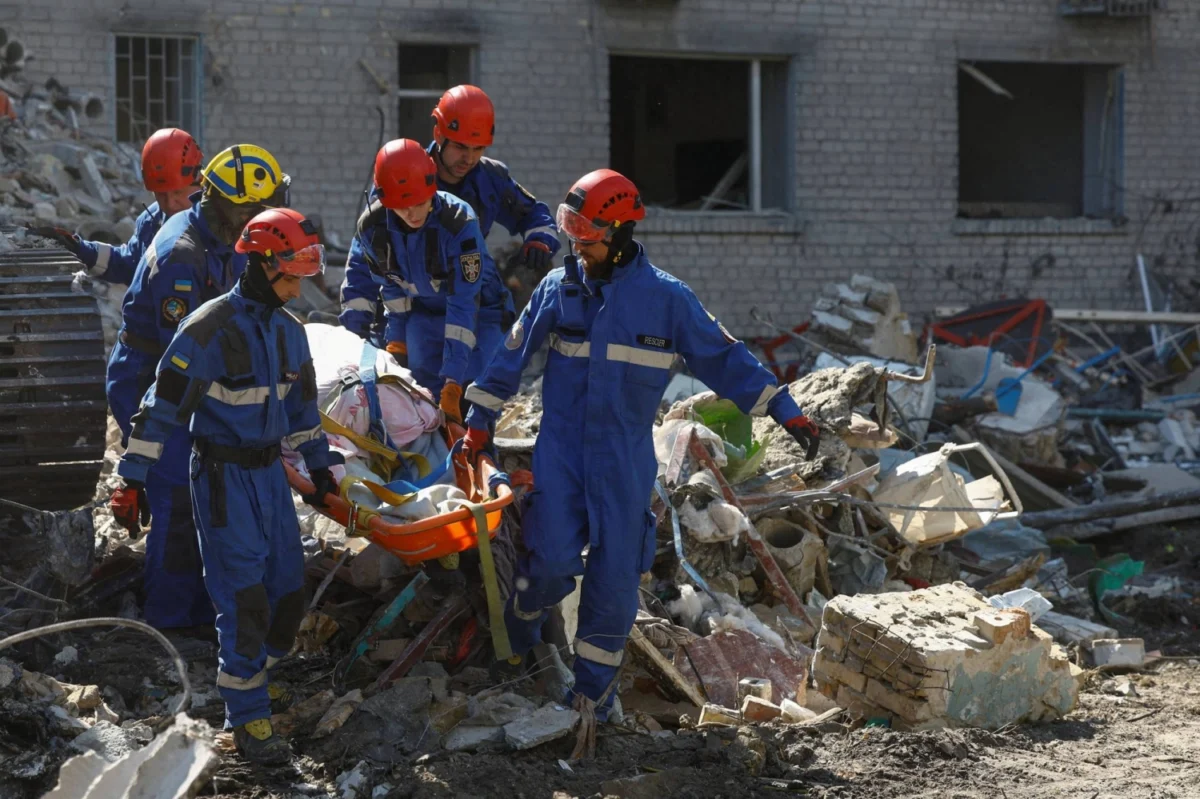
KYIV — The dawn sky over Kyiv did not bring the promise of a new day on Thursday; instead, it ushered in a landscape of pulverized concrete, twisted metal, and the harrowing silence of a city in mourning. In what officials are describing as the most lethal and coordinated aerial assault on the Ukrainian capital this year, Russia unleashed a massive barrage of hundreds of drones and dozens of ballistic missiles, tearing through the fabric of civilian life and leaving a trail of devastation that has shaken the nation to its core.
The coordinated strike, which spanned several hours through the night and into the early morning, targeted residential districts, critical infrastructure, and city centers, effectively transforming Kyiv into a frontline of terror. By the time the final air raid sirens faded, at least 27 people had been confirmed dead, with dozens more fighting for their lives in intensive care units across the capital.
A Night of Terror: The Chronology of the Assault
The violence began shortly after midnight, as the rhythmic hum of Iranian-designed Shahed "kamikaze" drones began to infiltrate the airspace over Kyiv. The initial wave appeared designed to saturate and exhaust Ukraine’s air defense systems. According to military analysts, this "swarm" tactic forced defenders to expend precious interceptor missiles on the cheaper, decoy-like drones before the primary payload—a sophisticated array of cruise and ballistic missiles—began to impact the city.
By 2:00 a.m., the night sky was illuminated by a series of blinding flashes as intercepted missiles disintegrated in mid-air, raining shrapnel onto the streets below. The sounds of explosions were described by residents as "unrelenting," with the ground shaking under the force of the blasts.
"It felt like the earth was being torn apart," said Olena, a resident of a central district whose apartment building was partially destroyed in the strike. "We spent the entire night in the metro station. When we emerged, we didn’t recognize our own street."
Throughout the pre-dawn hours, the intensity of the assault grew. Reports from the ground indicated that the Russian military utilized a mix of Iskander ballistic missiles and Kh-101 cruise missiles, designed specifically to evade detection. By 5:00 a.m., as the sun began to rise, the full scale of the destruction became apparent. Smoke choked the skyline, rising from at least 130 damaged buildings, including high-rise apartment blocks, schools, and local markets.
The Human Cost: A City in Mourning
As the dust settled, emergency services and first responders were met with scenes of unimaginable tragedy. The imagery captured by Reuters and other international news agencies showed rescuers laboring through unstable piles of debris, pulling bodies from the mangled skeletons of apartment buildings.
Tymur Tkachenko, the head of the capital’s military administration, provided a somber update via Telegram as the morning progressed. He confirmed that the death toll had risen to 27, following the death of one individual who succumbed to severe blast injuries in a local hospital. Additionally, 91 people were confirmed injured, many suffering from shrapnel wounds, severe burns, and trauma from collapsed structures.
The casualties include entire families who were caught in their homes as the missiles struck. Local hospitals are currently operating at maximum capacity, with surgeons working around the clock to treat the influx of patients. The psychological toll on the city’s population, already fatigued by years of war, is expected to be profound, as this attack strikes at the heart of what was previously considered the "safest" zone in Ukraine.
Supporting Data: The Scale of the Russian Offensive
Military intelligence reports indicate that this operation was likely months in the planning. The sheer volume of munitions utilized suggests a deliberate attempt to break the morale of the Ukrainian capital.
- Munitions Used: Analysts estimate over 100 drones and at least 40 high-precision missiles were launched in the coordinated volley.
- Structural Damage: Local authorities reported that approximately 130 buildings sustained varying degrees of damage, ranging from shattered windows and structural instability to complete collapse.
- Geographic Spread: While the primary focus was Kyiv, secondary strikes were reported in surrounding suburbs, complicating the logistical efforts of first responders who had to navigate destroyed transit routes.
The attack represents a departure from recent patterns, where Russia had primarily targeted energy infrastructure. By shifting the focus to residential density, the Kremlin appears to be signaling a shift toward a "total war" strategy, aimed at forcing the Ukrainian government into negotiations by making the cost of domestic life untenable.

Official Responses and International Condemnation
The response from the Ukrainian government was swift and resolute. President Volodymyr Zelenskyy, in a televised address, condemned the "cowardly" nature of the attack, labeling it a "crime against humanity."
"Russia has once again proven that it is a terrorist state that does not differentiate between military targets and innocent civilians," Zelenskyy stated. "This is not a military operation; this is a calculated attempt to break the spirit of our people. But they will fail."
International leaders were quick to echo these sentiments. The United Nations and the European Union issued statements condemning the strikes, with many Western capitals calling for an immediate increase in the delivery of long-range air defense systems, such as the Patriot and NASAMS platforms, which have proven critical in protecting Kyiv’s airspace.
"The brutality we are witnessing in Kyiv is a chilling reminder of the indiscriminate nature of this war," said a spokesperson for the U.S. State Department. "We stand firmly with the people of Ukraine, and we are working urgently to ensure they have the tools necessary to defend their homes and their lives."
Conversely, Moscow has maintained its standard rhetoric, claiming that the strikes were aimed exclusively at "military-industrial complexes" and "decision-making centers," despite the overwhelming evidence of civilian carnage on the ground.
Implications: A Shifting War
This massive escalation comes at a pivotal moment in the conflict. With the front lines in the east remaining largely static, analysts suggest that Russia is attempting to leverage its remaining missile stockpiles to force a strategic retreat or to weaken the domestic stability of the Zelenskyy administration.
The implications of this attack are twofold. First, it places renewed pressure on the international community to move beyond rhetoric and toward tangible military support. If Kyiv’s air defenses can be saturated by such barrages, the protection of the capital becomes an existential issue for the entire Ukrainian war effort.
Second, the psychological impact on the civilian population cannot be overstated. As the war enters this new, more desperate phase, the resilience of the Ukrainian people is being pushed to its breaking point. However, if history is any indicator, these attempts to terrorize the populace often result in a hardened resolve rather than the capitulation Moscow seeks.
As Kyiv cleans up the debris and mourns its dead, the city remains on high alert. The sirens have gone silent for the moment, but the fear remains palpable. The task ahead for the Ukrainian government is now two-fold: to rebuild the shattered infrastructure of the capital, and to ensure that the international community does not look away as the conflict takes this latest, darkest turn.
For the families of the 27, the war is no longer a geopolitical abstraction—it is a personal, permanent tragedy that will forever be etched into the history of a city that refuses to fall.











