Every few years, when Adam Roberts steps into the classroom to teach a course on Science Fiction, he encounters a familiar, recurring friction. His students, eager and unprompted, attempt to define the genre. Are they discussing the literature of technological upheaval? Is it the fiction of "cognitive estrangement"? Is it a laboratory for hypothesis testing, or simply the aggregate of how the term "science fiction" is wielded in the wild?
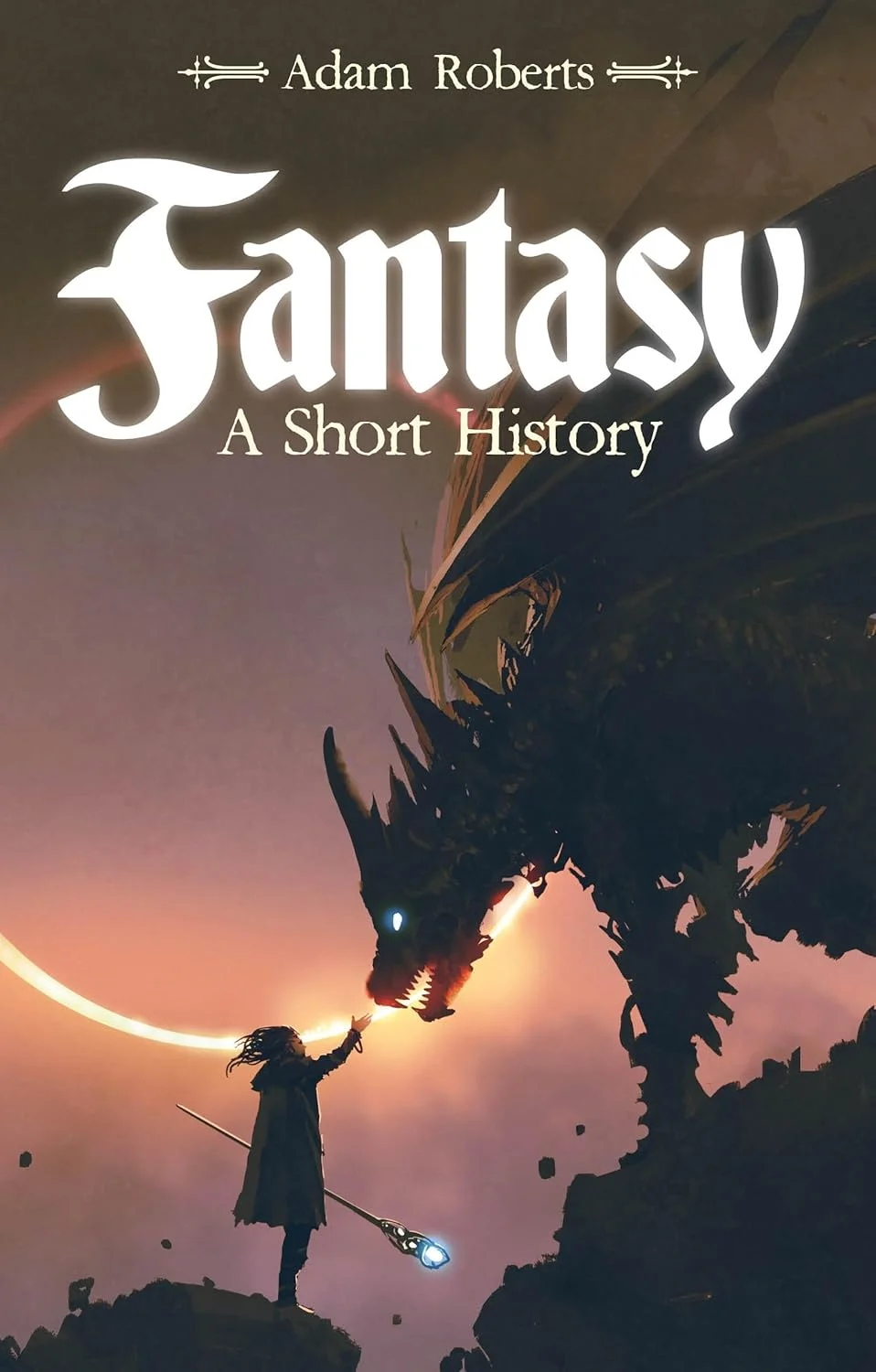
While science fiction remains a slippery, contentious beast, fantasy—to the undergraduate mind—often seems fixed, static, and crystalline. It is the literature of magic, myth, and legend, comfortably situated in pre-industrial landscapes. Yet, as Roberts argues in his latest critical endeavor, Fantasy: A Short History, the genre is far more dynamic, paradoxical, and historically contingent than it appears.
The Disenchanted Mirror: Situating the Genre
In his seminal 2006 work, The History of Science Fiction, Roberts famously framed SF as "disorderly technology fiction," a genre inherently linked to the Protestant Reformation and the scientific revolutions that forced humanists to grapple with a rational, materialist world. If science fiction is the "Other" to received religion and realism, Roberts posits in his new volume that fantasy acts as the "Other" to science fiction—and to our relentlessly technological age.
The fundamental premise of Fantasy: A Short History is that the genre is a modern phenomenon. "You can only re-enchant the world," Roberts notes, "if it’s been disenchanted first." While myth and epic are ancient, fantasy as a recognizable, self-conscious genre is a product of post-Enlightenment longing. It is a reactionary movement, a push-back against the cold, iron-clad logic of industrial modernity.
The Anatomy of an Enchanted Past
Roberts traces the genealogy of fantasy through a sturdy, arboreal structure. The roots are deep—planted in the soil of Victorian medievalism, John Bunyan’s allegories, and nineteenth-century folk tales. From there, the trunk thickens through the foundational works of J.R.R. Tolkien and C.S. Lewis.
Even as the genre evolves, moving away from its Eurocentric, Christian-inflected origins toward a more global, pluralistic future, it remains tethered to an "idealized fantasy past." Whether it is the portal fantasies of Seanan McGuire, the complex world-building of Michael Moorcock’s Melniboné, or the theological depth of Lois McMaster Bujold’s Chalion series, the genre functions by creating a secondary world that implicitly—and often explicitly—critiques our own.
Chronology of the Fantastic: From Sagas to Series
The development of the genre follows a trajectory of "instauration"—a term borrowed from critic John Clute. In the context of fantasy, instauration is effectively "fix-it fiction" at the level of world-building. Authors are not merely telling stories; they are rebuilding the temple, addressing the structural flaws of previous masters, and rerunning the ritual with a different set of values.
- 19th Century Origins: The emergence of Romantic nationalism, the collection of folklore, and the literary fairy tale.
- The Mid-20th Century Peak: The Tolkien-Lewis era, where the "secondary world" becomes the standard, establishing the tropes of the quest, the dark lord, and the binary morality of good and evil.
- The Commercial Explosion (1969–1974): The launch of Ballantine Books’ Adult Fantasy list and the widespread adoption of Dungeons & Dragons transformed the genre into a massive, serial-driven industry.
- The Modern Era: A shift toward "grimdark" realism (Joe Abercrombie, George R.R. Martin) and subversions of the "hero’s journey" (N.K. Jemisin, Sofia Samatar).
Roberts notes that this later period is defined by "dissipating epic prolixity." Once publishers realized that fantasy fans were hungry for sequels, the genre became dominated by the never-ending series. While this provided a "theme park" experience for readers seeking escape, it often resulted in a dilution of narrative craft—a reality Roberts addresses with a mix of academic rigor and sharp-witted cynicism.
Supporting Data: The Tension Between Art and Commerce
Roberts’ analysis does not shy away from the tension between literary ambition and market necessity. He observes that while fantasy claims to offer a higher truth, the mechanics of its production are often tied to the most base forms of capitalism.
The Case of the "Leveling Up" Trope
A significant portion of the book examines why readers remain so devoted to narratives of "ordinary young people" leveling up into power. This structure, which mirrors the mechanics of video games like Skyrim or Myst, is identified by Roberts as both a strength and a limitation. Video games, he argues, are "necessarily instrumentalizing" and "goal-oriented." When literature adopts this logic, it risks becoming "antagonistic and flattening."
The Political Spectrum of Magic
One of the most provocative assertions in the text is that fantasy’s "idioms of magic and myth, because they are not rational, can never really be liberal." This is not to say that fantasy is inherently conservative, but rather that it occupies a space outside the rationalist, liberal discourse of modern governance. Authors like Bujold and Jemisin attempt to square this circle by injecting pluralism and systemic critique into the fantasy framework. Jemisin’s Broken Earth trilogy, in particular, is highlighted as a work that critiques modern hierarchical, technocratic structures far more effectively than its predecessors.
Official Critiques and Intellectual Boundaries
Roberts is a generous critic, yet he maintains clear boundaries. He acknowledges that his history is, by necessity, incomplete. He spends little time on the chaotic, individualistic magic of non-English traditions, and he omits a significant discussion of graphic novels and comics—a glaring gap given his previous collaborative work in that medium.
Furthermore, he does not attempt to be a "John Clute-style" encyclopedist. He is selective. He praises the prose of Gene Wolfe and the world-building of Sofia Samatar, while he dings the "blood-soaked hypocrisy" of George R.R. Martin and the "enervatingly prolonged" nature of Robert Jordan’s epics. His assessment of J.K. Rowling’s Harry Potter series, which he frames as a "Panopticon-like" space of over-surveillance and sacrificial cruelty, reflects a critical willingness to look past the cultural saturation of a work to its underlying structural and moral assumptions.
Implications for the Future of the Genre
What does the future hold for a genre built on the desire to return to an enchanted past? Roberts suggests that the path forward lies in the "re-enchantment" of the present through more nuanced, diverse, and self-aware storytelling.
The shift toward "instauration" implies that the next generation of fantasy writers will not abandon the tropes of the past but will instead deconstruct them. We are moving away from the "warrior-shame culture" of earlier decades and toward stories that emphasize interdependence, patience, and systemic critique.
The Ecotone of Imagination
Roberts concludes by framing the genre as an "ecotone"—a transition zone between commerce and imagination, logic and dream, and childhood and maturity. It is a messy, vibrant, and often contradictory space. While his history is undeniably English-centric and limited by the constraints of a single volume, it succeeds as a map for the reader.
As Roberts closes his study, he invokes the final lines of The Lord of the Rings—"Well, I’m back"—reminding us that all fantasy is ultimately a journey. We go into the secondary world to escape the disenchanted modern one, but the true value of the genre lies in what we bring back with us when we return. By documenting the growth of this "enormous tree," Roberts provides not just a history of books, but a history of how we have attempted to dream our way out of the machine.
For the student, the fan, and the critic alike, Fantasy: A Short History serves as a vital, if sometimes prickly, companion. It does not provide all the answers, but it asks the right questions—challenging us to consider not just what we read, but why we so desperately need the magic to be real.