

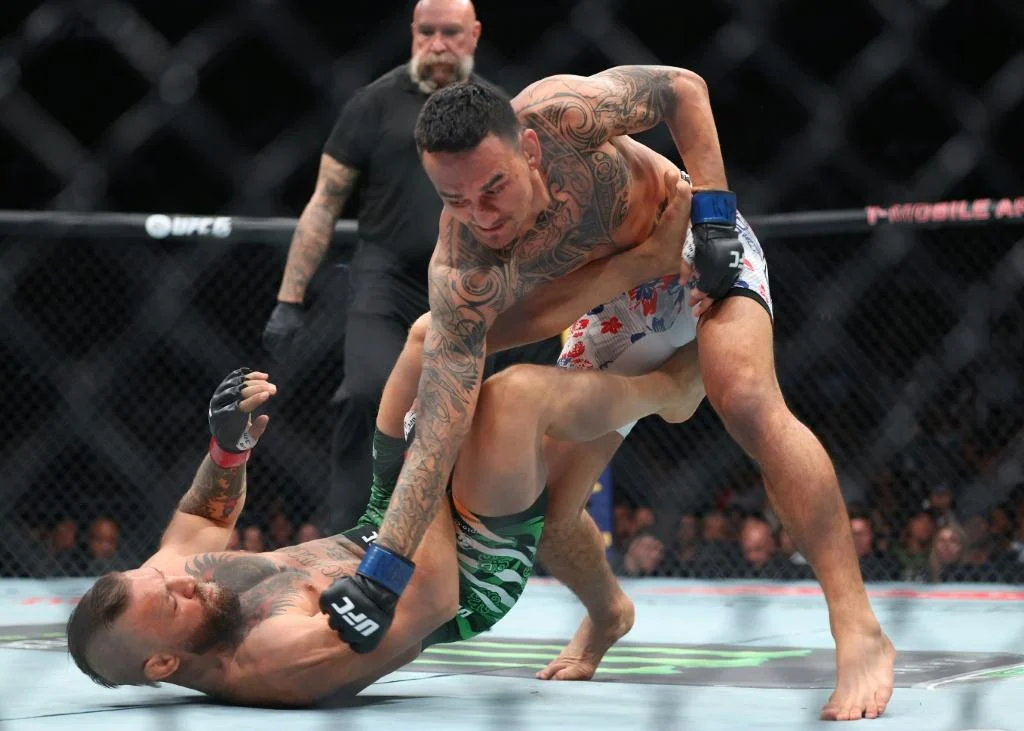
LAS VEGAS — The narrative was set for a historic redemption arc, a spectacle that promised to remind the world why Conor McGregor remains the most polarizing and magnetic figure in the history of mixed martial arts. Instead, the highly anticipated return of the “Notorious” Irishman at UFC 329 ended in a flash of confusion and agonizing physical failure.
McGregor, 37, saw his much-ballyhooed return to the Ultimate Fighting Championship—his first appearance in the octagon following a five-year hiatus—come to a premature and devastating halt just 69 seconds into his welterweight contest against Max Holloway. The bout, which was billed as the definitive chapter in a long-standing rivalry, was stopped by referee Mike Beltran after McGregor suffered a catastrophic right knee injury during an opening-sequence strike.
The Chronology of a Short-Lived Main Event
The energy inside the T-Mobile Arena was electric as the lights dimmed for the main event. McGregor, donning his signature bravado, moved with an urgency that suggested he intended to make a statement. However, the fight began to unravel almost immediately.
In the opening seconds, McGregor attempted a high-stakes maneuver, launching a dynamic roundhouse kick directed at Holloway. As he planted his lead leg to pivot, the structural integrity of his right knee appeared to give way. The immediate change in his movement was palpable; the fluidity that once defined his striking game was replaced by a visible, staggering instability.
Over the next 60 seconds, the sequence turned from a technical battle into a rescue mission. McGregor crumpled to the canvas three separate times, each collapse seemingly more jarring than the last. He reflexively grabbed at his right knee, his face contorted in a mixture of pain and frustration. Observing the fighter’s inability to maintain a base and the clear distress he was under, referee Mike Beltran intervened, stepping between the fighters to wave off the contest at the 1:09 mark.
A Rivalry Stalled: Official Responses and Fighter Reactions
The aftermath of the stoppage was marked by a heavy atmosphere of disappointment. While Holloway secured the victory, there was no celebration, only a sense of unfinished business.
"What can I say? I had him weak in the knees, I guess," Holloway remarked during his post-fight interview, though his tone remained respectful and somber. "There was so much hype behind this. We were both looking forward to this for years. To have it end like this? It sucks for the fans, it sucks for me, and it sucks for him."
Holloway noted that he noticed the shift in momentum almost instantly. "I could tell the moment he planted that foot. His whole demeanor changed. He stopped trying to set up his combinations and started fighting out of desperation. He was yelling, ‘Fight! Fight!’, trying to keep me at bay, but I knew he was in trouble. I just hope the injury isn’t too crazy. I want to run it back one day—when he’s 100 percent."
For his part, McGregor remained uncharacteristically silent. He departed the octagon with the assistance of his medical team, offering no comment to the press or the broadcast team. His camp has yet to release a detailed medical prognosis, though early reports suggest a significant ligament strain or tear that will require extensive imaging in the coming days.
The Context: A Long Road to an Abrupt End
To understand the weight of this loss, one must look at the five-year trajectory that led McGregor to this night. McGregor had not stepped into the octagon since his harrowing 2021 defeat to Dustin Poirier, a fight that ended when McGregor suffered a gruesome broken left leg. That injury sidelined him for years, sparking a long and grueling rehabilitation process that fueled the marketing narrative of this fight being "the comeback of all comebacks in sports history."
This bout was intended to be a redemption of his own legacy—a rematch of their 2013 featherweight encounter, which McGregor had won via unanimous decision. At the time, that victory was a building block for his meteoric rise. By 2016, McGregor had achieved the impossible, becoming the first fighter in UFC history to hold two titles simultaneously in different weight classes.
His career has been defined by extreme highs and, recently, long periods of inactivity. Following his 2017 foray into professional boxing—a superfight against Floyd Mayweather that reportedly netted him upwards of $100 million—McGregor’s relationship with the sport of MMA became increasingly sporadic. His last true victory in the octagon dates back to January 2020, a clinical 40-second TKO of Donald “Cowboy” Cerrone.
Supporting Data and The "Paddy" Factor
While the main event left the crowd stunned, the undercard provided a glimpse into the future of the lightweight division. In a display of raw aggression, England’s Paddy "The Baddy" Pimblett made a massive statement, stopping France’s Benoit Saint Denis via submission in just 52 seconds. Pimblett’s rapid victory served as a stark contrast to the main event, proving that even as veterans like McGregor face the attrition of time, the sport continues to churn out hungry, explosive talent.
The financial stakes of the evening were also immense. UFC 329 was projected to be one of the highest-grossing pay-per-view events of the year, driven almost entirely by the McGregor brand. With the fight ending in the first minute, the implications for the promotion—and the betting markets—are significant. Fans who paid premium prices for the main event are likely to be vocal in their frustration, and the UFC will now face the logistical challenge of rescheduling or re-evaluating the future of its biggest star.
Implications: The End of an Era?
The immediate question facing the MMA community is whether this is the final chapter for Conor McGregor. At 37, the physical toll of elite-level combat sports is unforgiving. Recurring injuries—first to the left leg, now the right knee—suggest that the human body can only absorb so much punishment before the decline becomes irreversible.
1. The Medical Reality
Ligament injuries at this stage of a career are notoriously difficult to rehabilitate. Unlike a broken bone, which often heals with structural integrity, soft-tissue injuries in the knee can lead to long-term instability, affecting a fighter’s ability to generate the explosive movement that McGregor’s karate-based stance relies upon.
2. The Legacy Question
McGregor’s legacy is already cemented; he brought the UFC to the mainstream, bridged the gap between boxing and MMA, and became a global icon. However, his standing as a top-tier competitive threat is now at its lowest point. If he chooses to return, he will likely have to navigate a landscape that has moved on, occupied by younger, faster, and more technically diverse fighters who do not fear the “McGregor mystique.”
3. The UFC’s Promotional Pivot
The UFC relies heavily on star power. With McGregor’s future uncertain, the promotion must now accelerate its efforts to build the next generation of global superstars. The performance of Paddy Pimblett and the continued dominance of champions like Max Holloway indicate that while individual fighters may fade, the engine of the promotion remains robust.
Conclusion
The 69 seconds of action at UFC 329 will be remembered as a cautionary tale about the fragility of greatness. Conor McGregor arrived in Las Vegas promising a return to the peak of the mountain, but he left with a knee injury that casts a long, dark shadow over his future in the sport.
Whether this was the final act of a legendary career or merely another painful hurdle in a life defined by extremes, remains to be seen. For now, the combat sports world is left to reflect on a night where the hype was silenced not by an opponent, but by the cruel, inevitable reality of age and injury.
© 2026 AFP











