

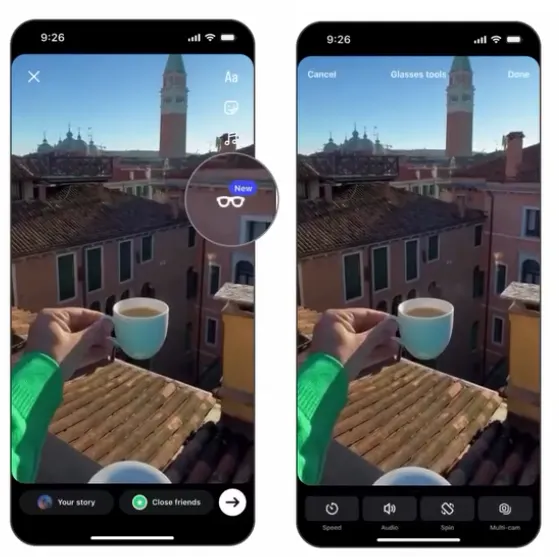
In a strategic move to solidify its position at the forefront of wearable technology, Meta has officially launched a suite of advanced content creation tools for its AI-powered smart glasses. By integrating sophisticated capture formats directly into Instagram Stories, Meta is not only enhancing the user experience for early adopters but is also executing a masterclass in product marketing—turning every shared story into a high-visibility advertisement for its hardware ecosystem.
The update introduces three primary features: "Spin View," "Multi-Cam Sync," and advanced in-app editing capabilities. These tools move beyond simple point-and-shoot video, leveraging the unique hardware configuration of Meta’s smart glasses to offer perspectives that traditional smartphones simply cannot capture.
The Core Features: A New Era of Immersive Storytelling
The introduction of these features marks a significant shift in how social media content is conceived. By breaking free from the static, single-frame constraints of mobile phone cameras, Meta is encouraging a more dynamic, "first-person" style of digital expression.
1. Spin View: The Panoramic Revolution
Perhaps the most innovative addition is "Spin View." This interactive format allows viewers to tilt or rotate their mobile devices to pan through a scene. Instead of a flat, linear video, the user is presented with a panoramic window into the creator’s experience. Meta describes this as an effort to "break free from the static frame," allowing the audience to explore the environment as the creator lived it. This is made possible by the wider-angle, multi-camera arrays embedded within the frames of the glasses, which capture a broader field of view than a standard handset.

2. Multi-Cam Sync: Seamless Integration
Recognizing that creators often juggle multiple devices, Meta has introduced "Multi-Cam Sync." This tool automatically synchronizes footage captured on the smart glasses with clips taken on a phone. By aligning the timelines of these distinct perspectives, Meta simplifies the post-production workflow, allowing for complex, multi-angle edits that previously required professional-grade video editing software.
3. Advanced In-App Editing Suite
To accompany these capture modes, Instagram has updated its Stories composer. Users can now perform granular edits directly within the app, including reframing shots, adjusting playback speeds for dramatic effect, and balancing audio levels. These features ensure that the "POV" (point-of-view) content captured by the glasses retains a polished, cinematic quality before it is shared with the creator’s following.
Chronology: From Hardware Launch to Ecosystem Integration
The trajectory of Meta’s smart glasses—often viewed as the successor to the smartphone—has been a calculated, multi-year rollout.
- Initial Beta and Testing: Following the initial launch of the Ray-Ban Meta smart glasses, the company focused on building core functionality, such as livestreaming and basic voice-assistant integration via Meta AI.
- Expansion of Capability: Throughout 2024, Meta incrementally rolled out updates to increase the device’s utility, focusing on multimodal AI—the ability for the glasses to "see" and "understand" what the user is looking at.
- Integration with Social Infrastructure: In late 2024 and early 2025, the focus shifted from hardware capability to software distribution. By embedding specific features for the glasses into Instagram, Meta effectively transformed its primary social app into a dedicated interface for its hardware.
- The Current Launch: The rollout of Spin View and Multi-Cam sync represents the first major wave of "feature-parity" updates, where software features are explicitly designed to justify the hardware purchase.
Supporting Data: Why Meta is Betting on Wearables
Meta’s hardware division, Reality Labs, has long been a source of significant capital expenditure. However, the decision to tie hardware success to the reach of Instagram and Facebook is a data-driven response to market saturation.

According to industry analysts, the smartphone market has reached a plateau in terms of form-factor innovation. By pushing smart glasses, Meta is attempting to capture the "in-between moments"—the seconds before a user pulls their phone out of their pocket.
Data from recent quarterly earnings calls suggests that the "Meta AI" experience is the primary driver of device adoption. When users realize that their glasses can act as a personal assistant, a camera, and a translator, the perceived value proposition shifts from "gimmick" to "essential tool." By integrating these new Instagram tools, Meta is essentially creating a "viral loop": every time a user posts a high-quality Spin View video, their followers see the unique perspective and are exposed to the capabilities of the hardware, creating organic marketing that traditional advertising cannot replicate.
Official Stance and Strategic Implications
Meta’s official position is that these updates are designed to "empower creators" and "foster deeper connections." In a statement, a Meta spokesperson emphasized that the goal is to allow users to capture moments without being tethered to a screen, thereby encouraging more authentic, "in the moment" content.
However, the industry implications run much deeper:

The "Smartphone Successor" Narrative
Meta is not just building glasses; they are building the infrastructure for an "ambient computing" future. By making these features exclusive to its wearable line, Meta is creating a "walled garden" that incentivizes users to stay within the Meta ecosystem. If a creator wants the best tools for immersive storytelling, they are increasingly compelled to use Meta hardware.
Marketing Through Utility
In our October 2026 predictions report, we noted that Meta would leverage the massive scale of its applications to drive hardware awareness. This recent update is the realization of that forecast. By providing features that make content "pop" on the Instagram feed, Meta is using its social network as a massive billboard for its wearables. It is a brilliant, self-sustaining cycle: better features lead to better content, which leads to more hardware sales, which leads to more users creating content.
Competition and Market Positioning
This move also places Meta in a unique position relative to Apple and Google. While Apple focuses on high-end, immersive computing with its Vision Pro headset, Meta is focusing on "everyday" AI. By prioritizing accessibility and social sharing, Meta is betting that the winning form factor for AI will be the one that is the most social, not necessarily the most technically powerful.
The Future of Content Creation
What does this mean for the average user? We are entering an era where the "content creator" will be defined by their ability to leverage hardware to provide unique perspectives. The "static frame" of the traditional smartphone era is beginning to feel limited. As creators look for ways to stand out in an increasingly crowded social feed, the ability to offer an interactive, panoramic, or multi-angle perspective will become a competitive advantage.

Expect to see a flurry of similar updates in the coming months. As Meta continues to refine the AI capabilities of its glasses, we anticipate:
- Enhanced Spatial Audio: Integrating more deeply with the visuals to provide a 360-degree sound experience.
- Real-time AI Editing: The potential for the glasses to automatically suggest "best cuts" or "highlight reels" based on the user’s movement and focus.
- Cross-Platform Expansion: While currently focused on Instagram, it is highly likely that these features will eventually permeate the entire Meta family of apps, including Facebook and potentially WhatsApp.
Conclusion
Meta’s latest update is more than a set of software tweaks; it is a clear signal that the company’s pivot to AI and wearables is entering a phase of aggressive growth. By blurring the lines between social media and hardware utility, Meta is forcing the industry to rethink what a "phone" actually is.
As these tools gain traction, we are likely to see a shift in the aesthetic of social media. The "Stories" of tomorrow will be less about curated photos and more about immersive, interactive experiences that allow the viewer to step into the creator’s shoes. For Meta, the gamble is clear: if they can make their glasses the lens through which we view the world, they will own the next generation of digital connection. Whether users will fully embrace this shift remains to be seen, but one thing is certain: the era of the static, handheld social media post is officially on the decline.










