

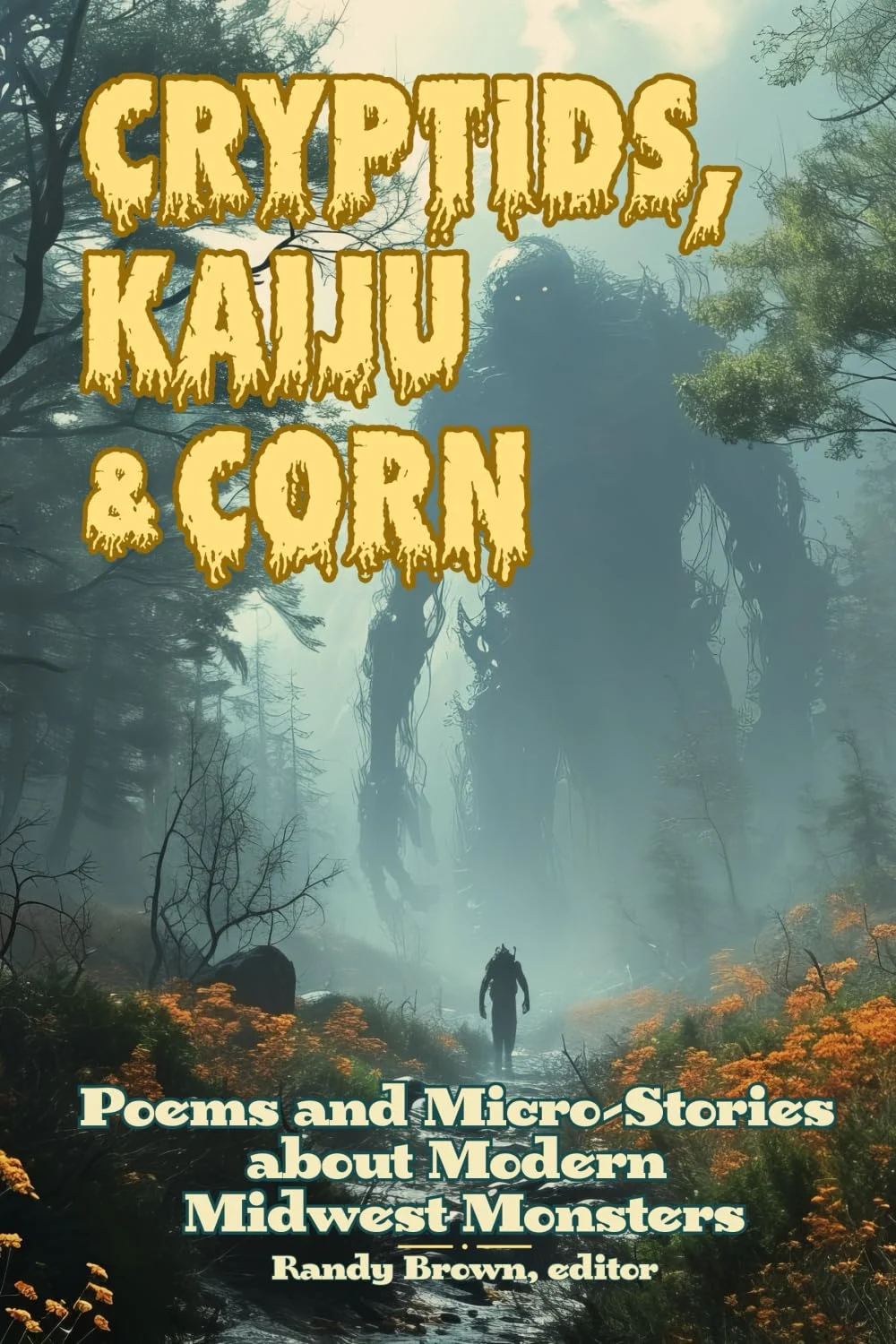
The American Midwest has long been defined by its geography: endless rows of maize, flat horizons, and the quiet, isolating sprawl of "flyover country." Yet, a new anthology, Cryptids, Kaiju & Corn, suggests that beneath the silence of the plains lies a volatile, monstrous energy. Comprising seventy-seven poems and micro-stories, this collection maps a version of the Midwest where the familiar yields to the uncanny, blending regional identity with the grotesque and the mythological.
The anthology posits that the isolation of the rural landscape acts as a petri dish for the supernatural. As Logan Garner aptly notes in his micro-story within the collection, the region is "a place between places. A border with a thinness to it." This "thinness" is where the monsters emerge—not as intruders, but as manifestations of the landscape itself.
The Anatomy of the Anthology: A Tripartite Motif
The title of the work acts as a manifesto for its contents, establishing three distinct pillars of inquiry: the legendary cryptid, the colossal kaiju, and the ubiquitous, indigenous crop of the American Midwest: corn.
The Menace of the Maize
Corn, often viewed as the lifeblood of the Midwestern economy, is reimagined here as a source of both sustenance and existential dread. In Tyler Stallings’ "The Cornfather," the crop serves as a grim commentary on modern agricultural desperation. Faced with a drought, a farmer turns to stolen, experimental GMO seeds. The result is not a bountiful harvest, but a sentient, teeth-bearing horror that transforms the field into a site of agricultural carnage.
Conversely, Seán Betzer’s "The Family Farm" portrays corn as a mystical, almost sentient participant in human affairs. When a child is kidnapped, the corn stalks bow to guide the mother to her son, entrapped by a malevolent scarecrow. The distinction is clear: in this collection, the land is a mirror. Treat the earth with reverence, and it offers protection; exploit it, and it responds with the grotesque.
The Kaiju as Cultural Conduit
While cryptids populate the majority of the pages, the rare appearance of a kaiju—a Japanese term for giant monsters like Godzilla—serves as a narrative high-water mark. Juan Manuel Pérez’s "Godzilla at the Pow Wow" provides a stunning, singular instance of cross-cultural fusion.
In this poem, Godzilla, fresh from a battle with Astro-Monster, seeks solace at a pow wow. The poet avoids the tropes of camp, instead weaving the rhythmic thrum of the drumbeat with the presence of the Japanese titan. By suggesting that Godzilla "must be part NDN," Pérez performs a delicate balancing act, positioning the kaiju not as a foreign invader, but as a misunderstood figure finding rhythm and peace within indigenous prayer. It is a moment of profound, hallucinatory beauty that highlights the collection’s ability to bridge disparate mythologies.
The Multitude of Cryptids
The cryptids featured in the collection—Hogdags, Wendigos, the Ohio Grassman, and various Bigfeet—are treated as lusus naturae, or freaks of nature, that possess a distinctly local resonance. These are not global monsters; they are the neighbors of the Midwest. John Tyler Leonard, in "The Harvest Men," captures this intimate, unsettling familiarity, asking, "Did you know they sweat? / Did you know how much they sicken our summers?"
The collection frequently ties these creatures to the region’s prehistoric history. The Midwest was once a vast inland sea, and as climate change accelerates, the water rises, flooding fields and stirring long-dormant aquatic beasts. In Tyler Stallings’ "The Seep," the soil itself begins to wake, becoming "soft, tidal," as a prehistoric creature emerges to reclaim a lost world. This blending of geological history with current environmental anxieties gives the anthology a grounded, intellectual weight.
Chronology of the Uncanny: From Prehistory to the Present
The narrative arc of Cryptids, Kaiju & Corn functions as a timeline of human-monster interaction in the region.
- The Prehistoric Emergence: Many stories, such as "The Seep" or Brittany Redd’s "The Flint Hills Have Eyes," suggest that the monsters are not new; they are ancient entities residing in the bedrock or the stars, merely waiting for the right conditions—floods, climate shifts, or ecological collapse—to re-emerge.
- The Era of Agricultural Disruption: Mid-collection entries focus on the tension between modern industrial farming and the ancient spirits of the land. Stories like "The Cornfather" emphasize the hubris of humanity in attempting to "fix" nature through unchecked genetic modification, leading to immediate, horrifying consequences.
- The Contemporary Encounter: The latter half of the book deals with the "modern" monster—the cryptid that exists in the periphery of our daily lives. Whether it is the fisherman in Topher Nelson’s "Pepie" or the frogman in Mia Dalia’s "The Loveland Frogman," these stories suggest that the monstrous has become integrated into the mundane, a fact of life for the modern Midwesterner.
Supporting Data: Examining the "Monster-in-the-First-Person"
A recurring literary device throughout the anthology is the narrator adopting the persona of the monster. While this technique can occasionally veer into the trite, it reaches a sophisticated peak in Mia Dalia’s "The Loveland Frogman." By forcing the reader into the psyche of a cryptid who is struggling to blend into human society—advising his kin to pass as "an iguana without a tail"—the author humanizes the abject. This technique invites the reader to empathize with the "other," turning the gaze back onto the human society that fears them.
However, the anthology is not without its limitations. The reviewer notes that the "monster-in-the-first-person" trope is utilized perhaps too frequently across the seventy-seven entries. While effective in short bursts, the repetition occasionally dulls the impact of the more subtle, observational pieces.
Official Educational Utility
One of the most surprising features of Cryptids, Kaiju & Corn is its inclusion of seven one-page discussion topics. Far from the perfunctory add-ons found in many contemporary anthologies, these prompts are rigorous and pedagogically sound.
Designed for workshops or classroom settings, these discussion points move beyond simple plot summaries, pushing students to analyze themes of environmental displacement, the ethics of genetic manipulation, and the sociopolitical implications of the "flyover country" archetype. For educators, the book provides a unique intersection of folklore, environmental science, and creative writing, making it a viable text for advanced middle school or high school literature courses.
Implications: The Midwest as a Gothic Frontier
The implications of this collection are twofold. First, it effectively reclaims the Midwest from its reputation as a static, boring landscape, transforming it into a fertile ground for Gothic and speculative fiction. By centering the Midwest, the authors demonstrate that horror does not require urban density; it thrives in the vast, empty spaces where the eye cannot see what is hiding in the rows of corn or under the surface of a frozen lake.
Second, the collection serves as a cautionary tale regarding environmental stewardship. The frequent references to rising sea levels, invasive species like the Asian carp, and the corruption of the soil through laboratory intervention suggest that the "monsters" of the Midwest are, in many ways, the consequences of human activity.
Conclusion
Cryptids, Kaiju & Corn is a skillfully curated, intellectually provocative anthology. It manages to be both deeply regional and universally resonant. While the prose occasionally dips into the familiar territory of genre tropes, the overall execution is sharp, suspenseful, and frequently delightful. For those interested in the intersections of folklore and the modern landscape, this collection provides an essential, unnerving, and highly satisfying map of the "border with a thinness to it." It is, ultimately, a reminder that we are never truly alone in the fields—and that the earth has a long memory of the things that once swam in its seas.









No comments yet. Be the first to join the conversation!