In a landmark move that signals a seismic shift in the artificial intelligence landscape, semiconductor giant Nvidia has officially entered into a definitive agreement to acquire Hugging Face—the world’s preeminent hub for open-source AI model development—for a staggering $12.93 billion. This acquisition marks a pivotal transition for Nvidia, moving the company beyond its established identity as a pure-play hardware manufacturer and into the realm of software-defined, platform-scale intelligence.
By absorbing the platform that serves as the "GitHub of AI," Nvidia is betting that its future dominance depends not just on the raw computational power of its H100 and Blackwell GPUs, but on the ecosystem that dictates how those chips are utilized.
A Chronology of Nvidia’s Strategic Ascent
To understand the weight of this acquisition, one must examine the trajectory of Nvidia’s rise. The company did not arrive at this $12.93 billion deal by accident; it is the culmination of a decade-long strategic pivot.
- The Early Days of Acceleration: Initially, Nvidia’s role in the computing world was defined by GPUs for gaming. However, the discovery that these parallel-processing architectures were uniquely suited for neural networks transformed the company.
- The Server and Data Center Pivot: As demand for AI training exploded, Nvidia moved vertically. It transitioned from selling individual components to designing entire AI servers, effectively creating the "black box" that every major hyperscaler now requires.
- Rack-Scale Platforms: With the introduction of systems like the DGX SuperPOD, Nvidia shifted its focus to data center-scale architecture, essentially becoming the foundational layer for the modern internet’s AI backbone.
- The Software Layer: Recognizing that hardware is only as good as the software that runs on it, Nvidia invested heavily in the CUDA ecosystem.
- The Hugging Face Integration: The acquisition of Hugging Face represents the final piece of the puzzle: the democratization and distribution of models. By controlling the platform where developers discover and deploy these models, Nvidia is securing the "top of the funnel" for its hardware ecosystem.
Supporting Data: The Scale of the Hugging Face Ecosystem
The numbers behind Hugging Face explain exactly why Nvidia was willing to pay a premium to bring the company into its fold. According to data released alongside the acquisition announcement, the platform is an indispensable utility for the modern AI engineer.
The platform currently boasts:
- User Base: More than 18 million developers, researchers, and data scientists rely on Hugging Face for their daily workflows.
- Model Inventory: A repository containing over 3 million pre-trained models.
- Data Assets: A massive library of 500,000 datasets, essential for fine-tuning and training new models.
- Application Deployment: Over 1 million active applications currently hosted on the platform.
- Corporate Adoption: More than 200,000 companies utilize the platform’s tools to evaluate, modify, and deploy AI solutions into their production environments.
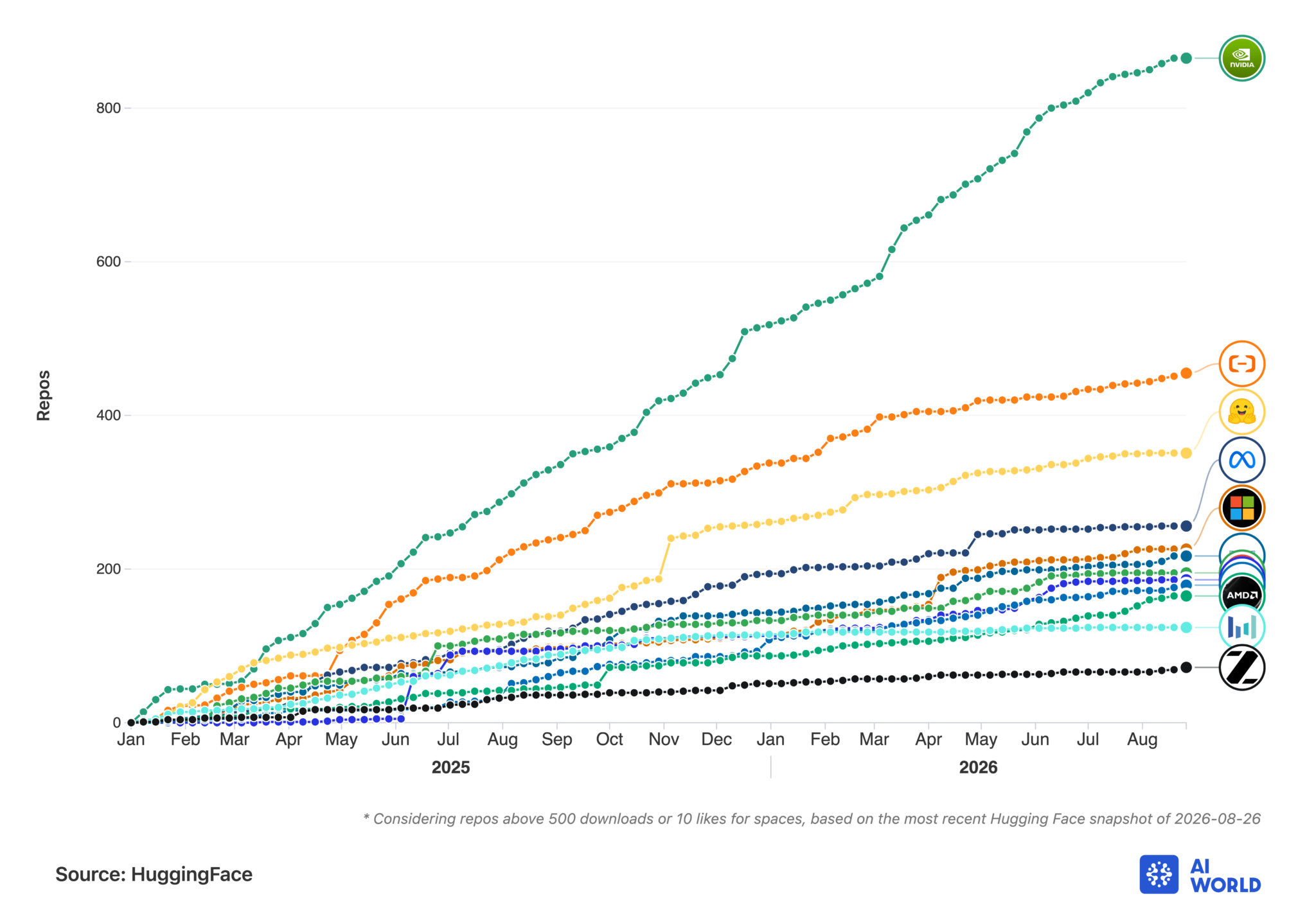
Nvidia’s own footprint on the platform is equally significant. With over 500 published models and 250 open datasets, Nvidia was already the most active participant in the community. This acquisition formalizes an existing partnership, effectively bringing the most important "customer" and the most important "vendor" under the same corporate umbrella.
Official Responses and Strategic Intent
Nvidia CEO Jensen Huang has framed the acquisition as a commitment to the open-source movement. Addressing concerns that Nvidia might "close off" the platform, Huang emphasized that Hugging Face will retain its brand identity and remain interoperable with multiple cloud providers and various hardware architectures.
"Clément Delangue, the founder of Hugging Face, approached us while evaluating the next stage of his company’s journey," Huang noted in a statement. "He and I agreed that Nvidia provides the ideal, well-resourced home for this community. Our goal is to accelerate the development of open-weight models, making them accessible to every developer, regardless of the size of their organization."
The message from Nvidia is clear: the company intends to be a "neutral" platform operator, even while being the primary beneficiary of the hardware sales that the platform generates. By investing in Hugging Face’s infrastructure, safety protocols, and deployment tools, Nvidia aims to lower the barrier to entry for AI adoption, thereby expanding the total addressable market for its high-performance chips.
Implications: The Future of the AI Industry
The acquisition carries profound implications for the tech industry, touching upon antitrust, open-source philosophy, and the future of cloud computing.
1. The "Open-Weight" vs. "Closed" Debate
While Nvidia claims it will maintain Hugging Face’s open nature, skeptics point to the inherent tension in a hardware monopolist owning an open-model repository. However, Nvidia’s argument is that by "opening" more models, it creates a rising tide that lifts all boats. If more companies can easily deploy high-quality open-weight models, they are more likely to purchase Nvidia hardware to run those models.
2. Deepening the Moat
By controlling the platform where models are discovered, Nvidia gains unprecedented insight into industry trends. They will be the first to know which architectures, frameworks, and use cases are gaining traction. This data is worth billions, as it allows Nvidia to optimize its future GPU roadmaps and software libraries to match emerging market needs before competitors even realize a shift is occurring.
3. Safety and Standardization
Nvidia has promised to use its resources to improve the "reliability and safety" of the Hugging Face platform. In the context of AI, this likely means integrating automated auditing tools, bias-detection frameworks, and performance-tuning software that is optimized for Nvidia silicon. While this improves the developer experience, it also subtly encourages developers to favor Nvidia-optimized paths, effectively creating a "soft" vendor lock-in.
4. Impact on Cloud Providers
Major cloud providers—AWS, Google Cloud, and Microsoft Azure—are currently the biggest customers of Nvidia’s H100 and Blackwell chips. With this acquisition, Nvidia becomes a direct service provider to the same developers who use these clouds. This creates a complex dynamic: Nvidia is both a supplier to the clouds and a platform owner that influences where those developers deploy their code.
Conclusion: A New Chapter
The $12.93 billion acquisition of Hugging Face is not just a financial transaction; it is a declaration that the era of "hardware-first" AI is evolving into an "ecosystem-first" strategy.
For the developer, the promise is one of continuity and increased performance. For the industry, the reality is that the lines between hardware provider, software vendor, and community platform are blurring. Nvidia has successfully positioned itself as the central architect of the AI age. As Hugging Face joins the Nvidia organization, the tech world will be watching closely to see if the promise of a "truly open" platform can coexist with the demands of a trillion-dollar hardware giant.
One thing is certain: the future of AI will be written, trained, and deployed on Nvidia-powered infrastructure, and now, it will be curated on an Nvidia-owned platform. The cycle of vertical integration is complete, and the stage is set for a new era of compute-centric intelligence.