Nana
Nana
For parents, the modern living room has become a minefield. While smart TVs have revolutionized how we consume media, they have also introduced a complex layer of risk. Between the infinite scroll of YouTube algorithms, the potential for accidental exposure to age-inappropriate content, and the frustration of navigating multiple, ad-heavy streaming interfaces, television time has become a source of anxiety rather than relaxation.
Recognizing this, Hisense, a global leader in consumer electronics, has announced a groundbreaking hardware solution: the industry’s first dedicated "Safe Streaming" remote control. By integrating this hardware with the Vidaa smart TV operating system, Hisense is aiming to shift the paradigm of child-centric media consumption from "policing the apps" to "creating a secure environment."
The Core Innovation: A Walled Garden for Kids
The initiative is the result of a strategic partnership between Hisense and A Parent Media Co Inc (APMC), the parent company of the acclaimed Kidoodle.TV service. The collaboration is designed to bypass the traditional complexities of parental controls—which often involve cumbersome PIN systems, individual app configurations, and constant monitoring—by providing a streamlined, hardware-level "walled garden."
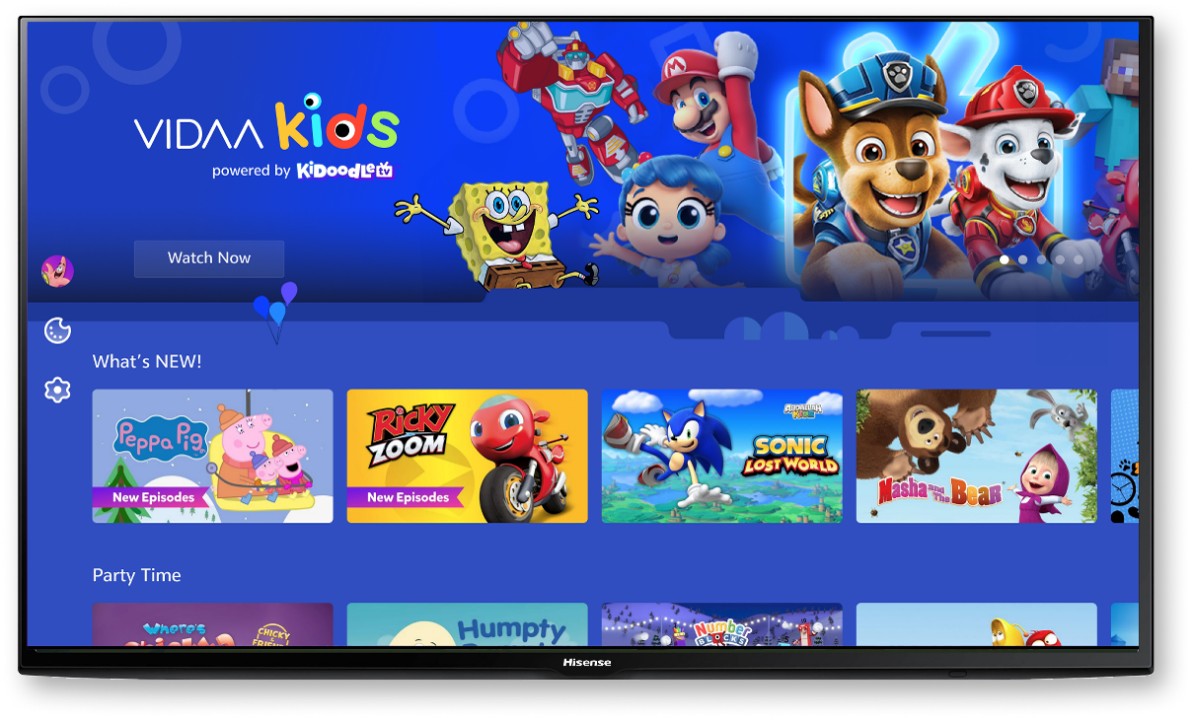
Instead of asking parents to curate content across disparate platforms like Netflix, Prime Video, or YouTube, the new Hisense system essentially creates a curated, kid-specific ecosystem. When the dedicated Safe Streaming remote is utilized, the TV interface pivots exclusively to "Vidaa Kids." This environment offers access to over 50,000 episodes of high-quality, age-appropriate programming, including beloved titles such as Spongebob Squarepants, PAW Patrol: Pup Tales, and Baby Shark.
The implications for household harmony are significant. By consolidating content into one secure app, the system eliminates the "app-switching" frustration that often leads children to click on unauthorized or mature content, effectively removing the possibility of accidental exposure to adult themes.

Chronology of Development: From Concept to 2026 Rollout
The road to the Safe Streaming remote reflects a broader industry trend toward "purpose-built" hardware.
- Initial Research and Development: Over the past 24 months, Hisense observed a growing demand from European and Asian markets for more robust, simplified child-safety features.
- The APMC Partnership: Discussions between Hisense and A Parent Media Co Inc began in early 2024, focusing on how to marry the Kidoodle.TV content library with the Vidaa OS architecture.
- The Prototype Phase: Throughout late 2024, engineers worked on mapping specific physical buttons on the remote to internal "safe-mode" commands, ensuring that the transition from a general viewing experience to a kid-safe zone was instantaneous.
- The 2026 Announcement: In the lead-up to the 2026 product cycle, Hisense confirmed that this feature would be a flagship selling point for their new premium television ranges.
- Current Launch: The rollout is currently underway, with the technology shipping as part of the 2026 MiniLED and RGB MiniLED product lines.
Supporting Data: Why "Safe Streaming" Matters
The necessity of this technology is backed by ongoing concerns regarding digital safety. According to recent surveys by the Children’s Digital Media Center, nearly 65% of parents report that they feel "somewhat" or "very" anxious about the content their children encounter on smart TVs when left unsupervised for even short periods.
The "Safe Streaming" approach addresses three primary pain points identified by consumer research:
- Complexity of Parental Controls: Traditional parental controls are often hidden in deep menu layers. By putting the control on the remote, Hisense brings security to the forefront of the user experience.
- Algorithm Risks: Algorithms in standard streaming apps are designed to maximize engagement, not prioritize age-appropriateness. The Vidaa Kids platform operates on a "human-curated" model, which is fundamentally safer.
- Hardware Obsolescence: Many parents are currently forced to use third-party "kiddie" tablets or separate dongles. Integrating this into the TV itself provides a cleaner, more robust solution that does not require additional hardware purchases.
Official Perspectives and Industry Impact
Hisense representatives have framed this release as a response to the "always-on" nature of modern households. "We wanted to create a solution that allows parents to step away for ten minutes to cook dinner or handle chores without the constant dread of what their child might find on the TV," said a spokesperson for the company.
A Parent Media Co Inc, the architects behind the content layer, emphasized the importance of high-quality, vetted media. "Our partnership with Hisense is about providing peace of mind. Every show available through the Safe Streaming remote has been vetted. It is not just about blocking the bad; it is about providing a rich, educational, and entertaining environment that is inherently safe."

Industry analysts have noted that this move could force competitors to reconsider their own UI/UX approaches. As smart TVs become the center of the home, companies that can offer "verified safety" as a core value proposition are likely to gain a competitive advantage with the crucial demographic of young families.
Technical Scope and Regional Availability
It is important to note the scope of this rollout. The Safe Streaming remote is designed specifically for the Vidaa operating system. Consequently, the feature is launching primarily in the UK, Europe, and select international markets where Vidaa is the standard OS for Hisense sets.
The integration will be available on the 2026 MiniLED and RGB MiniLED series, specifically:
- E8S Series
- U7S Series
- U7S PRO Series
- UR8S Series
- UR9S Series
Notably, this feature is not currently slated for the North American market, where Hisense TVs often utilize alternative operating systems like Google TV or Roku. This geographical limitation highlights a strategic choice to test the "walled garden" concept in markets where Vidaa has already established a strong, unified user base.
The Broader Implications for the Future of TV
The introduction of the Safe Streaming remote is a microcosm of a larger debate in the tech world: the tension between "open" and "closed" systems. While tech enthusiasts often champion the freedom of open, unrestricted platforms, parents—a massive segment of the consumer base—are increasingly voting with their wallets for "safe" and "curated" experiences.
If the Hisense experiment proves successful, we may see a shift in how smart TVs are marketed. The "Smart TV" of the future may move away from being a giant window into the uncontrolled internet and toward being a modular device that can switch between a "Professional/Adult" mode and a "Safe/Family" mode with a single button press.
Furthermore, this move sets a new standard for accessibility. By making safety a physical, tactile feature rather than a digital software setting, Hisense has made the technology accessible to children who are not yet tech-savvy and parents who are not technically inclined.
Final Thoughts: A Step Toward Digital Well-being
In an era where the screen is ubiquitous, the ability to control the environment is not a luxury—it is a necessity. Hisense’s Safe Streaming remote is not just a piece of plastic with a button; it is a declaration that the television industry is beginning to take its responsibility toward younger viewers seriously.
By removing the barriers to safety and the complexity of configuration, Hisense is offering parents more than just a TV—they are offering time. Time to finish a meal, time to fold the laundry, and most importantly, the peace of mind that comes from knowing that what their child is watching is, quite literally, safe by design. As we look toward the 2026 landscape, it is clear that the most "intelligent" feature a smart TV can have is no longer its resolution or its refresh rate—it is its ability to protect the most vulnerable members of our household.

 Asro
Asro
 Ali Ikhwan