Raul Delapena Setiawan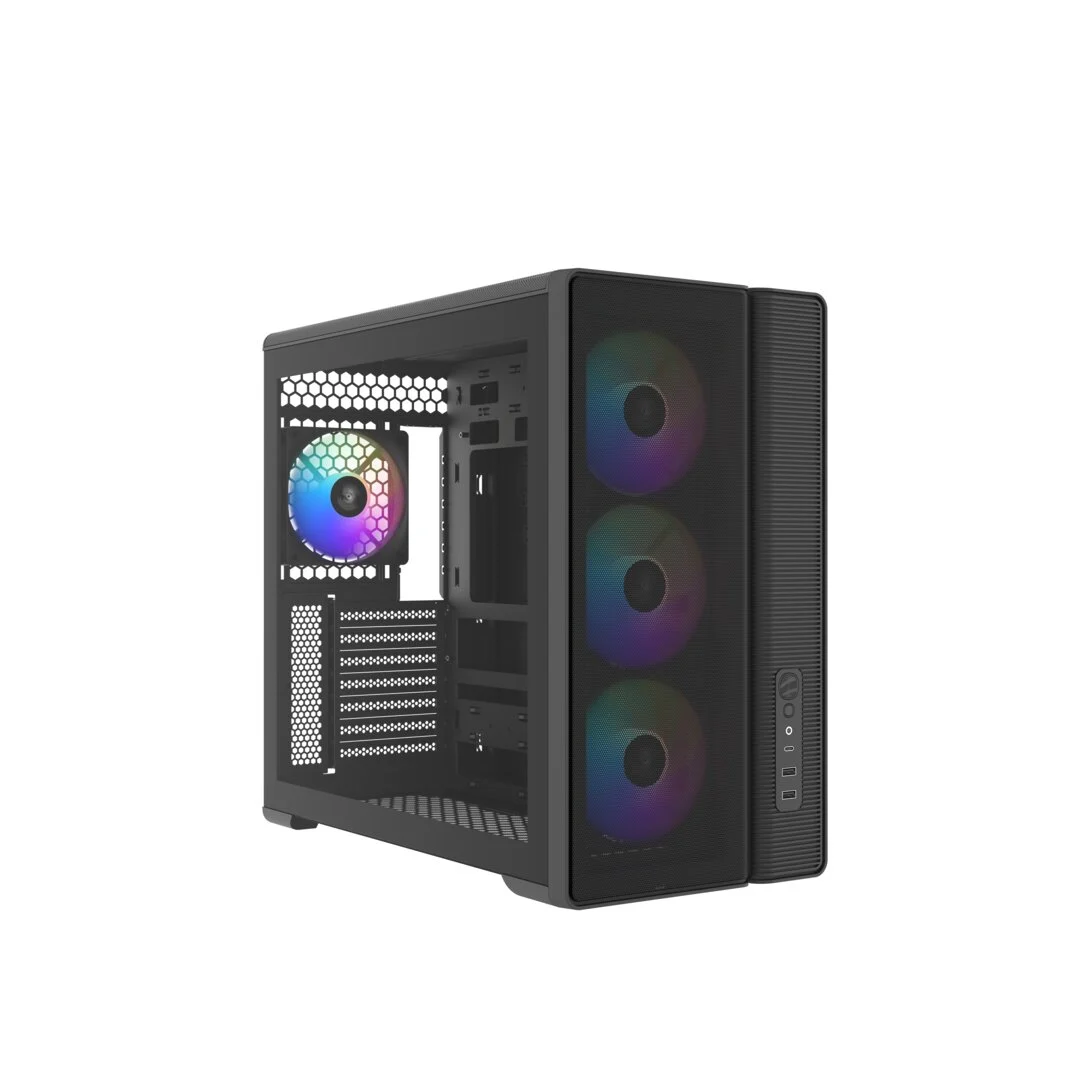
The landscape of PC case design has long been defined by a standardized layout that traces its lineage back to the era of 5.25-inch optical drives and legacy storage protocols. While many manufacturers have attempted to iterate on this traditional "box" design, few have managed to disrupt the status quo without compromising on thermal efficiency or hardware compatibility. Enter the Sama S50—a chassis that claims to "redefine" the compact ATX experience by fundamentally altering the positioning of the power supply unit (PSU).
By relocating the PSU to the front of the chassis, Sama is attempting to break the mold of the traditional ATX Midi-Tower. But is this a genuine revolution in form factor, or merely a clever "remix" of established concepts? This article explores the technical nuances, market implications, and architectural design of the new Sama S50.
Main Facts: A Shift in Internal Geometry
The core appeal of the Sama S50 lies in its unorthodox interior arrangement. Historically, the space behind the front intake of a case was reserved for optical bays—a relic of the late 1990s and early 2000s that has since become largely obsolete in the age of digital distribution and NVMe storage.
Sama utilizes this reclaimed real estate by mounting the power supply vertically and across the front panel, effectively "hanging" it behind the mesh front filter. By moving the PSU out of the traditional shroud located at the bottom rear of the case, the S50 gains a significant amount of vertical clearance. This repositioning allows for a more compact footprint while ensuring that the space above the motherboard remains unobstructed—a crucial requirement for users looking to mount high-performance AIO (All-in-One) radiators without the typical clearance battles associated with smaller towers.
Technical Specifications at a Glance:
- Dimensions & Volume: Approximately 48 liters.
- Cooling Configuration: Supports fans across the entire front mesh, top, bottom, and rear.
- Included Hardware: Four 120mm PWM fans (operating between 700–1,500 RPM, 28.5 dBA).
- Hub Support: Integrated LED/Fan hub capable of managing up to six units.
- Storage Capacity: Behind-the-motherboard tray accommodates up to four 2.5-inch drives or three 3.5-inch HDDs.
- Hardware Clearance: Supports CPU coolers up to 165mm in height and essentially unrestricted GPU length.
Chronology: The Evolution of Compact ATX
To understand why the S50 is generating discussion, one must look at the historical progression of PC case design.
In the early 2000s, ATX cases were monolithic, largely because they needed to house bulky optical drives and a multitude of 3.5-inch hard drive cages. As these components fell out of favor, the "empty space" problem emerged. Manufacturers initially dealt with this by creating large, hollow chambers that often led to poor airflow patterns.
Over the last decade, we have seen a "Micro-ATX/Mini-ITX" revolution where creative PSU placement became the gold standard for reducing volume. Designs like the Lian Li O11 series or various Jonsbo models began experimenting with moving the PSU behind the motherboard tray or into the front. Sama’s decision to apply this logic to a full-sized ATX tower is a culmination of years of enthusiast-driven research. While the S50 is not the first case to experiment with this front-mount design, it represents one of the most accessible iterations of this layout for the average consumer, moving the concept from niche enthusiast boutique builds into the mainstream retail channel.
Supporting Data: Thermal Dynamics and Airflow Efficiency
The primary benefit of moving the PSU to the front is the liberation of the floor and the rear exhaust path. In a traditional tower, the bottom intake fans are often suffocated by the presence of a massive power supply housing. In the S50, the removal of this obstruction allows for a "bottom-to-top" chimney effect, which is widely considered the most efficient way to cool a modern GPU.
Thermal Advantages
By placing the PSU in the front, Sama has ensured that the entire floor of the case can be utilized for intake fans that blow cool air directly into the GPU’s cooling fins. Furthermore, because the PSU is shielded behind its own bracket, it does not impede the airflow meant for the CPU or the PCIe lanes.
Noise Management
The inclusion of four pre-installed 120mm fans is a significant value add. Operating at a maximum of 1,500 RPM and capped at 28.5 dBA, these fans are designed to provide high static pressure without becoming an auditory distraction. The inclusion of a six-port hub is a welcome "quality of life" feature, as it mitigates the cable management nightmare often associated with front-mounted components.

Storage Flexibility
Despite the unconventional layout, storage has not been neglected. Sama has opted for a hidden mounting system located behind the motherboard tray. This approach keeps the main chamber clean and unobstructed, which is essential for the aesthetic appeal of a modern build, while still offering enough capacity for a multi-drive home server or workstation configuration.
Official Responses and Market Positioning
Sama has officially marketed the S50 as a way to "redefine" the compact ATX segment. However, industry analysts and the tech community have noted that while the case is innovative, it remains a "remix" of established engineering principles.
From a price-to-performance perspective, the S50 is positioned aggressively. At a retail price point of approximately €90 for the black model and €95 for the white, it sits firmly in the mid-range bracket. This makes it a direct competitor to "standard" mesh cases like the Fractal Design North.
While the Fractal Design North is celebrated for its Scandinavian aesthetic and wood accents, the Sama S50 competes on pure utility. It does not offer the premium materials of the North, but it offers a more flexible internal layout for users who prioritize cooling performance and hardware headroom over boutique design materials.
Implications: Is the S50 the Future of ATX?
The release of the Sama S50 carries several implications for the future of PC hardware design.
1. The Death of the "Empty Box"
The S50 is proof that consumers are no longer interested in buying empty, oversized cases. The industry is clearly moving toward cases that minimize "wasted" space while maximizing internal airflow. We expect to see more manufacturers adopting front-mounted or side-mounted PSU configurations in the next 18 to 24 months.
2. The Return of the "Utility-First" Design
For years, the industry focused on tempered glass and RGB lighting. The S50 suggests a pivot back toward "utility-first" design, where the internal structure is dictated by thermal requirements rather than purely visual trends. The inclusion of a robust fan hub and four pre-installed fans suggests that Sama recognizes that the "DIY" market is becoming more discerning about the total cost of ownership.
3. The Size Paradox
It is important to note that the S50 still occupies roughly 48 liters of space. While it is "compact" for an ATX case, it is not a small-form-factor (SFF) chassis. Users expecting an ITX-like footprint will be disappointed. However, for users who need a full-ATX motherboard and massive GPUs, the S50 offers a more streamlined experience than a traditional, cavernous tower.
Conclusion
The Sama S50 is an intriguing case that successfully bridges the gap between legacy ATX standards and modern thermal requirements. While it might not be the complete "redefinition" of the chassis that the marketing materials claim, it is a highly competent, well-thought-out piece of engineering that solves the most common airflow issues found in standard Midi-Towers.
For the builder who wants a high-performance system with excellent GPU temperatures, clean cable management, and a reasonable price tag, the S50 is a compelling choice. By relocating the PSU, Sama has proven that even in a mature market like PC hardware, there is still room for small, meaningful innovations that make a genuine difference in the daily experience of the end user. As we move forward, the success of the S50 will likely dictate whether this front-mounted PSU design becomes a new industry standard or remains a clever, specialized alternative to the traditional tower.

 Layla Zulfa
 Nana Muazin