


On May 12, 2026, music streaming giant Spotify experienced a significant, widespread service disruption that left millions of users worldwide unable to access their favorite playlists, podcasts, and audio content. The outage, which began mid-morning Pacific Time, triggered a massive surge in user complaints across social media and outage-tracking platforms, highlighting the fragility of modern cloud-based entertainment services.
The Scope of the Outage: A Global Phenomenon
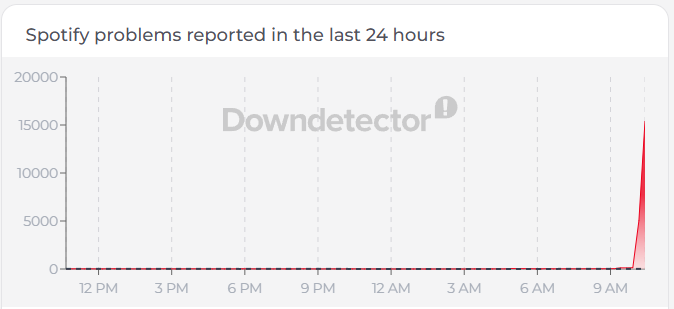
The disruption was not limited to a single region or server cluster; rather, it manifested as a truly global event. Shortly after 10:20 am Pacific Time, Downdetector—the industry standard for tracking real-time service outages—recorded a vertical spike in incident reports. What began as a trickle of approximately 100 reports at 9:30 am quickly ballooned into over 15,000 confirmed incidents within the hour.
User reports originated from diverse geographic locations, including the United States, Colombia, Spain, and North Macedonia. The outage map provided by Downdetector painted a stark picture of a service in distress, with major urban hubs across the U.S. appearing as "hotspots" of connectivity failure. Users reported a variety of symptoms, ranging from an inability to launch the application entirely to persistent errors during the login process and a complete failure of the search functionality.
Chronology of the Disruption
The timeline of the May 12 outage suggests a rapid escalation of technical failures.
- 9:30 am PT: Initial reports began to appear on monitoring platforms. At this stage, the volume was relatively low, suggesting localized connectivity issues rather than a systemic failure.
- 10:00 am PT: The frequency of reports increased, prompting initial concern among community moderators and power users.
- 10:15 am PT: Spotify’s social media team issued a proactive acknowledgement on X (formerly Twitter). This was a notable departure from standard corporate protocol, as companies often wait for an influx of data before confirming internal issues.
- 10:20 am PT: The "official" start of the major spike. Reports on Downdetector surged past the 2,000-mark in minutes, eventually peaking at over 15,400.
- 11:00 am PT and beyond: As of the latest update, the issue remained categorized as "under investigation" on Spotify’s official community forums.
The Disconnect Between Reality and Status Pages
One of the most frustrating aspects of the May 12 outage for subscribers was the inconsistency in communication. While the official @SpotifyStatus X account was relatively quick to acknowledge the technical difficulties, the company’s dedicated status page (spotify.statuspage.io) remained, for a significant duration, entirely uninformative.
Many users checking the official dashboard were met with the message that "all systems are operational." This lack of synchronization between user experience and official reporting tools drew sharp criticism from the tech community. Analysts noted that the status page appeared to be lagging behind the reality of the situation, with some observers pointing out that the page had not logged a significant incident in over two years—a statistical anomaly that undermined public trust in the tool as a reliable source of information.
User Experience: "The Page Got Tripped Up"
For the average listener, the outage manifested in a variety of frustrating error messages. The most common feedback indicated that the application would simply fail to load or, in some cases, refuse to authenticate credentials.
Some users were greeted with a whimsical, if unhelpful, error screen: "This page got tripped up. There was an error and we couldn’t load the page. You could try refreshing, or go back. If all else fails, why not go for a dance and come back later?" While intended to be a brand-aligned, lighthearted response to a server-side glitch, for users in the middle of a workday or a workout, the message served as a stark reminder of the limitations of streaming-only media consumption.
Technical Implications and Cloud Dependencies
The May 12 event underscores the increasing reliance on centralized cloud infrastructure for consumer media. As Spotify continues to integrate more features—including video podcasts, live audio rooms, and complex algorithmic recommendation engines—the backend architecture becomes increasingly complex.
When a service of this scale goes down, it is rarely due to a single "broken wire." It is more often the result of a misconfigured update, a failure in a content delivery network (CDN), or a hiccup in authentication servers. The fact that the application failed to even load for many users suggests that the issue occurred deep within the authentication or initial handshake layers of the service, preventing the app from even verifying the user’s subscription status.
The Role of Community and Transparency
During the outage, the Spotify "Ongoing Issues" board on the company’s community forums became a secondary hub for information. Moderators struggled to provide real-time updates as the engineering teams worked to isolate the root cause.
The incident highlights the critical role of transparency during digital crises. When users pay for a premium subscription, there is an implicit expectation of 99.9% uptime. When that expectation is not met, the way a company communicates—by acknowledging the problem early, as Spotify did on X—can significantly mitigate long-term damage to brand reputation. However, the failure of the automated status page serves as a reminder that even the largest tech companies struggle to keep their own internal reporting mechanisms aligned with the speed of global social media reporting.
Looking Forward: Lessons from the May 12 Outage
As of the time of writing, the situation is still being treated as an active investigation. The incident serves as a poignant case study for the streaming industry. As we move toward a world where physical media is a rarity and the "Cloud" is the primary vessel for our personal libraries, the impact of such outages becomes profound.
For the individual user, the outage acts as a wake-up call regarding the limitations of DRM-protected, online-only content. Without a local cache or an offline mode that remains robust during login failures, users are left entirely at the mercy of the provider’s server stability.
For Spotify, the priority in the coming days will likely involve a deep-dive post-mortem analysis. They must address why the official status page failed to reflect the reality of the outage and how they can improve the redundancy of their authentication services to ensure that, even if streaming services are interrupted, the app remains accessible.

In an era where "always-on" connectivity is expected, events like this are rare but disruptive. As the company works to restore full functionality to all regions, users are reminded that even the most sophisticated digital ecosystems are subject to the same laws of entropy as any other infrastructure. For now, millions of listeners are left waiting for the music to return, proving that in the digital age, silence is the most noticeable sound of all.












No comments yet. Be the first to join the conversation!