


Three different team members. Three separate approvals. Three distinct, conflicting versions of the same social media post. By 6:00 PM, when the content finally went live, the damage was done: the agency published a version from a stale Google Doc saved three weeks prior, completely bypassing two crucial rounds of revisions.
Nobody was careless. No one was negligent. The Slack thread buzzed with "all good" emojis at 11:00 AM, and the email chain confirmed "approved" by 2:00 PM. Yet, the final output was a relic of a discarded draft.
This is the "Version Drift" effect—a silent, structural failure that plagues marketing agencies from boutique shops managing five clients to global powerhouses juggling fifty. When the client inevitably asks, "Which version did you think we approved?" the silence that follows is the sound of a client relationship beginning to fracture.
The Anatomy of a Systemic Failure
To understand why this happens, one must look past the individual team members and into the infrastructure of the modern creative workflow. The failure isn’t human; it is architectural.
The Chronology of a Breakdown
Version drift rarely happens in a single, dramatic moment. It is a slow separation of truth. The lifecycle of a failed post often looks like this:
- The Origin: A copywriter creates a draft in a Google Doc.
- The Split: A manager copies that text into an email for a client.
- The Divergence: The client provides feedback via a quick WhatsApp voice note, which the account manager implements in the original Google Doc but forgets to update in the internal task management tool.
- The Confusion: A third team member, tasked with scheduling, pulls the "latest" file from the shared folder—unaware that the "approved" version is actually trapped in a thread buried three levels deep in an email chain.
- The Execution: The post is scheduled, published, and the error is only discovered once the client sees the wrong copy live on their feed.
In this scenario, everyone acted in good faith, yet the system failed to maintain a "Single Source of Truth."
The "Tool Trap": Why Collaboration Isn’t Management
The core issue lies in the reliance on tools designed for communication rather than state management. Google Docs, Slack, WhatsApp, and Email are exceptional at moving information. They are, however, catastrophic at holding a "final" status.
The Breakdown of Modern Infrastructure
| Tool | What It Does Well | Why It Fails as an Approval System |
|---|---|---|
| Google Docs | Real-time collaboration | No "locked" state; revision history is too chaotic to discern client sign-off. |
| Slack/Teams | Rapid, informal feedback | Conversations are ephemeral and disconnected from the asset itself. |
| Formalizing requests | Threads break, attachments get lost, and timestamps are buried. | |
| Immediate, casual sign-offs | Lacks the audit trail required for professional accountability. |
These tools lack the ability to bridge the gap between "this is a file" and "this is the legally binding, approved version of the truth." When approval is treated as a conversation rather than a system state, ambiguity is inevitable.

Supporting Data: The Cost of Disconnected Workflows
The impact of this fragmentation is not merely cosmetic; it is a measurable drain on agency resources.
A 2026 report by Swydo highlighted a harrowing case study: an agency lost 14 billable hours on a single campaign simply because three team members were working on three different versions of the same content simultaneously. When team members spend more time coordinating "who has the right file" than actually creating content, the agency’s profitability per client plummets.
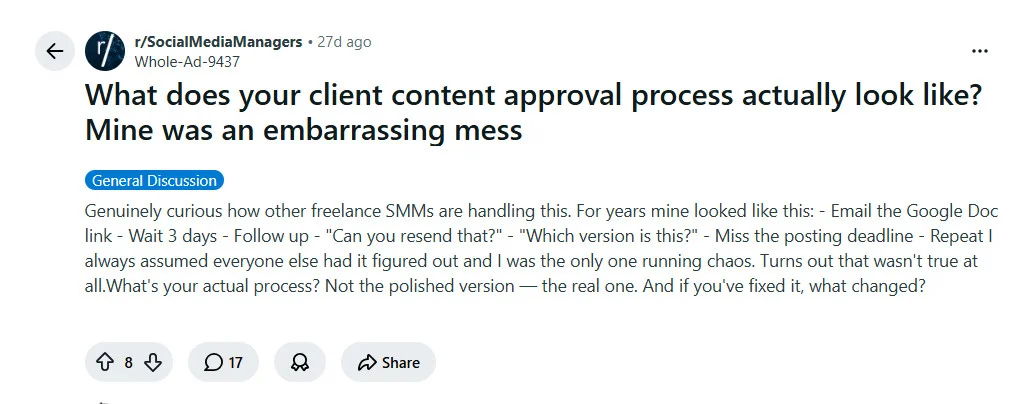
Furthermore, discussions on platforms like r/SocialMediaManagers reveal that this is a near-universal frustration. Managers frequently report that their days are dominated by "status chasing"—the non-billable, high-stress process of reconciling feedback across fragmented platforms. When an agency scales, this overhead does not just increase; it compounds, often leading to the "15-client ceiling," where the complexity of managing these threads makes further growth impossible without a complete collapse of quality control.
The Paradigm Shift: Approval as a System State
Agencies that have successfully eliminated version drift have stopped treating "approval" as a conversation and started treating it as a system state.
In a robust workflow, a post does not simply exist; it transitions through defined states:
- Draft: The creation phase.
- In Review: The feedback phase, locked from further internal changes.
- Client Approved: A locked state that prevents further editing and triggers the scheduling protocol.
- Scheduled: The final output.
When a post reaches the "Client Approved" state, the system acts as a vault. It ensures that the file being pulled by the scheduling tool is identical to the one that received the digital sign-off. The question for the team is no longer "Which version is final?" but rather "What is the status of this asset?"
The Role of Centralized Infrastructure
The only way to achieve this level of reliability is through a platform that integrates the workflow. By bringing drafting, feedback, and scheduling into one environment—such as SocialPilot—agencies can eliminate the need for external, disconnected tools.
Why Centralization Works:
- Elimination of Version Drift: Because the draft, the feedback, and the approved version live in one location, there is no "copying and pasting" between apps.
- Auditability: Every approval is stamped with a user ID and a timestamp, providing a clear trail for both the client and the agency.
- Efficiency: Account managers reclaim hours previously spent hunting for the "latest version" in email threads.
- Structural Integrity: When a post is "Approved," it becomes a rigid object. It cannot be accidentally altered by someone looking for a draft.
Implications for Agency-Client Relationships
The relationship between an agency and its client is built on trust, and that trust is maintained by consistency. When the wrong version of a post goes live, the client does not care about the internal miscommunication between a Slack thread and a Google Doc. They care about their brand identity.
The first time an error happens, a client may be forgiving. The second time, they begin to question the agency’s internal processes. The third time, they begin to look for a new partner.
Agencies that fail to resolve their structural infrastructure issues are effectively putting a ceiling on their client retention. It is not enough to be creative; you must be reliable. Reliability is not a personality trait; it is the result of a system that is structurally incapable of allowing the wrong version to go live.
Is Your Workflow Version-Proof?
If you are currently managing social media content, perform this audit on your own processes. If you cannot answer "Yes" to the following questions, you are operating with a significant risk of version drift:
- Does every draft start and stay inside one unified tool?
- Does client feedback arrive inside that same platform, rather than via email or chat?
- Can you see a definitive, timestamped record of who approved which specific version?
- Is it impossible for a team member to accidentally pull an old draft for publication?
- If a team member goes on vacation, can anyone else step in and immediately see the latest approved status?
If your answers are mostly "No," you are managing your agency’s reputation through luck rather than design.
Conclusion: The Only Version That Counts
In the eyes of the client, there is only one version that counts: the one that goes live. If your internal process relies on a chain of emails, shared documents, and chat messages, you are constantly one missed notification away from a failure that could cost you a contract.
The solution is not to "try harder" or to "be more careful." The solution is to change the environment. By moving to a system where approval is a locked, visible state, agencies can stop playing "detective" with their own content and start focusing on what they were hired to do: drive results.
The question is no longer whether your agency can afford to invest in a unified management system. The question is: what is the cost of staying in a system that eventually, inevitably, fails?












No comments yet. Be the first to join the conversation!