

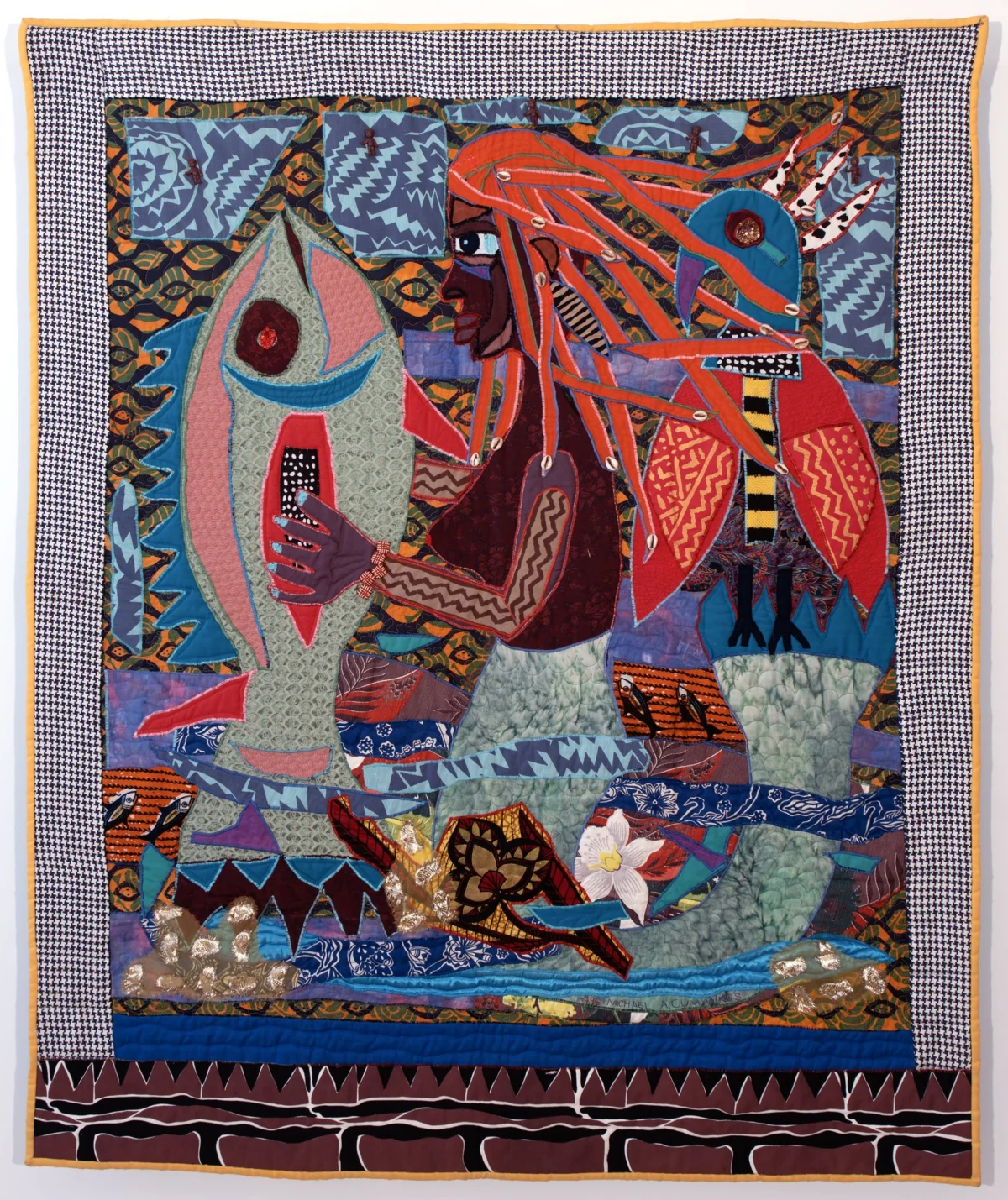
In the heart of Harlem, the Claire Oliver Gallery is currently hosting an exhibition that serves as both a profound aesthetic experience and a radical act of historical reclamation. Masters of the Stitch: Threaded Stories is not merely a display of craftsmanship; it is a meticulously curated assertion that Black quiltmaking—long relegated to the periphery of “folk art”—is a cornerstone of American fine art. Drawing from the formidable collection of Carolyn Mazloomi, founder of the Women of Color Quilters Network (WCQN), the exhibition brings together twelve visionary artists who transform fabric into a medium for cultural testimony, archival preservation, and public witness.
The Fabric of Memory: Main Facts of the Exhibition
Masters of the Stitch features a diverse array of works that span decades of creative output. From the intricate, near-abstract geometric patterns found in Sharon Kerry-Harlan’s Power in Numbers to the politically charged, portrait-driven works of Donna Chambers, the exhibition showcases how textile art serves as a repository for collective memory.

The exhibition is built on a central premise: the rejection of the “folk curiosity” label. For too long, the labor-intensive practice of Black quiltmaking was categorized by the art establishment as a domestic craft—an intimate, private hobby. Mazloomi’s curation flips this narrative, placing these textiles alongside traditional painting and sculpture. Each piece in the gallery functions as a historical document, capturing narratives that range from the personal—childhood nostalgia and familial bonds—to the epochal, such as the inauguration of President Barack Obama or the enduring legacy of the Freedom Train.
The gallery underscores that for generations, these textiles provided a sanctuary for stories that could not always be voiced aloud. In a society that often silenced Black voices, the quilt became a medium for resistance, grief, joy, and faith.

A Chronology of Craft: The Evolution of the Quilt as Fine Art
The trajectory of the artists featured in the exhibition reflects a broader shift in the American art world toward recognizing the intellectual rigor behind textile work.
The Foundational Years (1990s–2000s)
The exhibition includes earlier works like Michael Cummings’ Haitian Mermaid #2 (1996), which utilizes sequins, shells, and lamé to create a vibrant, sculptural narrative. During this period, quiltmakers began to aggressively integrate mixed media, moving beyond simple patchwork to incorporate found objects, acrylic paints, and industrial materials. Viola Leak’s About Jazz (ca. 2006) exemplifies this era, using metallic fibers, beads, and suede to capture the improvisational spirit of the music genre, effectively turning the fabric into a rhythmic, visual composition.

The Contemporary Renaissance (2010s–Present)
The last fifteen years have seen a surge in conceptual depth within the medium. Works like Sharon Kerry-Harlan’s On the Face Of It (2010) show a move toward large-scale, fine-art abstraction. This era also highlights the agility of the medium in responding to real-time events. Kathy Nida’s Covid’s Daughters (2020), for instance, provides an unflinching look at the biological and societal trauma of the pandemic. By representing anatomical organs through fabric, Nida demonstrates that quilting is as capable of clinical observation as it is of traditional ornamentation.
Recent works, such as Wendell Brown’s The Family (2024), continue this evolution by blending hand-painted elements with traditional hand-stitched techniques, proving that the medium is not static but constantly adapting to contemporary artistic languages.

Supporting Data: The Impact of the Women of Color Quilters Network
The importance of this exhibition cannot be measured without understanding the role of the Women of Color Quilters Network (WCQN). Founded by Carolyn Mazloomi, the organization has spent nearly four decades systematically documenting the history of Black quiltmaking.
- Institutional Shift: Before the WCQN, Black quiltmakers rarely saw their work in high-profile gallery settings. Today, artists associated with the network are increasingly represented in permanent museum collections, including the Smithsonian and the Museum of Arts and Design.
- Economic Empowerment: By fostering a professional network, the WCQN has helped elevate the market value of these textiles, allowing artists to pursue their craft as a viable, sustainable career rather than a secondary domestic activity.
- Archives as Art: The network maintains an extensive archive of oral histories and provenance records. This documentation is crucial; it ensures that the “threaded stories” are not lost to time but are preserved with the same rigor as the archives of a major institution.
Official Perspectives: The Philosophy of Public Witness
The curators at the Claire Oliver Gallery define the work in Masters of the Stitch as “simultaneously an intimate domestic practice and a form of public witness.” This duality is at the heart of the gallery’s mission to reframe the American art canon.

“Black American quilts occupy a singular position in the history of American art,” the gallery states. By centering the experiences of those whose lives were historically erased or marginalized, these artists are not just sewing fabric; they are sewing a new national narrative. The exhibition acts as a counter-history, where the stitches hold the tension between the pain of the past and the aspiration of the future.
The artists themselves speak to this philosophy in their work. Whether it is Peggie Hartwell’s evocative depiction of children waiting on a stoop in A Time to Wait (2015) or Marion Coleman’s haunting Living in the Shadows (2016), there is a shared commitment to narrative clarity. The quilts do not hide their meaning; they demand that the viewer engage with the lived reality of the figures depicted.

Implications for the American Art Canon
The inclusion of these works in a premier gallery space has significant implications for how we define "fine art."
- Dismantling Hierarchies: By showcasing these pieces, the exhibition challenges the historical bias that privileges Western-influenced painting and sculpture over indigenous or communal craft practices. It suggests that “fine art” is not defined by the material—be it oil on canvas or cotton on batting—but by the intent, the skill, and the depth of the narrative.
- The Democratization of Art History: Quilting has always been a practice of the people. By bringing this practice into the white-cube gallery environment, Masters of the Stitch democratizes the space, signaling to a new generation of artists that their heritage and their chosen medium are worthy of the highest levels of artistic consideration.
- A Call to Action for Collectors: The success of this exhibition sets a precedent for private and public collections. It serves as a directive that a comprehensive collection of American art is incomplete without the inclusion of Black textile narratives.
Conclusion: A Thread That Binds
Masters of the Stitch: Threaded Stories remains open through August 8 in Harlem. It serves as an essential destination for those interested in the intersection of sociology and aesthetics. For visitors looking to further explore this movement, the gallery suggests investigating the quilted paintings of Stephen Towns, which celebrate midcentury leisure in the South, or the globally recognized, vibrant portraits of Bisa Butler.

The exhibition is more than a display of objects; it is a conversation. It invites the viewer to look closer—not just at the fine stitching, but at the lives being told through every needle-prick. In a world where the noise of digital media often dominates, there is a radical, quiet power in the permanence of thread. These quilts remind us that history is not just written in books; it is woven, patched, and pieced together by those with the vision to preserve their own truths.
As the exhibition continues its run in Harlem, it leaves the viewer with a lingering question: what other stories are waiting to be stitched into the tapestry of our national identity? Masters of the Stitch provides the answer: all of them, provided we are willing to look, to listen, and to honor the work of the hands that held the needles.










No comments yet. Be the first to join the conversation!