

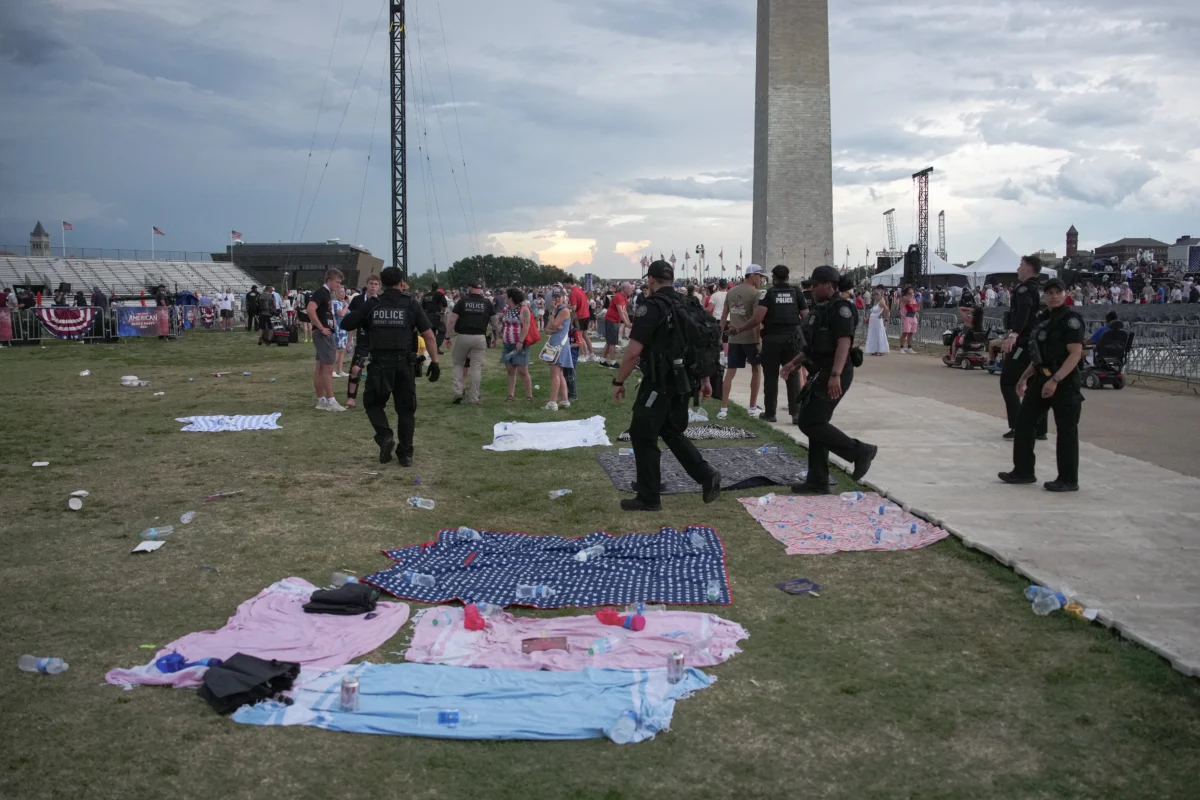
WASHINGTON, D.C. — The highly anticipated "Salute to America" celebration, a centerpiece event featuring a presidential address by Donald Trump and a massive fireworks display, was thrown into disarray late Thursday as severe, fast-moving storms swept across the nation’s capital.
What began as a day of record-breaking heat and military pageantry concluded with the abrupt evacuation of the National Mall. Thousands of attendees, who had gathered under a sweltering sun to mark the nation’s 250th anniversary, were forced to seek shelter as lightning and high winds triggered a suspension of the festivities.
The Chronology of a Disrupted Day
The atmosphere in Washington, D.C., was charged long before the clouds gathered. From the early morning hours, the city braced for a significant logistical challenge. The festivities were anchored by the "Freedom 250" programming, which included a series of military flyovers that necessitated ground stops at Washington Reagan National Airport and significant delays at Washington Dulles International Airport.
By mid-afternoon, the temperature in the region had reached triple digits, setting new records for the date. The sweltering heat, a common occurrence in D.C. summers, created a volatile atmospheric environment. By 5:00 p.m. ET, the National Weather Service issued warnings as scattered, intense storm cells began to materialize over the Potomac River.
The "Salute to America" event was slated to begin at 7:00 p.m. ET, with President Trump scheduled to deliver his remarks from a stage erected near the iconic Washington Monument. However, as the clock approached the start time, the threat of electrical storms rendered the outdoor venue untenable. At 6:45 p.m. ET, event organizers officially advised all attendees to vacate the grounds immediately.
Official Responses and Safety Protocols
The evacuation was a coordinated effort involving multiple federal agencies, including the United States Secret Service, the United States Park Police, the National Park Service, and the Federal Emergency Management Agency (FEMA).
Danielle Alvarez, a spokesperson for the Freedom 250 initiative, issued a formal statement emphasizing that the decision was dictated by a singular priority: public safety.
"The safety of our guests, performers, and staff is our top priority," Alvarez stated. "Due to approaching severe storms, Freedom 250, United States Secret Service, United States Park Police, National Park Service, the Federal Emergency Management Agency, and all public safety partners are asking all guests to evacuate event grounds and seek temporary shelter in a nearby building."
The Secret Service, tasked with the security of the President and the venue, took the additional step of suspending all admissions to the Mall. In a briefing, the agency noted that security checkpoints, which had been processing thousands of guests throughout the day, were effectively shuttered. "This action was taken solely in the interest of public safety, and we have no estimate for when screening may resume," a Secret Service representative confirmed.
To facilitate the movement of thousands of people in a short window, organizers provided a comprehensive list of nearby government and public buildings designated as emergency shelters. These included:
- The Department of Commerce
- The Department of Education
- The Department of Agriculture
- The Internal Revenue Service
- The VOA Building
- The Thomas Jefferson Memorial
- The National Museum of American History
- The National Museum of Natural History
- The National Museum of African American History and Culture
- The Ronald Reagan Building
Meteorological Context and Operational Challenges
The weather in Washington is notoriously unpredictable during the Fourth of July period, but Thursday’s conditions were particularly volatile. Monica Crowley, serving as the Chief of Protocol, addressed the situation on Fox News, noting that the intensity of the lightning strikes posed a clear and present danger to the large crowds assembled in an open-air environment.
"We are watching the weather very closely," Crowley stated. "The safety of the public and the security of the President are paramount, and the meteorological data coming in suggests that these storms are not passing through as quickly as initially anticipated."
The technical logistics of an event of this magnitude are immense. The stage set up near the Washington Monument, located just west of the Great American State Fair grounds, was equipped with sophisticated audio-visual equipment and pyrotechnic controls. High winds and potential water damage necessitated a complete halt to technical operations. As of 8:30 p.m. ET, the President’s address, which was originally scheduled for 9:45 p.m. ET, remained in a state of flux, pending a break in the severe weather window.
The Broader Implications: Celebrating a 250th Anniversary
The "Salute to America" was intended to be more than a political rally; it was marketed as a grand tribute to the nation’s 250th anniversary. The day was defined by "Freedom 250" events, a celebration of military prowess and American history. The inclusion of military flyovers—involving some of the most advanced aircraft in the U.S. arsenal—was a deliberate effort to project strength and unity.
However, the weather-related disruption serves as a stark reminder of the challenges inherent in hosting large-scale outdoor events in the nation’s capital. The event has faced scrutiny from various quarters, ranging from budget concerns regarding the cost of military displays to the logistical footprint on the National Mall.
The delay highlights the tension between the ambitious goals of the organizers and the uncontrollable variables of nature. For the thousands who traveled to D.C. to witness the speech, the event became a test of patience and resilience. The National Mall, usually a site of serene historical reflection, transformed into a scene of chaotic egress as families and tourists scrambled to find cover under the eaves of the Smithsonian museums and the heavy marble corridors of federal agencies.
Assessing the Economic and Social Impact
Beyond the immediate disruption, the meteorological event has had a tangible impact on the local D.C. economy. The hospitality sector, which had been operating at peak capacity for the holiday, faced a sudden shift in demand as thousands of patrons moved indoors. Local businesses and public transit systems were pushed to their limits as commuters and tourists attempted to navigate a city under a severe weather alert.
Furthermore, the postponement of the fireworks—a staple of the D.C. Independence Day experience—leaves a vacuum in the evening’s schedule. Fireworks are highly sensitive to wind conditions and low cloud cover; even if the rain ceases, the humidity and atmospheric instability may make the planned pyrotechnic show unsafe to execute.
Looking Ahead: Will the Celebration Resume?
As the night progresses, the primary question for event planners and the White House is whether the window for the President’s speech remains open. The "Salute to America" is not merely a speech; it is a meticulously choreographed production. Rescheduling such an event on short notice requires the re-coordination of Secret Service assets, broadcast crews, and local law enforcement.
The unpredictability of the storm front suggests that even a brief clearing might not be enough to resume full-scale operations. For now, the National Mall remains largely empty, a stark contrast to the festive crowds that occupied the space just hours earlier. The federal government, through its various agencies, continues to monitor the situation, maintaining a posture of extreme caution.
The incident is a sobering reminder that even the most carefully planned national celebrations are subject to the whims of the environment. While the nation’s 250th anniversary was meant to be a display of power and prestige, the evening has instead become a case study in crisis management and the necessity of prioritizing public welfare over political optics.
As the clock ticks toward the potential 9:45 p.m. speech time, the eyes of the nation remain fixed on Washington. Whether the event proceeds or is ultimately cancelled, the day will be remembered as one of the most logistically challenging celebrations in recent memory, defined by a battle between the pageantry of the state and the volatility of the summer sky.










