

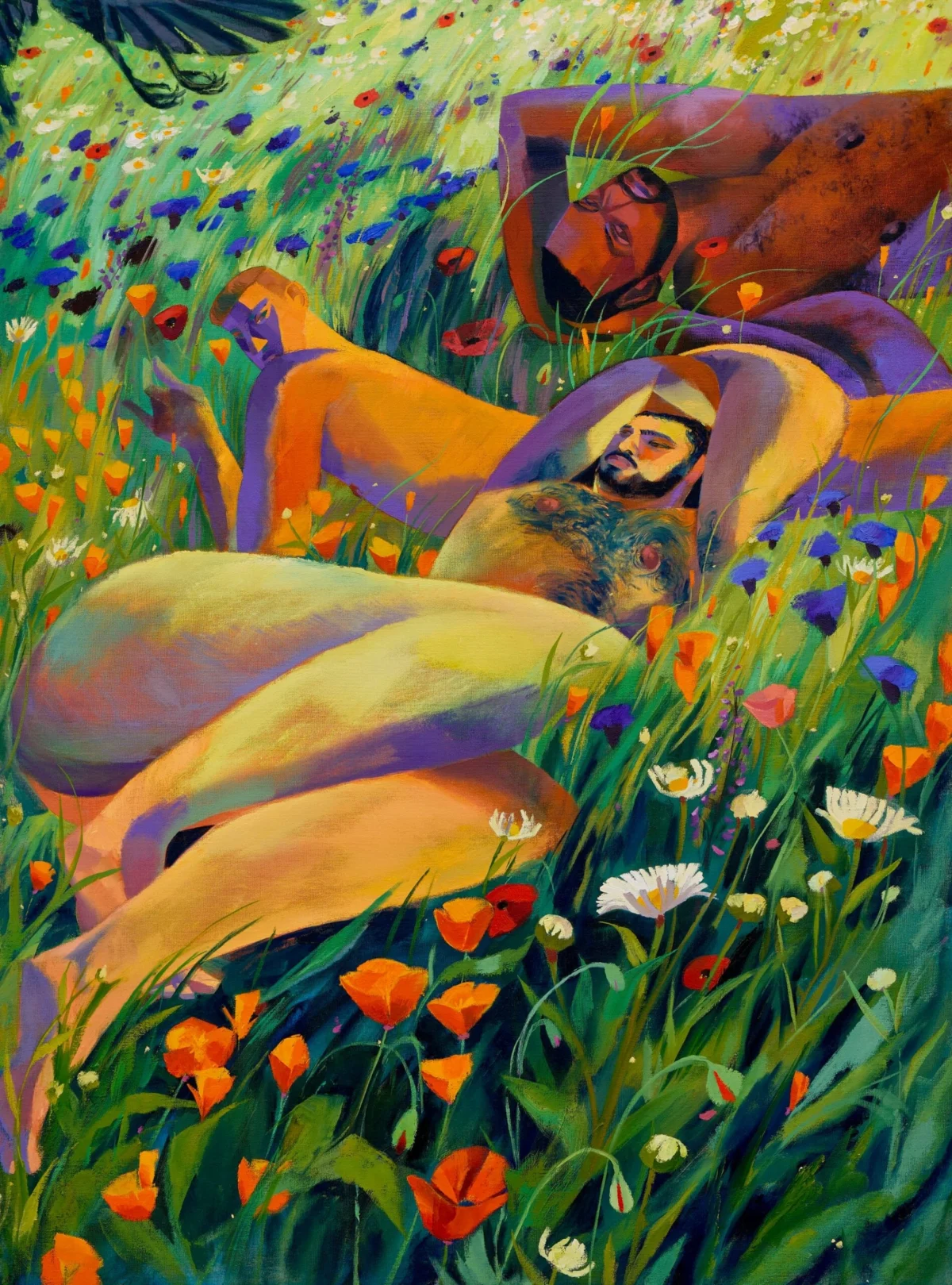
“Color, for me, is a heightened reality,” says J Carino, an artist whose work sits at the intersection of classical figurative tradition and a contemporary, queer-coded reimagining of the natural world. Through palettes rooted in a dynamic dance between earthy ochres and vibrant jewel tones, Carino renders lush, expansive scenes where nude figures commune with the environment in ways that feel both primal and deeply intimate.
His compositions are characterized by bold blocks of color and raw, gestural brushstrokes, which together challenge the viewer to reconsider the boundaries of the "natural." Whether depicting a sturdy back buttressing a fallen tree or a muscular grip cradling a small mule amid a surging, metaphorical flood, Carino’s work is an exploration of existence, resilience, and the inherent beauty of the queer experience.

Main Facts: The Architecture of Intimacy
At the heart of Carino’s practice is a commitment to blending the observation of the physical world with the internal landscape of personal identity. His paintings are not merely depictions of bodies in nature; they are psychological environments where the human form becomes one with the organic motifs of the meadow, the forest, and the water.
The artist’s process is a deliberate orchestration of varied inputs. He synthesizes renderings of live models, personal video documentation, and his own plein air pastel drawings—the latter of which are crucial in establishing the emotional temperature of his color palettes. “Typically, my work begins with observation of nature,” Carino notes. “It might be a fallen tree, a particular animal, or a plant that I then make drawings of.”

By researching the historical and cultural symbols associated with these forms, he allows connections to emerge spontaneously. This "collage-like aesthetic" is a hallmark of his style, where disparate elements—a biblical flood, a determined donkey, or the skeletal structure of an autumnal leaf—are woven together to create a cohesive, if enigmatic, narrative.
Chronology: A Path to the Canvas
Carino’s artistic trajectory has been one of consistent development, characterized by an evolving dialogue with his environment.

- Early Explorations: His foundational years were spent developing a visual language that prioritizes the "pattern" as a symbolic tool. He began to view natural motifs as a form of personal linguistics, allowing him to encode his paintings with larger themes of desire, paradise, and identity.
- The Shift toward Synthesis: Over the past few years, Carino has moved away from purely observational painting toward a more conceptual, narrative-driven approach. This shift allowed him to integrate his interest in the "queer life" into the fabric of his natural scenes, effectively "queering" the landscapes he once merely documented.
- The Relocation: Recently, Carino made the significant decision to relocate to London. This geographical transition has served as a catalyst for his next professional chapter, as he prepares to enter a master’s program at the prestigious Royal College of Art this fall.
- Current Momentum: June 2026 marks a pivotal moment in his career, with his work being featured in a major group exhibition at the Albertz Benda gallery in Los Angeles. This exhibition serves as a milestone, signaling his growing presence in the international contemporary art market.
Supporting Data: The Anatomy of a Painting
To understand the complexity of Carino’s work, one must examine the tension between his subjects and his application of paint. His compositions, such as the poignant "Flood" or the expansive "Eden," rely on a deliberate distortion of reality.
Technical Composition
Carino’s reliance on "blocks of color" is a departure from traditional realism. Instead of smoothing out transitions to create a photographic image, he uses visible, gestural brushwork to emphasize the physical act of painting. This creates a vibrating energy on the canvas—a sense of "heightened reality" that he so frequently cites.

Thematic Symbolism
The recurrence of certain motifs in his work is no coincidence. Research suggests that the "donkey," the "fallen tree," and the "meadow" are not merely background elements but are loaded with cultural history. By placing the queer body in these spaces, Carino reclaims the "pastoral" tradition, which has historically been used to frame specific, often exclusionary, notions of "natural" human behavior. In Carino’s world, the nude figure is not a passive object of the gaze but a participant in a grand, often tumultuous, struggle for survival and connection.
Official Responses and Critical Reception
The art world has responded to Carino’s work with increasing interest, particularly regarding his ability to balance technical rigor with emotional vulnerability. Critics have noted that his work avoids the trap of being purely "political," opting instead to explore queer existence through the lens of timelessness.

"There is a resilience in his work," says one curator familiar with the upcoming Albertz Benda exhibition. "Even when he paints disaster—floods or the collapse of a landscape—there is an overwhelming sense of beauty. He captures that uniquely human ability to find deep bonds with one another even in the face of chaos."
The artist himself maintains that the "collage-like" nature of his work is meant to reflect the complexity of modern life. By weaving together symbols that are historically disparate, he forces the viewer to engage in a process of active interpretation. He does not provide a singular answer; he provides a vocabulary.

Implications: The Future of Queer Landscape Painting
The implications of Carino’s work extend beyond the aesthetic. By placing the queer body at the center of the natural world, he is challenging the long-standing binary between "civilization" and "nature." In his paintings, the human is not a conqueror of nature but an integral part of its cycle—subject to its floods, its decay, and its growth.
The Educational Pivot
His upcoming enrollment at the Royal College of Art suggests a period of intense intellectual growth. Master’s programs often serve as a "pressure cooker" for emerging artists, and given Carino’s already strong foundation in theory and observation, this period is likely to result in a more sophisticated, perhaps more abstract, evolution of his current style.

Global Reach
With his move to London and his presence in Los Angeles, Carino is positioning himself at the center of the international art circuit. His work speaks to a global audience that is increasingly interested in "new figurations"—art that moves away from the sterile, digital-influenced aesthetics of the early 2010s and back toward a tactile, human-centered, and deeply personal style of painting.
The Legacy of "Heightened Reality"
As he continues to build his body of work, Carino’s legacy will likely be defined by his ability to make the viewer feel the weight of a brushstroke. His art is a reminder that reality is subjective, and that through the medium of paint, we can re-map the world to include the stories, bodies, and desires that were once relegated to the margins.

Whether he is capturing the quiet intimacy of two men embracing in "Everything is Golden" or the chaotic, survivalist energy of "Flood," J Carino continues to prove that the most radical act an artist can perform is to look closely, paint honestly, and refuse to apologize for the vibrancy of their own reality.
Exhibition Details:
- Exhibition: Group Exhibition
- Location: Albertz Benda, Los Angeles
- Opening: Early June
- More Information: J Carino’s Official Website | Instagram









No comments yet. Be the first to join the conversation!