

By Staff Reporter
Published: May 2026
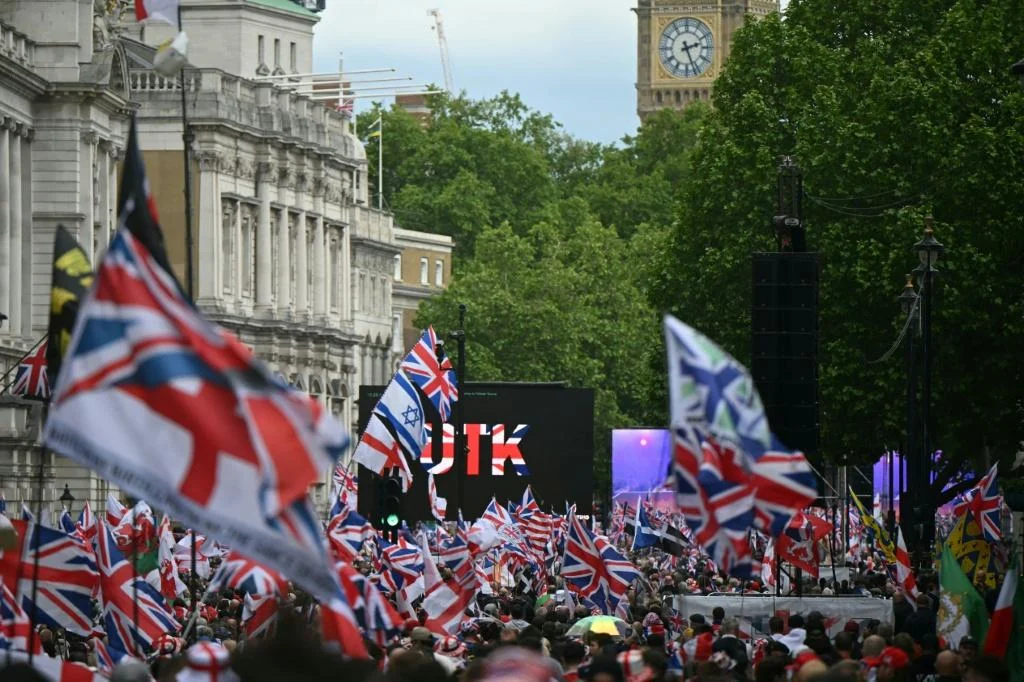
London’s Metropolitan Police force executed one of its most complex and large-scale security operations in recent memory this past Saturday, as the capital became the epicenter of a volatile ideological collision. Tens of thousands of demonstrators descended upon the city center for two distinct, diametrically opposed marches, testing the limits of public order and sparking a wave of arrests that reached a total of 43 by the end of the weekend.
The events—a far-right demonstration dubbed “Unite the Kingdom” led by activist Tommy Robinson, and a counter-protest combining anti-fascist efforts with a march marking "Nakba Day"—transformed central London into a grid of barricades and police cordons. As the day progressed, the initial atmosphere of political fervor gave way to a series of confrontations, leading to the detention of individuals for a spectrum of offenses ranging from public order violations to suspected hate crimes.
The Anatomy of the Conflict
The primary catalyst for the heightened security presence was the "Unite the Kingdom" march, organized by Stephen Yaxley-Lennon, known publicly as Tommy Robinson. A former football hooligan and a polarizing figure in British far-right politics, Robinson utilized the platform to call for what he termed a “cultural revolution.” Addressing a crowd gathered in Parliament Square, Robinson attempted to maintain a veneer of discipline, explicitly urging his supporters to abstain from alcohol and to refrain from wearing face coverings, framing the rally as a "peaceful and courteous" exercise of democratic expression.
Simultaneously, a significant contingent of counter-protesters, organized by the group Stand Up to Racism and supplemented by activists commemorating Nakba Day—which marks the displacement of Palestinians during the 1948 establishment of the State of Israel—marched through the city. The juxtaposition of these two groups, both deeply entrenched in their respective grievances and ideological frameworks, created a powder keg that the Metropolitan Police had spent weeks preparing for.
Chronology of a Tense Saturday
The Metropolitan Police’s strategy was proactive, deploying thousands of officers across the city center to prevent the two factions from converging in a manner that could incite violence.
- Morning hours: As early as 10:00 AM, the arrival of thousands of protesters from both sides saw the city center cordoned off. Police utilized high-visibility patrols and aerial surveillance to manage the flow of demonstrators.
- Early Afternoon: Tensions escalated as the march routes neared each other. Police utilized Section 12 and Section 14 powers under the Public Order Act to impose strict conditions on where protesters could congregate, attempting to maintain physical separation between the far-right participants and the pro-Palestinian/anti-fascist groups.
- The Mid-Day Rally: Tommy Robinson took to the stage in Parliament Square, positioning himself as the vanguard of a movement leading toward the 2029 general election, which he provocatively labeled the "battle of Britain." His rhetoric, while ostensibly calling for calm, drew immediate scrutiny from observers and law enforcement.
- Evening Unrest: As the events began to disperse, the volume of arrests rose. While the majority of attendees remained within the bounds of the law, a persistent minority engaged in behaviors that necessitated immediate police intervention. By the early hours of Sunday, the Met confirmed that 20 arrests had been linked to the Robinson-led march, 12 to the counter-protest, and 11 individuals detained were classified as non-affiliated or those whose specific protest links remained under investigation.
Supporting Data: The Breakdown of Charges
The scale of the police response was matched by the breadth of the charges brought against those detained. According to the data released by the Metropolitan Police on Sunday, the legal consequences for Saturday’s activities were significant.
Hate Crime Statistics
A core component of the police investigation centered on hate crimes. The Met confirmed that 11 arrests were directly related to offenses motivated by race, religion, sexuality, or disability.
- Nine arrests were made within the "Unite the Kingdom" march cohort.
- Two arrests were made at the Nakba Day gathering.
- Ongoing investigations: The force noted that an additional seven suspected hate crimes occurring at the pro-Palestinian protest remain under active investigation, suggesting that the final arrest figures may climb in the coming weeks.
Public Order and Assault Charges
Beyond hate crimes, the arrests reflected the raw nature of the confrontations:
- Assault on emergency workers: Two individuals were arrested for assaulting police officers during the course of their duties.
- Weaponry: One arrest was recorded for the possession of an offensive weapon.
- Compliance: Three people were detained at the Nakba Day protest specifically for failing to remove face coverings when directed to do so by officers, a tactic used by authorities to ensure identification and prevent the concealment of illegal activities.
- General offenses: Other charges included drunk and disorderly conduct, breach of public order, and, in a notable instance, the arrest of an individual suspected of supporting a proscribed organization.
Official Responses and Strategic Challenges
The Metropolitan Police have faced significant scrutiny regarding their handling of such events, particularly in light of the September protests where violent confrontations marred the proceedings. With crowd estimates fluctuating—the Met suggests 60,000 attended the "Unite the Kingdom" event, while organizers claimed significantly higher numbers—managing the sheer volume of humanity was a logistical triumph for the force, albeit one that came at a heavy cost in manpower and public funds.
While the Met did not respond to formal requests from AFP to comment on the discrepancy between official estimates and organizer claims, the force’s leadership emphasized that the primary objective was the maintenance of public safety.
"The policing operation was designed to ensure that the rights of those wishing to protest were balanced against the safety of the wider public," a spokesperson for the force stated. "We will continue to investigate every report of criminal behavior, regardless of which side of the political spectrum the perpetrator aligns with."
Implications: A Divided Nation
The events of Saturday serve as a grim reflection of the increasingly polarized political climate in the United Kingdom. As Britain looks toward the next general election cycle in 2029, the rhetoric employed by figures like Robinson—who frames political participation as a form of “cultural revolution”—suggests that the coming years will be defined by further ideological friction.
The intertwining of domestic far-right grievances with global geopolitical issues, such as the Israeli-Palestinian conflict, has created a complex web of protest culture. This intersectionality makes it increasingly difficult for police to isolate individual movements, as protests are no longer monolithic, but rather multifaceted demonstrations of anger.
Moreover, the prevalence of hate crime allegations during the weekend’s events underscores a troubling trend in public discourse. The use of language and symbols that target specific groups based on their identity is becoming a hallmark of these street demonstrations, forcing the legal system to grapple with the fine line between free speech and the incitement of hatred.
For Londoners, the sight of thousands of police officers in full tactical gear, the sound of chants echoing through the corridors of power, and the presence of barricades in Parliament Square have become an all-too-frequent reality. As the city recovers from the weekend’s disruptions, the question remains: can the democratic process withstand the pressure of such intense street-level agitation?
The events of Saturday confirm that the battle for the "soul" of the nation is being fought in the streets of London, and as the 2029 election approaches, the intensity of these confrontations is unlikely to wane. The Metropolitan Police will be forced to continue refining their strategies, not only to manage the immediate security threats but to ensure that the fundamental right to protest does not devolve into a cycle of permanent, and potentially violent, social fragmentation.
© 2026 AFP












No comments yet. Be the first to join the conversation!