For years, the "desktop computer" has been synonymous with consumer-grade components—silicon intended for gaming, content creation, or office productivity. However, the paradigm shifted at Computex 2026, where Nvidia introduced a new breed of hardware: the DGX Station. While initially shrouded in secrecy regarding pricing, the industry’s worst-kept secret is now official. A listing from hardware integrator Exxact has confirmed that the entry price for this enterprise-grade beast, the Valence VWS-158270643, sits at a staggering $94,930, with high-end configurations easily pushing past the six-figure mark.
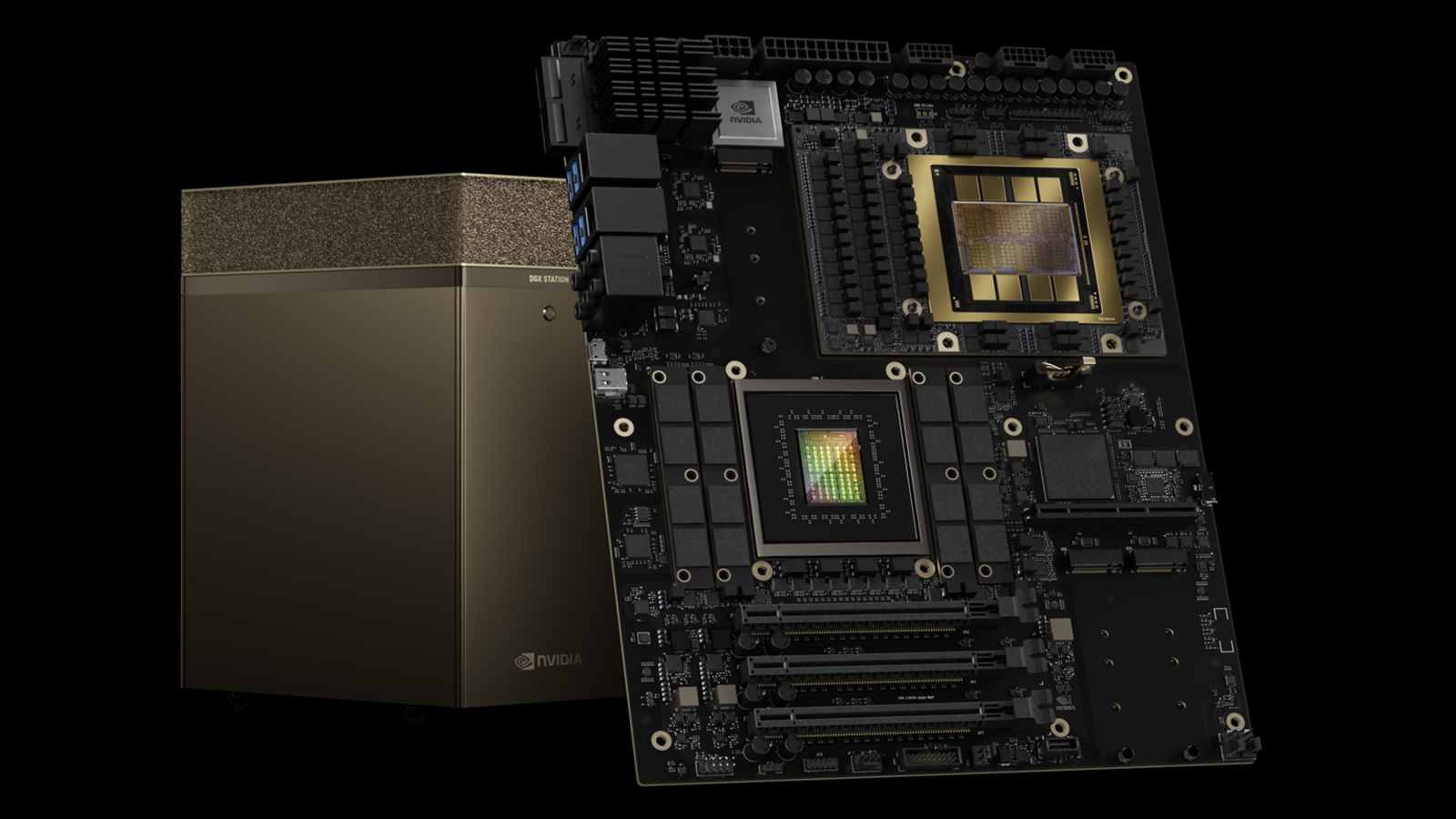
This is not merely a high-end workstation; it is an AI supercomputer in a tower chassis. By bringing the "Blackwell" architecture to a desktop form factor, Nvidia is enabling researchers, developers, and large enterprises to handle massive AI workloads locally, effectively bypassing the latency, security risks, and recurring token costs of cloud-based AI infrastructure.
The Anatomy of a Superchip: The GB300
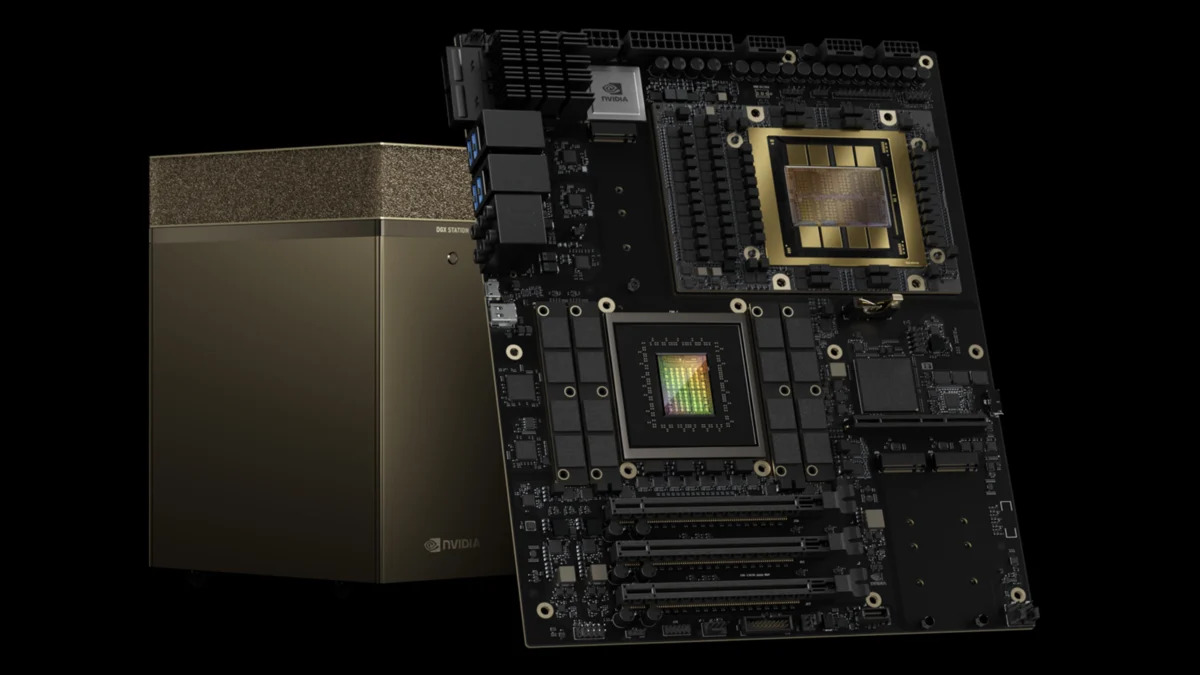
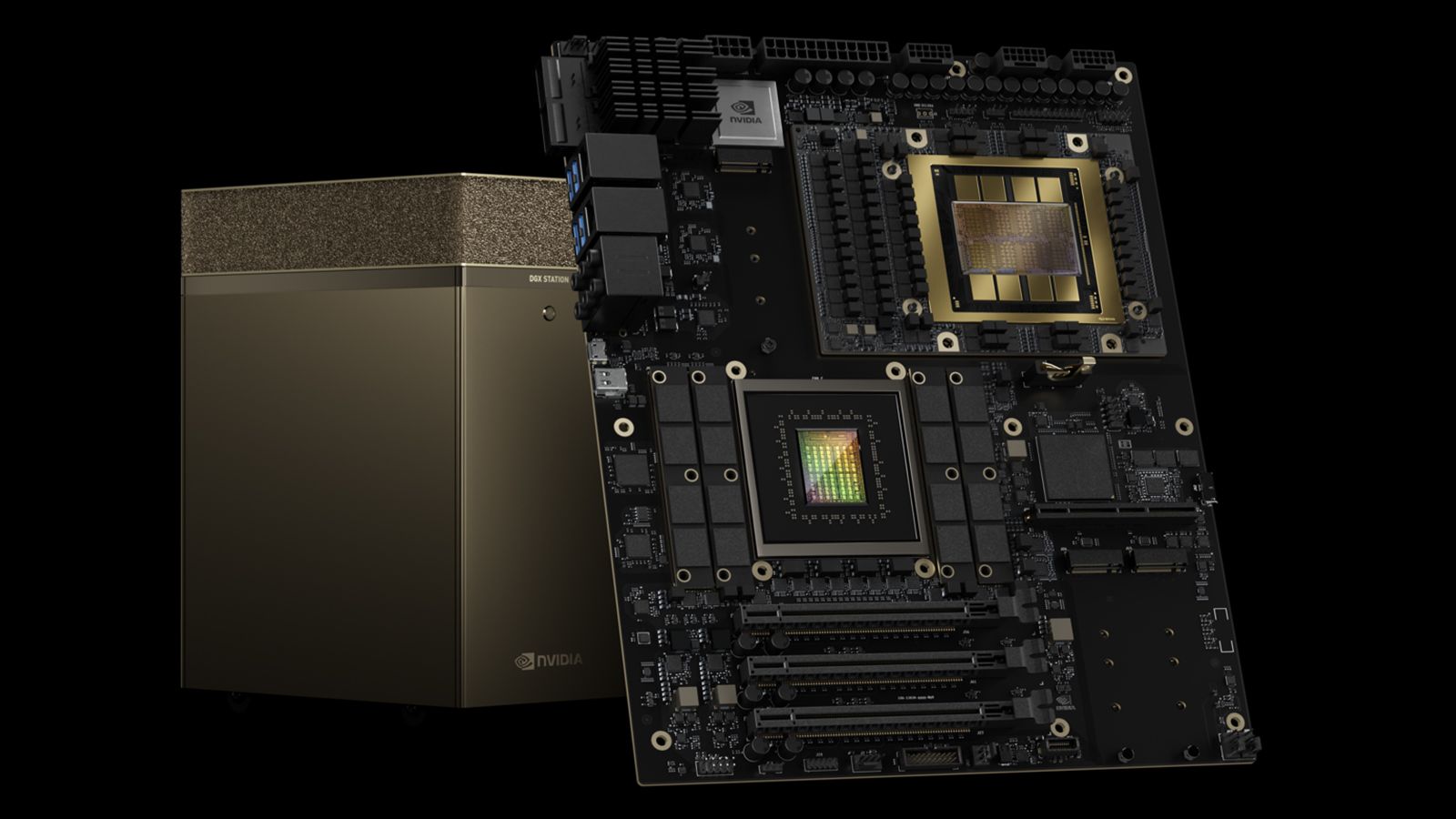
At the heart of the Valence VWS-158270643 lies the crown jewel of modern compute: the Nvidia GB300 Grace Blackwell Superchip. This is not a typical CPU-GPU arrangement. Instead, it represents the pinnacle of heterogeneous computing.
The GB300 architecture integrates a high-performance Blackwell Ultra GPU, boasting a massive 252GB of HBM3e (High Bandwidth Memory) with a 72-core Arm-based Grace CPU. These two powerhouses are fused together via a 900 GB/s NVLink-C2C interconnect. This high-speed bridge allows the processor and the graphics core to share a unified memory pool of 748GB (including 496GB of LPDDR5x RAM).
For data scientists, this massive pool of memory is the difference between success and failure. Modern Large Language Models (LLMs) and generative AI architectures require vast amounts of VRAM to perform inference or fine-tuning. By providing 748GB of unified memory, Nvidia allows users to load complex models directly onto local hardware, enabling rapid iteration without the need for massive server clusters.
Chronology: From Rumors to Retail
The journey of the DGX Station to the public market has been one of calculated ambiguity.
- June 2026 (Computex): Nvidia officially unveiled the DGX Station at Computex, showcasing its potential to revolutionize local AI development. During the event, Nvidia representatives remained famously tight-lipped about pricing, often dodging questions or citing the nature of enterprise-grade procurement.
- Summer 2026: Speculation began to swirl. Industry analysts and enthusiasts hypothesized that the unit would cost roughly $100,000, given the rarity of the Blackwell silicon and the complexity of the cooling requirements.
- August 22, 2026: The speculation was confirmed when Exxact Corporation published a listing for the Valence VWS-158270643. The listing provided the first concrete price tag for the hardware, bringing an end to the guessing game and revealing the reality of "Blackwell-tier" pricing for the desktop market.
The refusal of Nvidia to provide a public MSRP at launch was largely expected. In the enterprise world, hardware is rarely sold "off the shelf." Instead, it is part of a broader service contract, including support, deployment, and bespoke configuration. The Exxact listing is significant precisely because it democratizes the transparency of this high-end pricing, even if the purchasing process remains a "request a quote" affair.
Technical Specifications and Configuration
The Valence VWS-158270643 is not just about the Superchip; the supporting ecosystem is equally robust.
Power and Cooling
Running an AI supercomputer in a desk-side tower requires significant thermal management. The unit utilizes a direct-to-chip (D2C) liquid cooling solution for both the Grace CPU and the Blackwell Ultra GPU. This is supplemented by a high-airflow chassis featuring three dedicated fans. Despite the massive power density, the system is powered by a 1,600W 80+ Titanium power supply, meaning the unit can be plugged into a standard wall outlet rather than requiring specialized industrial power infrastructure.
Connectivity and Expansion
The rear I/O is a testament to the system’s role as a network node. It features:
- 2x QSFP112 ports: Driven by an integrated ConnectX-SuperNIC, these ports allow for 800 Gbps interconnect speeds, enabling two DGX Stations to be linked together to create a localized mini-cluster.
- Management Ports: A dedicated 1Gbps RJ45 port for BMC (Baseboard Management Controller) and a mini-DisplayPort for local BMC management, ensuring that IT departments can monitor the unit remotely.
- Standard Connectivity: 4x USB Type-A ports, a 10 Gbps RJ45 data port, and a 3.5mm headphone jack for local debugging.
Storage and Customization
While the base configuration starts at $94,930, users can customize their units based on storage needs. High-performance PCIe 5.0 SSDs are available to handle the immense datasets required for AI model training. Furthermore, users can opt to install a secondary display-out GPU—such as the RTX Pro 6000 Blackwell—to provide local graphical output, as the GB300 Superchip is strictly a compute-focused module and lacks video display headers. Top-tier, fully-loaded configurations can see prices rise to approximately $108,350.
Why Buy a $100,000 Desktop?
The core question remains: why would a company spend $100,000 on a single desktop when cloud-based GPU services like AWS or Google Cloud offer scalable access to similar hardware? The answer lies in three key pillars: Security, Latency, and Sovereignty.
Data Privacy and Security
For financial institutions, healthcare providers, and government agencies, the risk of sending proprietary or sensitive data to a cloud provider is often unacceptable. By deploying a DGX Station, these entities can keep their data and their fine-tuned AI models behind their own firewall. The "air-gapped" nature of a local workstation provides a level of security that cloud multi-tenancy simply cannot match.
Eliminating Token Costs
Cloud-based AI models are often billed by the token or by the hour. For a startup or an enterprise team iterating on a model 24/7, these costs can spiral out of control. With a DGX Station, the capital expenditure (CapEx) is front-loaded, but the marginal cost of running the machine is limited to electricity. Over a three-year period, this can prove more cost-effective than a massive, recurring cloud bill.
Localized Iteration
Developing AI models requires constant testing and refinement. The ability to "tweak and test" locally, without waiting for cloud deployment pipelines, allows researchers to iterate at the speed of their own hardware. It is the difference between working in a sandbox and working in a remote, shared laboratory.
The Broader Implications for the AI Industry
The availability of the DGX Station signals a maturation of the AI market. We are moving past the era where AI was exclusively the domain of hyperscalers like Meta or Microsoft. As hardware becomes more capable and specialized, the "democratization of compute" is beginning to take root.
However, this democratization comes with a high barrier to entry. At $100,000, these machines remain out of reach for independent researchers and small businesses, reinforcing the gap between well-funded AI laboratories and the rest of the tech world.
Furthermore, the shift toward liquid-cooled, high-performance desktop units suggests that the future of the office is changing. We may soon see "AI closets" or specialized data-center-grade desks in the offices of Fortune 500 companies, housing hardware that, just a decade ago, would have required a dedicated, climate-controlled server room.
Conclusion
The Nvidia DGX Station, powered by the GB300 Grace Blackwell Superchip, is a marvel of modern engineering. While the price tag of $94,930 to $108,350 is undeniably high, it is a calculated investment for organizations that prioritize speed, security, and the ability to control their own destiny in the AI-driven landscape. As we look toward the future, the success of this platform will likely dictate how large organizations approach the next generation of generative AI development—moving away from the cloud and back to the edge, one $100,000 tower at a time.