

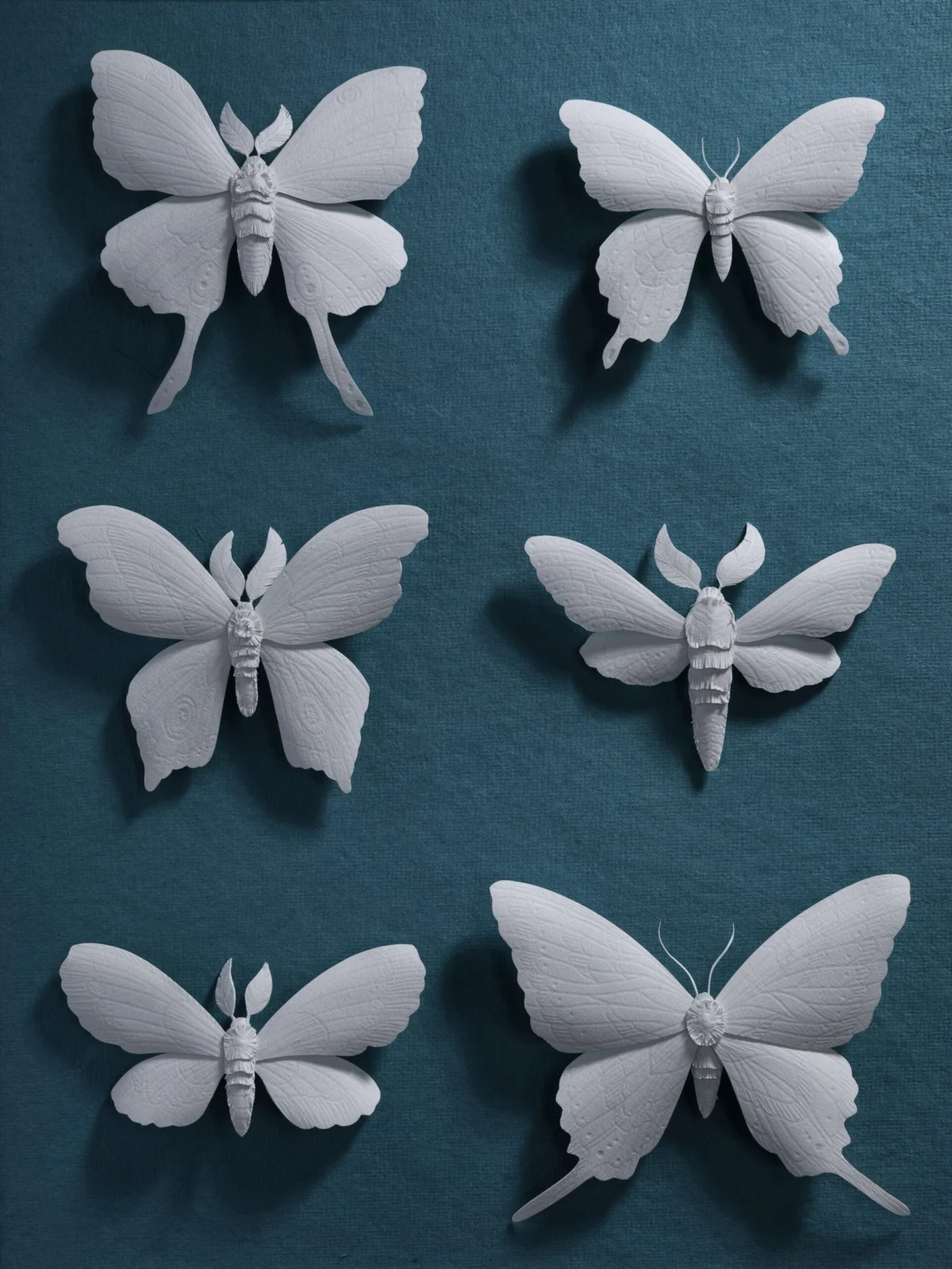
In the quiet, methodical atmosphere of her Boulder, Colorado studio, Marisa Aragón Ware performs a daily act of transformation. With nothing more than a scalpel, a steady hand, and stacks of paper, she breathes life into the discarded and the commonplace. Her work—intricate, multi-layered white paper reliefs of flora and fauna—has garnered international attention for its uncanny ability to blur the line between the fragile and the monumental. By carving, scoring, and folding, Ware elevates an ephemeral material into a testament to the natural world’s complex, interconnected beauty.
Main Facts: Sculpting the Natural World
Marisa Aragón Ware is a contemporary sculptor whose practice centers on the delicate intersection of biological observation and artistic intervention. Her primary medium is paper—a material she intentionally selects for its universality and its overlooked nature.

Her process is one of intense precision. Each piece begins with a rigorous study of organic forms. Whether she is rendering the skeletal structure of a mammal, the gossamer veins of an insect’s wing, or the rhythmic unfolding of a woodland petal, Ware prioritizes anatomical accuracy. Through a meticulous technique of cutting and scoring, she introduces volume and depth to flat sheets of paper, creating reliefs that play with light and shadow. The resulting images are not merely representations of nature; they are tactile invitations to observe the intricacies of the environment that often go unnoticed in the rush of daily life.
A Chronological Evolution: From the Rockies to the Studio
To understand the depth of Ware’s work, one must look to her formative years in the Rocky Mountains. Her childhood was defined by a sensory immersion in the Colorado wilderness. This was not a passive experience; it was a tutelage in the natural sciences, facilitated by her father, a scientist who taught her to identify and appreciate the hidden lives of fungi, wildflowers, and forest birds.

The Scientific Foundation
These early lessons instilled in Ware a reverence for biodiversity. As she transitioned into adulthood, this scientific foundation became the backbone of her art. Initially, her fascination with the organic was a hobby—a way to catalog the beauty she saw on her hikes. However, over time, this fascination evolved into a formal artistic practice. She moved from sketching to sculpting, finding that the three-dimensional nature of paper allowed her to better capture the "volume" of the world she grew up studying.
The Shift to Exploration
In recent years, Ware has reached a pivotal juncture in her career. Having spent decades mastering the technical precision required for her hyper-realistic reliefs, she has begun a period of internal questioning. She is currently exploring how to marry her high-level technical skills with a "beginner’s mindset." This shift is leading her toward experimental territory, including the integration of cyanotypes and more intuitive, less controlled methods of creation. This evolution marks a transition from purely observational art to a more exploratory, conceptual practice.

Supporting Data: The Theory of Biophilia
At the core of Ware’s artistic philosophy is the biophilia hypothesis, a concept popularized by biologist E.O. Wilson. The hypothesis posits that human beings possess an innate, genetically determined tendency to seek connections with nature and other forms of life.
Why Nature Matters
For Ware, this is not just a theory—it is a directive. She argues that the human need for nature is not merely a matter of survival, but a fundamental requirement for our psychological and spiritual health. Her sculptures serve as "biophilic triggers," designed to reignite the viewer’s connection to the wild.

"Our need for nature extends far beyond physical survival; it also nourishes imagination, spirituality, and our sense of meaning," Ware notes. By stripping away color and focusing on form and texture, she forces the viewer to engage with the essential "essence" of the animal or plant. This, she believes, is the first step toward fostering a protective instinct for the ecosystems they inhabit.
Official Responses and Perspectives
The art world has responded with significant enthusiasm to Ware’s ability to turn the "mundane" into the "extraordinary." Her inclusion in high-profile exhibitions, such as the Common Waters showcase at Arch Enemy Arts, underscores her relevance in the contemporary art conversation.

Critics and curators have frequently highlighted the "tension of the medium" in her work. Because paper is associated with the disposable—grocery lists, newspapers, and packaging—its elevation into a permanent, venerated work of art creates a jarring but welcome dissonance for the audience. As Ware herself puts it: "Paper is deeply familiar—everyone has handled it, written grocery lists on it, folded it, torn it, discarded it. Because it’s such an everyday material, there’s something especially powerful about transforming it into something unexpected."
The Call for Conservation
Ware’s work is frequently categorized as "environmentally conscious art." By focusing on the fragility of her subjects—moths, skulls, wings—she mirrors the vulnerability of the species she depicts. Her participation in exhibitions like Common Waters, which often functions as a fundraiser for ocean conservation, cements her status as an artist who views the gallery space as a platform for advocacy.

Implications: The Future of Paper Art
The implications of Ware’s practice are twofold: they speak to the future of material exploration and the role of the artist in the climate era.
Reclaiming the Beginner’s Mind
Ware’s current focus on loosening her technique is a significant development. In an era where hyper-realism is often achieved through technological intervention or obsessive digital precision, Ware’s return to the "hand-made" and the "uncontrolled" is a radical act. By incorporating cyanotypes—a 19th-century photographic printing process—she is allowing the unpredictability of light and chemical exposure to dictate parts of her work. This suggests a future where the artist acts less as a controller and more as a collaborator with nature.

The Power of Intimacy
Perhaps the most profound implication of her work is the scale of the impact. In a world saturated with digital imagery, the quiet, analog nature of paper relief demands physical presence. It forces the viewer to stand close, to look for the veins in the paper-petals, and to acknowledge the deliberate, slow labor involved.
As she continues to evolve, Ware’s work remains a bridge between the clinical observation of her childhood and the urgent, spiritual necessity of the present. Whether through her intricate moths or her stark, beautiful skulls, she reminds us that nature is not just a backdrop for our lives, but a complex, fragile partner that requires our constant, careful attention.

Conclusion: A Living Legacy
Marisa Aragón Ware’s journey from the forests of Colorado to the forefront of contemporary paper sculpture is a testament to the power of sustained, curious observation. She has not only mastered her medium; she has imbued it with a philosophy that is both ancient and vital. As she moves forward into a new phase of experimentation, one thing remains clear: her commitment to the "biophilic" connection will continue to shape not just her own artistic output, but the way her viewers perceive the delicate, paper-thin balance of the natural world.
For those interested in witnessing this transformation firsthand, her recent work remains a vital stop on the circuit of contemporary ecological art. Through her eyes, a simple sheet of white paper is never just paper—it is a forest, a wing, a life, and a reminder of all that we must work to preserve.









No comments yet. Be the first to join the conversation!