


For decades, the vibrant, high-definition packaging of Japanese snacks has been a hallmark of the konbini (convenience store) experience. From the neon-bright bags of Calbee potato chips to the meticulously designed graphics of seasonal delicacies, the visual marketing of Japanese food is a multi-billion-dollar industry. However, as of late May, those aisles are beginning to lose their luster.
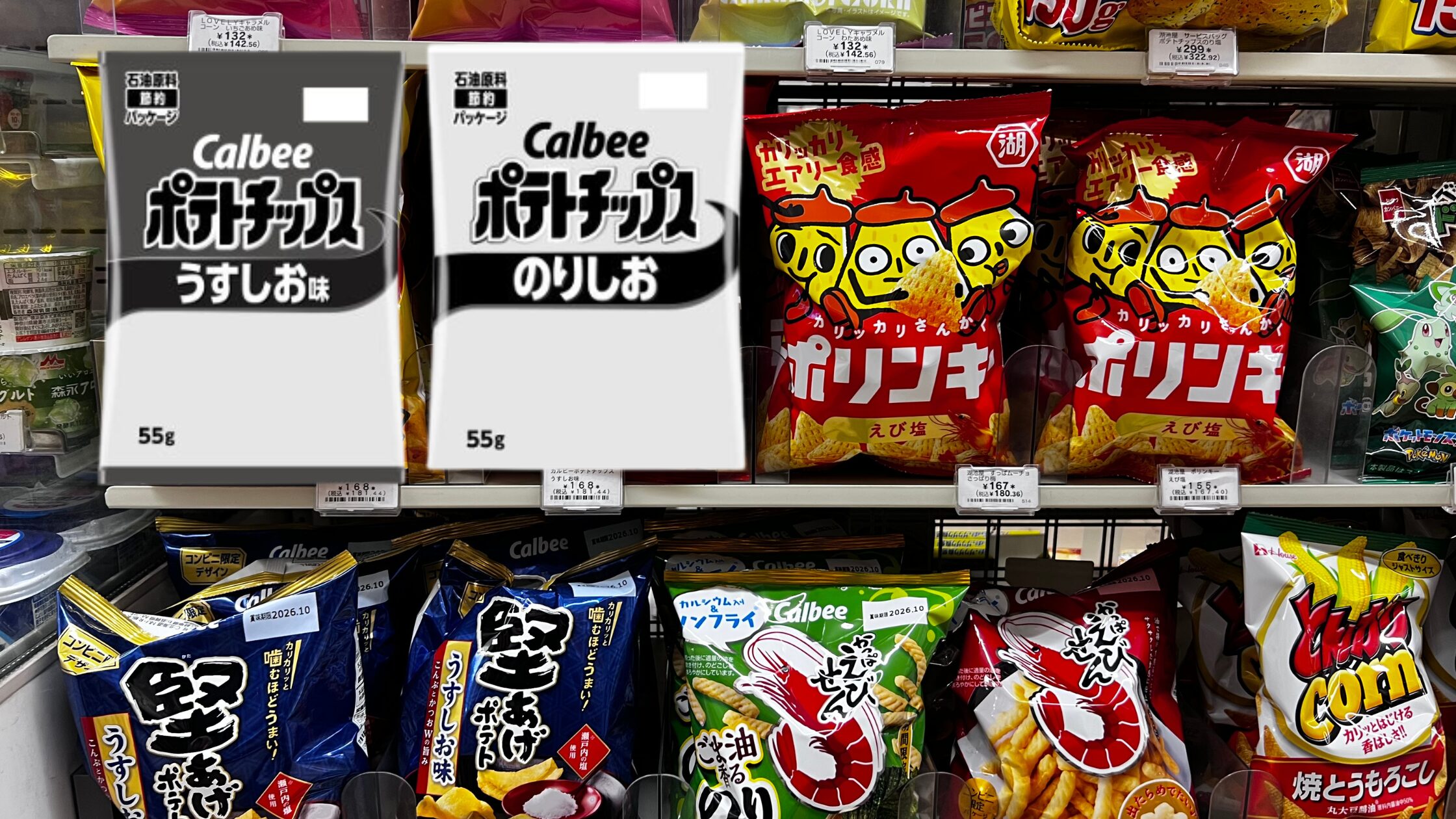
A stark, minimalist aesthetic is taking over, as major manufacturers—led by industry giant Calbee—have begun shipping products in black-and-white, text-heavy packaging. This transition is not a trendy marketing pivot or a minimalist design experiment; it is a visible, tactile symptom of a deepening supply chain crisis triggered by the ongoing conflict in the Middle East. The disruption has cut off the flow of naphtha, a critical petroleum derivative, effectively starving the ink-pigment industry of its essential raw materials.
The Trigger: A Crisis in the Strait of Hormuz
The roots of this domestic disruption lie thousands of miles away. On February 28th, the closure of the Strait of Hormuz—a vital maritime chokepoint for global energy markets—sent shockwaves through international supply chains. Japan, a nation that relies heavily on energy imports, was immediately placed in a precarious position.
Naphtha, a clear, volatile liquid obtained from the distillation of petroleum, is the lifeblood of the modern plastics and chemical industries. Beyond its role in manufacturing the plastic films used for food packaging, it is a non-negotiable feedstock for the production of the pigments used in industrial printing. When the supply of crude oil—and by extension, refined naphtha—stalled, the downstream chemical industries that support Japanese manufacturing felt the impact almost instantly.
Chronology of a Corporate Pivot
The impact of the supply chain freeze began to manifest publicly in early May. On May 25th, Calbee, which commands a dominant position in the Japanese market—holding over 50% of the overall snack market and more than 70% of the domestic potato chip sector—formally announced a shift in its packaging strategy.
The company confirmed that 14 of its flagship products would transition to monochrome labeling. The first wave of this shift, effective the week of May 25th, includes consumer staples such as Potato Chips Usushio, Kappa Ebisen (shrimp crackers), and Frugra (granola). This will be followed by the Kataaage Potato line in late June.
While Calbee has been transparent about the "Middle East situation" being the driving force, they have yet to provide a projected end date for this measure. The austerity extends beyond simple packaging; reports from FNN Prime Online indicate that the company has quietly canceled the July launch of a new Sour Cream-flavored potato chip line. This "invisible" loss—a product that will never reach the shelves—serves as a grim reminder of how far-reaching the economic consequences of this geopolitical instability truly are.
A Viral Reality: When Satire Meets Fact
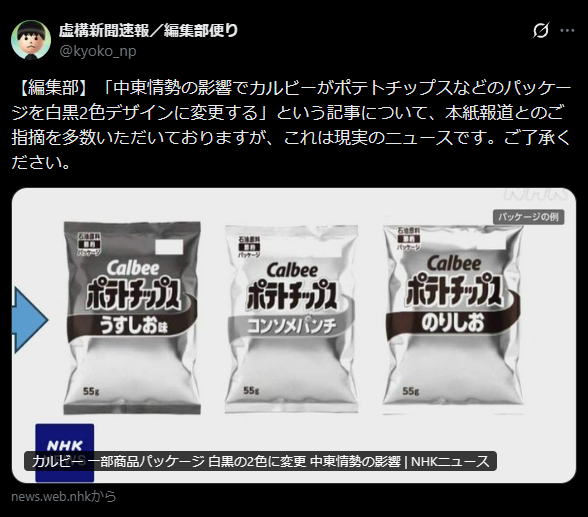
The visual impact of monochrome packaging has been so jarring that it sparked immediate skepticism across Japanese social media. Many users, accustomed to the colorful, consumer-centric nature of the snack industry, initially dismissed the photos as elaborate internet hoaxes or creative marketing stunts.
The confusion reached such a fever pitch that Kyoko Shimbun—Japan’s premier satirical news outlet, often compared to The Onion—had to issue a formal clarification on its social media channels. The outlet, known for its biting, fictional headlines, felt compelled to inform its followers: "This is real news." This moment of absurdity underscored the severity of the situation; when the public finds it easier to believe in satire than the reality of a global supply chain breakdown, the disconnect between the severity of the crisis and the public’s perception is profound.
Official Responses: The Government’s "Hearing"
The announcement from Calbee has placed the government of Prime Minister Takaichi Sanae in an uncomfortable position. In the same week that Calbee issued its warning, members of the Takaichi administration were adamant that there was no disruption in Japan’s naphtha supply.
Deputy Chief Cabinet Secretary Sato Kei struck a dismissive tone when questioned about the shift in packaging. "In addition to continuing domestic naphtha refining using stockpiled crude oil, imports of naphtha from non-Middle Eastern sources have tripled in May compared to levels prior to the escalation of tensions in the Middle East," Sato told reporters. He noted that the national supply is balanced: 40% from the Middle East, 20% from alternative foreign sources, and 40% produced domestically.
Following these statements, the government announced it would hold a "hearing" with Calbee executives. This move has been widely interpreted as an attempt to pressure the company to maintain the status quo, yet it also highlights a critical failure in the government’s diagnostic approach.
The Disconnect: Aggregate Data vs. Industrial Reality
The friction between the government’s narrative and the reality faced by manufacturers stems from a fundamental misunderstanding of supply chain complexity. The government is measuring success in aggregate tonnage—the total volume of naphtha reaching Japanese shores. However, industrial chemical production is not a monolith.
The pigment production chain requires specific grades of chemical precursors, not just raw petroleum. The instability in the market has disrupted the niche suppliers who refine naphtha into the complex chemicals required for high-grade printing inks. When these specialized suppliers fail to receive their feedstock, the entire downstream process grinds to a halt.
Calbee is not an outlier. Industry reports suggest that other major players are facing similar dilemmas. Ito Ham, a titan in the processed food sector, has reportedly informed the Nikkei that it is considering its own "lower-color" runs for product packaging. The fact that multiple industry leaders are taking identical, drastic steps suggests a systemic failure at the bottom of the supply chain—one that cannot be corrected by simple government assurances or rhetoric.
Broader Economic Implications: The Looming Inflation
The monochrome packaging issue is merely the tip of a much larger, more dangerous iceberg. The Takaichi administration is already under intense scrutiny for its inability to mitigate rising consumer prices. Takaichi campaigned heavily on the promise of temporarily eliminating the consumption tax on groceries—a policy that currently sits in legislative limbo.
The visual shift in the snack aisle serves as a constant, daily reminder of the government’s perceived inaction. Furthermore, the economic data suggests that this is only the beginning of a larger inflationary cycle. Since the pandemic and the onset of the conflict in Ukraine, Japan has endured steady increases in utility and transportation costs. The most acute pressure point in the past year was rice, which saw prices skyrocket after a disastrous growing season, forcing the government to tap into strategic reserves to stabilize the market.
While rice prices have recently begun to retreat—with some analysts even fearing an oversupply-driven crash—the damage to the broader consumer basket is already done. Over 6,000 products have seen price hikes in the past year, while countless others have been subjected to "shrinkflation," where companies reduce package sizes while maintaining price points to mask the impact of rising costs.
Conclusion: A Precursor to Wider Pain
If the naphtha shortage continues, the repercussions will ripple far beyond the snack aisle. Experts warn that the same chemical constraints affecting ink production will soon hit the manufacturing of toiletries, cosmetics, and essential household seasonings.
The monochrome snack bag is more than just a piece of cardboard or plastic; it is a signal of a tightening economy. For the average Japanese consumer, the visual shift in their local konbini may be the first warning sign that the real economic pain is not behind them, but waiting on the horizon. As supply chains struggle to adapt to a world of heightened geopolitical risk, the monochrome shelf may well become the defining aesthetic of a new, more difficult era for the Japanese consumer.












No comments yet. Be the first to join the conversation!