

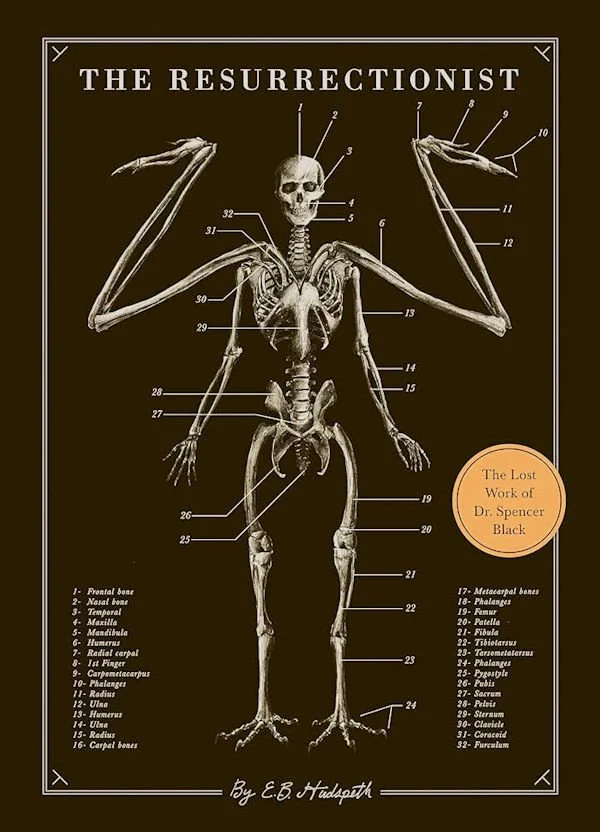
In the landscape of contemporary speculative fiction, few works manage to bridge the gap between historical realism and grotesque fantasy as effectively as E.B. Hudspeth’s The Resurrectionist. Set against the smog-choked, gas-lit backdrop of 1870s Philadelphia, the book presents itself not merely as a novel, but as a recovered artifact—a testament to the life and psychological disintegration of the fictional Dr. Spencer Black. By blending a biographical narrative with a meticulously illustrated anatomical atlas, Hudspeth has created a genre-bending experience that challenges the reader to question where scientific inquiry ends and pathological obsession begins.
Main Facts: A Convergence of Myth and Medicine
At the heart of the narrative is Dr. Spencer Black, a protagonist born into the shadow of his father’s illicit trade as a grave robber. Raised amidst the macabre realities of the Philadelphia medical scene, Black ascends to the hallowed halls of the Academy of Medicine, a gifted student with a radical, borderline heretical theory.
Black’s hypothesis is as audacious as it is disturbing: he posits that the mythological creatures of antiquity—the sphinx, the siren, the centaur, and the harpy—are not merely the products of ancient imagination. Instead, Black argues they are the evolutionary precursors to humanity. He views these beasts not as monsters, but as biological anomalies that have been marginalized and misunderstood by history. The novel traces his journey from a promising, albeit unconventional, medical prodigy to a disgraced outcast who ultimately abandons the constraints of academic ethics to prove his theory through the most visceral means possible.
Chronology: The Descent of Dr. Spencer Black
The narrative trajectory of The Resurrectionist is a study in the erosion of moral boundaries. While the text is brief, its progression is marked by distinct, escalating phases:
Phase I: The Academic Prodigy (The Early Years)
The reader is introduced to a young, driven Spencer Black. His education at the Academy of Medicine is marked by brilliance and a detachment from the societal norms of the late 19th century. His interest in anatomy is coupled with an obsession with congenital deformities, which he begins to categorize alongside legendary creatures.
Phase II: The Hypothesis (The Middle Period)
Black begins to document his findings in secret. He starts to synthesize his medical training with his burgeoning belief in "mythological biology." It is during this period that his work shifts from clinical observation to a fervent, desperate search for physical evidence. His interactions with his peers become strained as his theories are rejected by the scientific establishment.
Phase III: The Unraveling (The Carnival and Beyond)
Driven by the need for funding and autonomy, Black pivots toward the world of sideshows and carnivals. This marks the most tragic turn in his life, as he descends into a world where science is secondary to spectacle. The narrative chronicles his transition from a respected surgeon to a man living on the fringes, his sanity increasingly compromised by the weight of his "discoveries."
Supporting Data: The Codex Extinct Animalia
Perhaps the most compelling component of the work is the Codex Extinct Animalia, which occupies the latter half of the volume. Presented as an authentic medical textbook, the Codex provides a series of anatomical plates illustrating the internal workings of creatures ranging from the minotaur to the satyr.
These illustrations are not mere sketches; they are rendered with the clinical, detached precision of an 1870s medical atlas. The muscle structures, skeletal integrity, and organ placement are depicted with such anatomical accuracy that they force the reader to engage in a "suspension of disbelief."
The efficacy of the Codex lies in its context. Without the preceding biography of Dr. Black, these images might be dismissed as fantasy art. However, when placed in the hands of a reader who has witnessed the psychological decline of the man who supposedly drew them, the plates undergo a transformation. They cease to be beautiful illustrations and become evidence of a fracturing psyche. Each page serves as a silent witness to a mind attempting to force the world into a shape that fits its own internal delirium.
Official Responses and Literary Reception
Since its publication, The Resurrectionist has garnered significant attention within the niche of "fictional non-fiction" and horror literature. Critics have lauded the book’s commitment to its premise. The "found footage" style of the writing—often utilizing academic jargon and period-appropriate syntax—creates an immersive experience that feels authentic to the Victorian era.
However, the book has also sparked debate regarding its pacing. Many readers and critics have noted a desire for a more expansive exploration of Black’s later life. The transition from a respected surgeon to a man conducting clandestine, gruesome experiments is a narrative goldmine that some feel is rushed. By keeping the text concise, Hudspeth creates a sense of unease, but arguably sacrifices the potential for a deeper, more agonizing portrayal of Black’s terminal descent. Despite this, the consensus remains that the work is a singular achievement in world-building and aesthetic consistency.
Implications: The Thin Line Between Genius and Madness
The ultimate implication of The Resurrectionist is a philosophical inquiry into the nature of the "genius." Dr. Spencer Black represents the archetype of the man who sees truths that others refuse to acknowledge. However, the tragedy of his character is that his refusal to accept the boundaries of his reality leads not to a scientific revolution, but to his own destruction.
This theme resonates with the history of medicine itself. Many great advancements in the 18th and 19th centuries were born from practices that, by modern standards, would be considered barbaric or unethical. By centering his story on a grave robber’s son who is tasked with "resurrecting" the truth, Hudspeth asks:
- At what point does curiosity become pathology?
- Is scientific progress inherently linked to the rejection of morality?
- Does the "beauty" of a scientific discovery justify the cruelty required to obtain it?
The book forces the reader to acknowledge that the pursuit of knowledge is not always a noble or clean endeavor. In Black’s world, the anatomy of a monster is not found in the beast itself, but in the man who dissects it.
Conclusion: A Masterclass in Atmospheric Fiction
The Resurrectionist stands as a unique entry in the library of the macabre. It succeeds because it refuses to break character. From the opening pages to the final plate in the Codex, the book maintains a tone of unwavering, chilling conviction. It is an essential read for those who enjoy the "unreliable narrator" trope, but it is equally rewarding for anyone who appreciates the marriage of art and narrative.
While one might wish for a more comprehensive exploration of the latter half of Dr. Black’s life, the brevity of the work only adds to its mystique. It is a haunting, elegant, and deeply unsettling experience—a reminder that in the right light, with enough obsession, the line between myth and reality can become dangerously, perhaps permanently, blurred. For readers who enjoy books that feel like they have been pulled from a forbidden shelf in a dusty library, E.B. Hudspeth’s work is, quite simply, unparalleled. It does not merely tell a story; it presents a piece of history that never happened, and in doing so, makes the reader believe it was there all along.










No comments yet. Be the first to join the conversation!