Rifan Muazin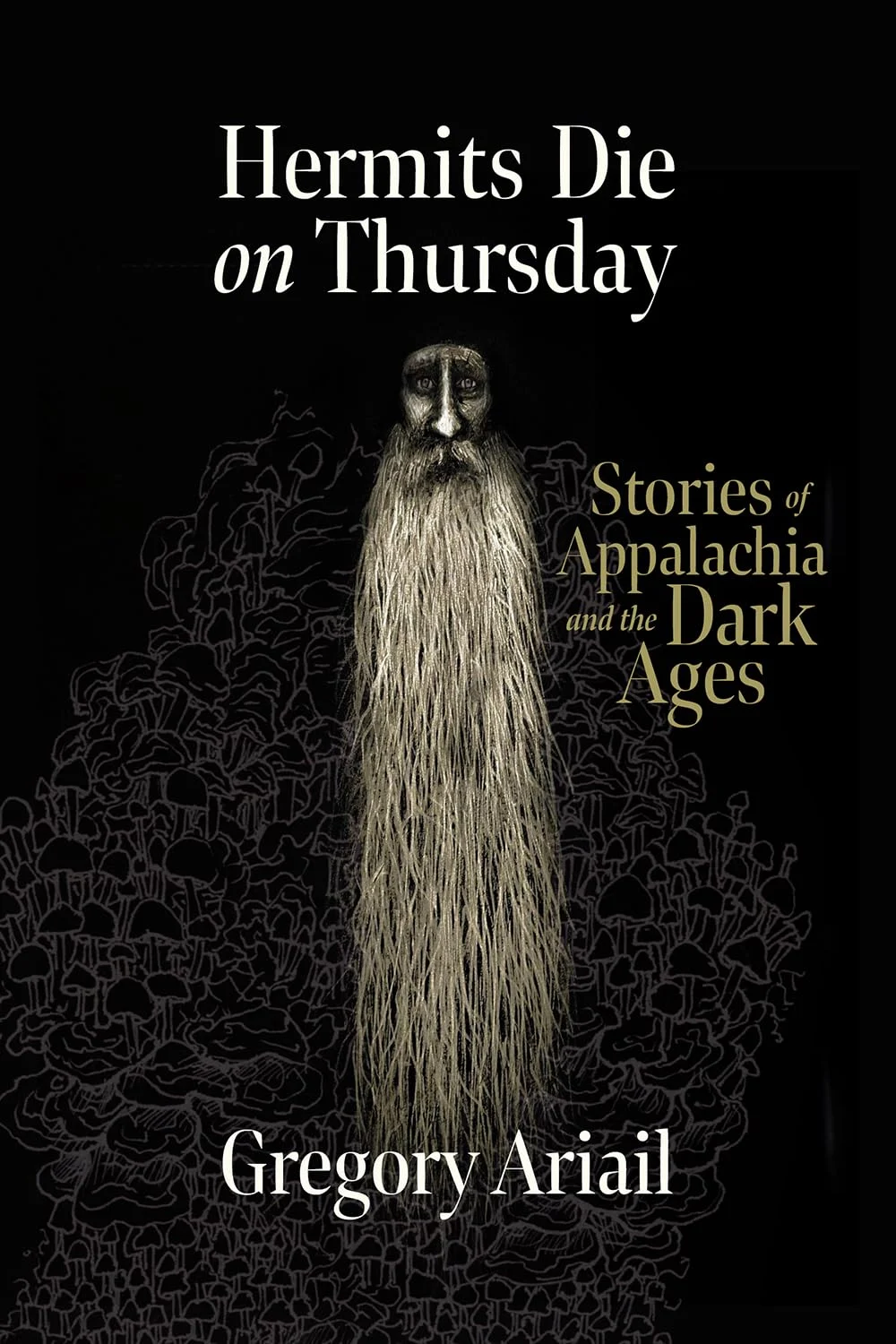
In the collective imagination, the hermit is a figure of static simplicity—a man or woman reduced to the sum of their solitude. Yet, as writer Tim Lockette observes, to peel back the layers of a life lived in seclusion is to uncover a chaotic, knotted mess of biographical wires and philosophical vines. It is this "irreducible" nature of the isolated human experience that Alabama writer Gregory Ariail captures with haunting precision in his latest collection, Hermits Die on Thursday: Stories of Appalachia and the Dark Ages.
By blending the grit of Appalachian history with the fluid, often unsettling logic of magical realism, Ariail transforms the regional short story into a conduit for the uncanny. The result is a work that challenges our reliance on the "blanket of rationality" we drape over the natural world, suggesting that the mountains—and the people who haunt them—are far more alien than our sociopolitical histories care to admit.
The Historical Hermit: Reality vs. Folklore
To understand the gravitational pull of Ariail’s fiction, one must first look at the soil from which his inspiration springs. Southern history is populated by figures who defied the conventions of their era, often retreating into the foothills to preserve their radicalism or their eccentricities.
Marx Edgeworth Lazarus: The Antebellum Anarchist
Perhaps the most striking historical precursor to the literary hermit is Marx Edgeworth Lazarus. Born in 1822 in North Carolina, Lazarus was an intellectual anomaly in the antebellum South. A doctor and philosopher who possessed the sensibilities of a New England transcendentalist, Lazarus spent his life convinced of the perfectibility of human society. His writings were as unconventional as his lifestyle; he authored treatises on the supposed "dangers" of nocturnal emissions and railed against the institution of marriage as a system of female enslavement—only to marry a nineteen-year-old woman in his thirties.
Lazarus was a staunch advocate for the "phalanstery," a communal living experiment rooted in anarchist theory, where property was shared and social hierarchies were dismantled. Despite his efforts to convert Southern plantations into multiracial, communist utopias, he found no takers. Following his service as a Confederate surgeon, Lazarus retreated to the Appalachian foothills of Alabama, choosing to vanish from the public record. Like many hermits, he performed his life away from the eyes of history, leaving behind only the cryptic debris of his theories.
The Alabama Goat Man: Ches McCartney
If Lazarus represented the intellectual hermit, Ches McCartney—the legendary "Alabama Goat Man"—represented the nomadic soul. A fixture of the Southeast, McCartney traversed the region in a wagon pulled by a team of goats, a stark contrast to the emerging age of the Chevrolet and air-conditioned suburban life.
McCartney was not merely a local curiosity; his life was a tapestry of bizarre ambition. He ran away as a teenager to marry a circus knife thrower and later embarked on a cross-country trek to Los Angeles with the singular, quixotic goal of courting actress Morgan Fairchild. These men, while grounded in historical fact, possess the "biographical wires" that make the hermits in Ariail’s fiction feel less like inventions and more like forgotten ghosts of our own landscape.
The Literary Construction of the Uncanny
Gregory Ariail’s Hermits Die on Thursday acts as a bridge between these historical oddities and the realm of the speculative. The collection’s title story utilizes short, sharp obituaries to deliver a shorthand version of the hermit’s complexity.
Magical Realism as Regional Truth
Ariail’s hermits are not just men in the woods; they are conduits for the impossible. In his narratives, characters choke to death on beards that have grown with impossible velocity, or they levitate as corpses, tethered to the earth only by the gravity of their own histories. One character leaves a suicide note promising to "ride the moon all the way down to hell to meet my mother and Mr. Price, my Latin teacher."
This juxtaposition—the mundane, harsh reality of mountain poverty against the intrusion of astronomical and supernatural phenomena—is the hallmark of Ariail’s style. He refuses to allow the reader to categorize his subjects. When he writes of a hermit, he is asking: Why shouldn’t a mountain dweller have a Latin teacher? Why must the forest be limited by the laws of biology?
The Shift from Fantasy to Landscape
Ariail’s journey to this unique voice is as interesting as his fiction. Growing up in North Carolina, he was a consumer of fantasy—the high-stakes, epic tropes of the genre. However, it was not until he ventured into the wilderness to film fan projects that he realized the Appalachian landscape itself was a more potent artistic subject than any secondary world.
This realization—that a landscape does not need to be a fictional realm like Endor to be inherently interesting—marks a critical shift in regional literature. Ariail treats the mountains not as a backdrop for human drama, but as a vast, untamed entity that dictates the terms of life. He suggests that if one truly touches the mountains, one enters a spirit world, one that has been present all along, hidden behind the highway-side views of the casual observer.
Implications: Appalachia and the Limits of Logic
The term "Appalachia" is often used as a shorthand for economic hardship. While poverty is a valid lens through which to examine human nature, Ariail uses it to highlight a different kind of scarcity: the lack of sufficient explanation.
The Failure of the "Rationality Blanket"
In the world of Hermits Die on Thursday, there is not enough logic to explain the events that transpire. There is not enough God to ensure justice. The universe is described as having "feet that stick out of this too-short blanket of rationality." When the logic of the world fails to cover the reality of the experience, the magic creeps in.
For those who have lived in the region, the uncanny is not entirely foreign. Residents often encounter biological anomalies—moths the size of dinner plates or massive, unexplained gatherings of insects—that defy easy categorization. Ariail simply takes this inherent "weirdness" of the Southern landscape and turns the dial up. If you can wake up to find a room full of ladybugs, why not a chicken with a human-like, bearded face? The surprise is not in the event, but in the realization that the world is far more chaotic than our rigid structures suggest.
The Dark Ages and the Universal Hermit
The latter half of the collection shifts the setting from the Appalachian hills to the Europe of the Dark Ages. While this transition might seem jarring, Ariail handles it with a seamlessness that suggests the hermit is a universal archetype.
The themes remain consistent: the proximity to a treacherous, unforgiving nature; the presence of demon-like figures; and the isolation of the individual. By moving between the American South and medieval Europe, Ariail argues that the "hermit condition" is not bound by geography or era. Whether in a mountain shack or a remote Nordic fjord, the hermit is a figure who has stepped outside the boundaries of human society to confront the raw, unmediated universe.
Final Verdict: A Necessary Portal
For the reader, Hermits Die on Thursday serves as a portal. It invites us to re-examine the "ignored" corners of our own lives and landscapes. Ariail’s work is a testament to the idea that literature does not always need to explain the world; sometimes, it is enough to show how the world fails to explain itself.
As Tim Lockette notes, whether you approach this book looking for insights into your own existence or simply seeking the transportive power of high-concept fantasy, Ariail’s collection is an essential addition to the Southern canon. It is a brilliant, inventive, and deeply luminous exploration of what happens when the human spirit is left entirely to its own devices, beneath the vast and indifferent gaze of the stars.


 Muslim
 Reynand Wu