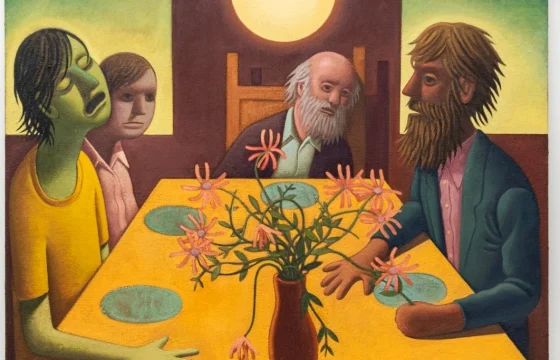
HESSE FLATOW, NEW YORK — In an era where figurative painting often leans toward the hyper-real or the hyper-digital, Nat Meade’s latest body of work offers a return to the primal, the symbolic, and the deeply human. With the opening of Franklin, his third solo exhibition at HESSE FLATOW, Meade invites viewers into a visual lexicon that functions as both a personal diary and a universal map of the male experience. The exhibition, which remains on view through April 18, 2026, serves as a poignant meditation on the transition between generations, the weight of inherited trauma, and the quiet resilience found in the act of parenting.
The Landscape of the Psyche: An Overview of Franklin
At its core, Franklin is a narrative of succession. Meade, an artist whose practice is inextricably linked to his lived experience as a father, son, partner, and academic, has moved away from the literal depiction of his own life to embrace the power of the archetype. His figures are not portraits of specific people; they are conduits for the existential anxieties that define the human condition.
The exhibition is a study in dualities: the somber and the humorous, the violent and the tender, the ancestral and the nascent. By employing what he describes as "allegorical distance," Meade navigates the complexities of middle age—specifically the recent passing of his father—with a brushstroke that is at once vulnerable and unflinching. The paintings are populated by figures that feel timeless, appearing in scenes that bridge the gap between mythic tragedy and the mundane, messy reality of domestic life.
Chronology of a Creative Evolution
Meade’s trajectory toward this specific thematic focus has been a decade-long refinement of his visual vocabulary.
- Early Career: Meade’s early work often featured figures battling the elements—literal manifestations of internal struggle. His protagonists were frequently seen struggling against turbulent winds or being overtaken by crashing, violent waves, reflecting a period of life defined by external pressures and the chaotic nature of becoming.
- Mid-Career Shift: As his roles shifted to include the responsibilities of fatherhood, his work began to pivot. The "struggle" shifted from physical battles with nature to internal, psychological negotiations.
- The Catalyst: The recent passing of his father acted as the primary catalyst for the current collection. The grief associated with loss, combined with the reflective responsibility of raising his own children, forced a re-examination of the masculine identity.
- The Present: Franklin represents the culmination of this reflection. The turbulent seas of his previous work have calmed. The focus has moved from the trauma of the past to the possibility of the future, marking a clear turning point in his aesthetic and thematic narrative.
Supporting Data: Symbols and Cultural Signifiers
Meade’s work is dense with iconographic references that demand an engaged viewer. He does not merely paint figures; he constructs environments where historical, literary, and pop-culture references collide.
The Horror of the Patriarch
The exhibition’s title, Franklin, is a deliberate and provocative nod to the 1974 horror classic The Texas Chainsaw Massacre. In the film, the character of Franklin Hardesty represents a fragility and a victimhood that stands in stark contrast to the film’s brutal, deranged patriarch. Meade uses this reference to explore the "inner turmoil" of the male experience—the struggle to reconcile one’s own violent or antagonistic impulses with the societal expectation of the "good man."
Classical Allusions
Meade’s figures are often caught in states of mythic punishment or hubris:
- Prometheus and the Vulture: Several works feature imagery reminiscent of the Greek myth, where the vulture’s predation serves as a metaphor for the cyclical nature of suffering and the inability to escape the consequences of one’s actions.
- Blake’s Nebuchadnezzar: By referencing William Blake’s famous portrayal of the Babylonian king reduced to an animalistic state due to his lust for power, Meade comments on the degradation of the ego. These figures, often shown on hands and knees, represent the moment when the "powerful" patriarch is stripped of his authority and forced to confront his own base nature.
The Spectral Presence
A recurring motif in Franklin is the "ghostly specter." These ethereal forms hover over his characters, representing the weight of inherited trauma. In a technique that feels borrowed from the visual shorthand of classic cartoons—where a soul might detach from the body—Meade’s spirits appear to be looking back on their physical counterparts with a mixture of amusement, regret, and pity.
Official Perspectives and Critical Implications
While the artist prefers his work to speak for itself, the implications of Franklin are significant within the contemporary art discourse.
On Vulnerability and Mortality
In works like Poise, which depicts a pair of legs dangling from a cloud, the viewer is confronted with the liminal space between life and death. Meade asks, through paint, whether the figure is ascending or descending. This ambiguity is intentional; it reflects the interchangeability of birth and death. By addressing mortality with such directness, Meade challenges the viewer to look at their own life cycle not as a linear progression, but as a series of constant arrivals and departures.
The Hope of the Next Generation
Perhaps the most striking evolution in this exhibition is the contrast between the adult figures and the younger ones. If the adults are burdened by "rocky histories," the children are depicted with a refreshing, harmonious autonomy.
- The Navigator: In one painting, a young boy steers a boat with a torch, charting a path that feels unburdened by the familial pressures weighing down the adult subjects.
- The Seeker: Another work shows an adolescent exploring a cove, reaching into the water to touch the starfish and anemones. This is a moment of pure, unadulterated curiosity—a stark departure from the anxiety-ridden states of the adult figures.
The implication here is one of healing. Meade suggests that by acknowledging and "releasing" the traumas of the past, the current generation can provide a clearer, safer path for the next. The image of the father and son standing together in a shallow, calm pool is the exhibition’s emotional anchor—a quiet, tender act of guidance that replaces the turbulence of Meade’s earlier work.
The Resilience of Human Nature
The ultimate takeaway from Franklin is not one of despair, but of stubborn resilience. Nat Meade has successfully created a space where the "insurmountable heaviness" of life—grief, aging, and the pressure of legacy—is held in balance with the wonder of existence.
By transposing his personal experiences onto archetypal figures, Meade invites the audience to participate in his own reconciliation. We see our fathers, our children, and ourselves in these paintings. We see the specters we carry and the potential for the "calmer seas" that Meade now depicts.
In a world that often feels increasingly fractured, Franklin serves as a reminder of the power of introspection. It argues that progress is not only attainable but necessary. Through the act of painting, Meade demonstrates that while we cannot change our history, we can change our relationship to it. We can acknowledge the vultures and the specters, and yet, like the young boy with the torch, we can continue to steer the boat.
The exhibition is a testament to the fact that painting remains one of the most effective tools for processing the complexities of being human. Whether through the lens of horror-movie tropes or classical mythology, Meade finds the common thread that binds us all: the desire to be understood, the fear of being forgotten, and the relentless, beautiful hope for renewal.
Franklin is currently on view at HESSE FLATOW through April 18, 2026. For those interested in the evolution of contemporary figurative painting, this exhibition offers an essential look at an artist coming into his own, proving that the most profound stories are often the ones we tell about our own families.