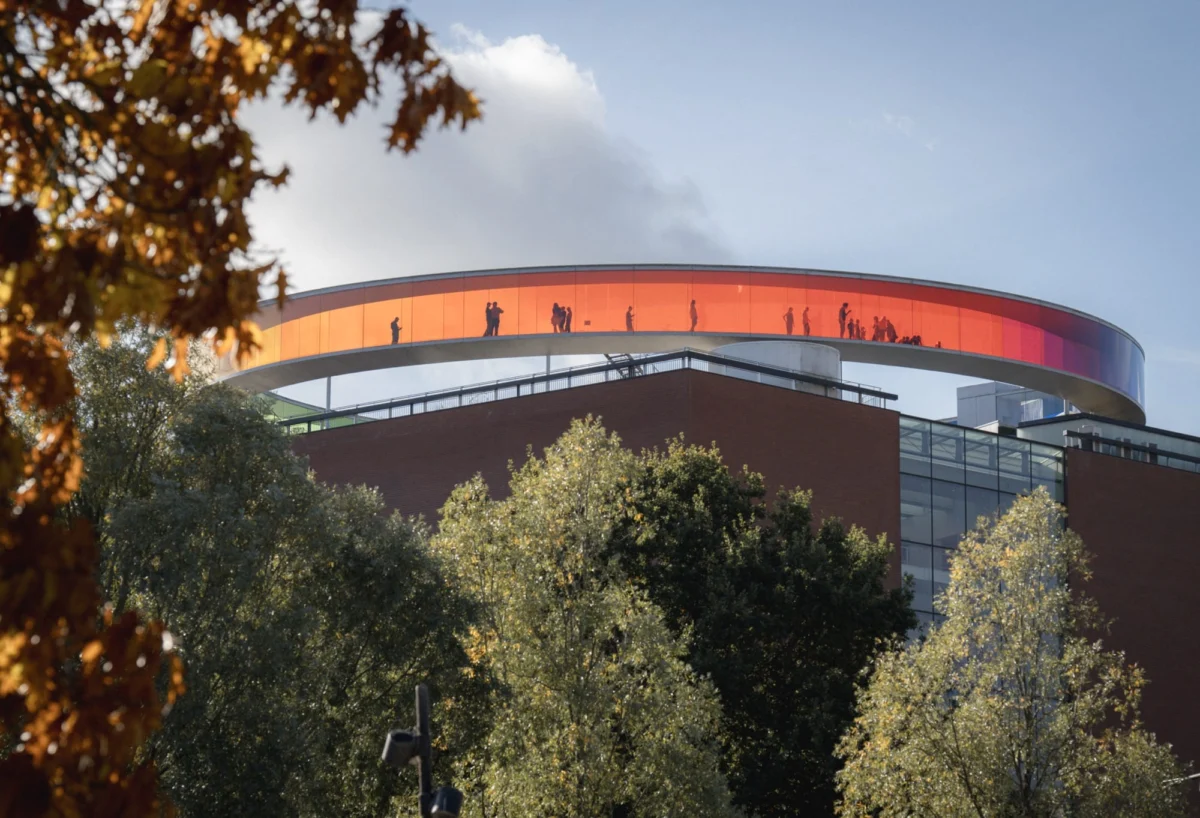
In the rarefied world of contemporary art, few creators have managed to turn the fundamental mechanics of human perception into a spiritual encounter with the same consistency as James Turrell. This month, the pioneering artist reached a historic career milestone with the unveiling of his 100th Skyspace, a monumental installation titled "As Seen Below." Permanently housed at the ARoS Aarhus Art Museum in Denmark, this latest architectural intervention serves as both a culmination of a lifelong obsession with light and a testament to the enduring power of minimalist, site-specific art.
The Milestone: A Century of Light and Architecture
For decades, James Turrell has invited audiences to reconsider the act of seeing. His Skyspaces—enclosed, domed, or rectangular chambers featuring an aperture oriented toward the heavens—are designed to frame the sky as a shifting, tangible canvas. With the opening of the Aarhus installation, the count of these ethereal structures has reached 100, scattered across 26 countries and a variety of landscapes ranging from the arid deserts of the American Southwest to the urban density of European capitals.

"As Seen Below" is a massive achievement in scale, rising over 50 feet high and spanning 130 feet in width. It functions as a bridge between the celestial and the terrestrial, forcing the viewer to confront the sky not as a distant background, but as an immediate, physical presence. By removing the frame of the horizon, Turrell strips away the context of our daily environment, allowing the viewer to engage with the "aperture" in a state of pure, unmediated observation.
A Chronological Evolution of Perception
To understand the significance of the 100th Skyspace, one must look back at the trajectory of Turrell’s career, which began in the mid-1960s.

The Early Years: The Light and Space Movement
Emerging from the Southern California "Light and Space" movement, Turrell’s early work was defined by his refusal to treat art as a commodity. His initial projects involved projecting light into corners of rooms to create the illusion of three-dimensional forms. These experiments laid the groundwork for his eventual mastery of the "Skyspace."
The Mid-Career Expansion: Building the Horizon
By the 1980s and 90s, Turrell transitioned from gallery-based projections to permanent, site-specific architecture. His most famous undertaking, Roden Crater—a monumental work carved into the cinder cone of an extinct volcano in Arizona—remains the pinnacle of his practice. It was during these decades that the Skyspace concept matured from a purely experimental idea into a standardized, albeit deeply nuanced, architectural form. Each subsequent installation built upon the last, refining the "color shifts"—a sophisticated lighting system that seals the oculus and bathes the interior in saturated hues, altering the viewer’s perception of the sky’s color through the psychological phenomenon of Ganzfeld (total field) effect.

The Modern Era: Global Proliferation
The turn of the 21st century saw a surge in the international demand for Turrell’s meditative spaces. From the peaceful hills of Japan to the bustling metropolitan centers of Europe, the 100th milestone represents a transition of Turrell’s work from avant-garde obscurity to a foundational element of contemporary museum design.
Technical Specifications and Data
The sheer ambition of "As Seen Below" at ARoS demands a technical breakdown. The installation is not merely a room with a hole in the ceiling; it is a complex, computer-controlled light instrument.

- Structural Footprint: The dome spans 130 feet in diameter, requiring significant structural engineering to maintain a seamless, interior curvature that facilitates the illusion of infinite space.
- Aperture Dynamics: The oculus is designed with specific beveling to minimize the thickness of the roof, effectively creating a "knife-edge" that makes the sky appear to sit flush with the ceiling plane.
- Lighting Arrays: The interior is equipped with a sophisticated LED array hidden behind architectural coves. These lights are programmed to cycle through a sequence that reacts to the shifting ambient light of the Danish sky.
- Visitor Capacity: Designed for immersive solitude, the space is engineered for acoustic dampening, ensuring that the only "sound" in the room is the whisper of the wind or the gentle hush of the crowd.
The Philosophy of the Aperture: Official Perspectives
The arrival of the 100th Skyspace has been met with both critical acclaim and institutional pride. In discussions surrounding the ARoS opening, museum curators have emphasized that Turrell’s work is not about the "object" of the art, but the "subject" of the viewer.
"James Turrell doesn’t just build spaces," one spokesperson for the ARoS museum noted during the opening ceremony. "He builds time. By sitting in this space, you are forced to slow your internal clock to match the slow, subtle transitions of the light. In an era of constant digital distraction, that is a revolutionary act."

Turrell himself has long maintained that his art is "about the light, not the architecture." His philosophy, often referred to as "seeing yourself see," suggests that the brain is a participant in the creation of reality. By manipulating the environment in which we view the sky, he allows us to experience the "celestial vault" as a tangible, deep blue substance, rather than an empty void.
Societal and Cultural Implications
The cultural impact of 100 Skyspaces is profound. As public spaces become increasingly commodified and noisy, Turrell’s installations provide rare, secular "chapels" for reflection. They have become fixtures of cultural tourism, drawing thousands of visitors who seek a moment of quietude in a chaotic world.

The Democratization of Transcendence
Critics have often noted the spiritual undertones of Turrell’s work, despite his insistence that he is a "perceptual" rather than "religious" artist. The Skyspace has effectively democratized the experience of the sublime—a feeling once reserved for those who could travel to mountaintops or remote deserts. Now, through the reach of 100 global locations, this encounter with the infinite is accessible to a broad public.
The Future of Site-Specific Architecture
The success of the Aarhus installation confirms that there is a growing institutional appetite for "slow art." As architects and urban planners look toward the future, the lessons provided by the Skyspace series—specifically the importance of natural light and the psychological benefit of contemplative space—are likely to influence the design of public buildings for decades to come.

Conclusion: Looking Upward
The 100th Skyspace is more than a numerical milestone; it is a point of arrival for an artist who has dedicated his life to the pursuit of pure, unadulterated vision. As "As Seen Below" opens its doors to the public in Aarhus, it invites us to pause, look up, and realize that the most spectacular art we will ever see is the one that has been above us all along.
Whether one is a devotee of the Light and Space movement or a casual museum visitor, the experience of standing in a Turrell dome remains one of the most powerful artistic experiences available today. For those interested in witnessing this latest chapter of light, tickets are currently available via the ARoS museum website, offering a chance to step into the 100th iteration of a vision that has quite literally changed the way the world sees the sky.