

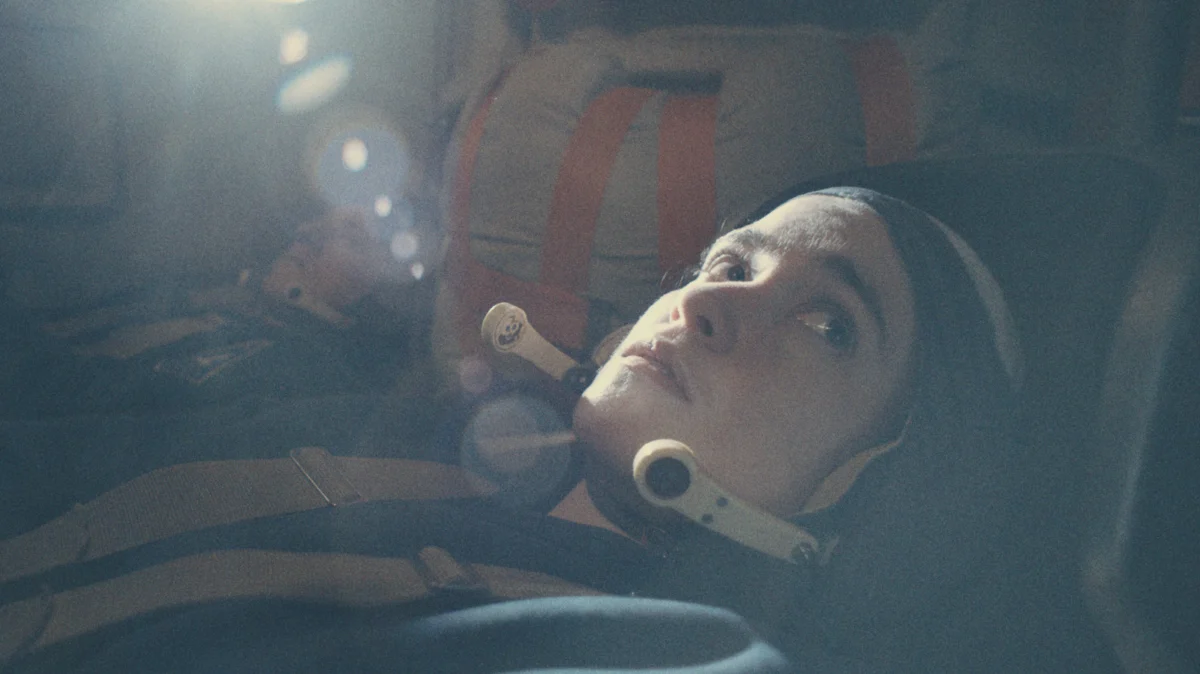
Spoilers ahead for the premiere of "Star City," titled "The Eyes."
The sprawling, alternate-history universe established by Apple TV+’s For All Mankind has long been defined by its optimistic, albeit tumultuous, exploration of space. However, its new spin-off, Star City, pivots sharply away from the triumphant spirit of the lunar race. Instead, the series offers a claustrophobic, high-stakes dive into the Soviet space program, trading the open vacuum of space for the tightening noose of Cold War paranoia.
While the show serves as a companion piece to its parent series, it functions primarily as a psychological autopsy. At its center is Irina Morozova (Agnes O’Casey), a character who, in For All Mankind, stands as a monolithic antagonist—a ruthless, calculating force within the KGB and Roscosmos. In Star City, however, we meet her not as a monster, but as a blank slate. The series is, at its heart, the tragic, inevitable origin story of one of the most terrifying figures in modern television.
The Genesis of a Cold Warrior: A Chronology of Corruption
The premiere episode, "The Eyes," introduces us to a version of Irina Morozova that is almost unrecognizable to those who have followed her trajectory in For All Mankind. She is an idealistic, wide-eyed recruit entering the KGB surveillance wing of the Star City complex.
To understand the weight of this narrative, one must look at the chronology of her descent:
- The Phase of Innocence: We first encounter Irina as a young mother, a woman who still possesses a moral compass. Her entry into the KGB is framed not by a lust for power, but by a sense of duty and the naive belief that she is serving a greater, patriotic good.
- The Surveillance Catalyst: The "Eyes" of the title refer to the crushing reality of her job. Rather than conducting grand geopolitical maneuvers, her early days are spent eavesdropping on the intimate, mundane, and deeply human conversations of her colleagues. This invasion of privacy serves as the first fissure in her moral foundation.
- The Point of No Return: The narrative arc shifts violently when Irina discovers a procedural error. A colleague’s mistake has led to the imprisonment of an innocent woman. Initially, Irina feels a sense of professional validation in uncovering the truth—until the systemic reality of the KGB reveals itself. Her superiors do not seek to rectify the error; they order the summary execution of the innocent woman to preserve the agency’s infallibility.
This moment serves as the foundational trauma of the series. It is the juncture where the "good" Irina is effectively euthanized by the state, replaced by the pragmatic, cold-blooded operator who eventually ascends to the heights of the Soviet space hierarchy.
![Why Star City Is Secretly An Origin Story For The Best Villain In For All Mankind [Exclusive]](https://www.slashfilm.com/img/gallery/why-star-city-is-secretly-an-origin-story-for-the-best-villain-in-for-all-mankind-exclusive/l-intro-1779733939.jpg)
The Anatomy of an Antagonist: Official Insight
Ben Nedivi, co-showrunner of Star City, has been vocal about the creative imperative behind this origin story. In an exclusive interview, Nedivi emphasized that the goal was to avoid the tropes of "born evil" villains, opting instead for a more grounded, humanizing, yet ultimately chilling approach.
"It was one of the things that inspired us to do this," Nedivi explained. "I think what’s fascinating about her is when you meet her on For All Mankind in Season 4, she’s a terrifying woman who you’re scared whenever she opens her mouth, because you know what she’s capable of. We thought, in the great tradition of humanity, we’re not born evil. To see her start, and to see her beginning that journey that takes us to where we—if you watch For All Mankind—understand where this ends up, felt like a vital narrative thread."
Nedivi’s perspective highlights the "systemic" nature of her transformation. The series does not simply track a character "breaking bad"; it examines how an oppressive regime systematically strips away individual empathy to facilitate survival. "How is that innocence taken away? How is that broken down by the system and by the experiences she goes through?" Nedivi posits. These are the questions that drive the tension of the season.
Beyond the Space Race: The Tone of ‘Star City’
While For All Mankind deals with the physics of orbital mechanics and the politics of Martian colonization, Star City operates in the shadow of The Americans. The show is an atmospheric, paranoid thriller that examines the cost of excellence under an authoritarian thumb.
The aesthetic of the show reflects this shift. The bright, sterile corridors of NASA in the parent series are replaced by the brutalist, shadow-drenched offices of the Soviet Union. The dialogue is sparse, often conveyed through glances, pauses, and the heavy weight of what cannot be said. For the audience, the show functions as a "secret history." Every time Irina makes a decision—every time she chooses a cold, calculated path over a compassionate one—the viewer feels the tragedy of her trajectory. We are watching a woman slowly building the cage that will eventually trap her, and by extension, the rest of the world.
The Implications of a Villain-Centric Spin-Off
The decision to build a spin-off around the origin of a primary antagonist is a bold maneuver for Apple TV+. It shifts the focus from the "what" of space exploration to the "who" of the human machinery that powers it.
![Why Star City Is Secretly An Origin Story For The Best Villain In For All Mankind [Exclusive]](https://www.slashfilm.com/img/gallery/why-star-city-is-secretly-an-origin-story-for-the-best-villain-in-for-all-mankind-exclusive/intro-1779733939.jpg)
1. Expanding the ‘For All Mankind’ Universe
This approach sets a precedent for the franchise. If the creators can successfully map the history of one character, the entire For All Mankind timeline becomes a sandbox for character studies. We are no longer just looking at the history of space flight; we are looking at the history of the people who were ground down by the competing ideologies of the 20th century.
2. The Psychology of Compliance
The most striking implication of Star City is its exploration of complicity. Irina’s journey is not a sudden jump into villainy; it is a series of small, incremental compromises. By the time she is a high-ranking official, she has forgotten the woman she used to be. The show forces the audience to ask: At what point does a survivor become a perpetrator?
3. A New Genre Standard
By leaning into the "spy thriller" aesthetic, the production team has successfully differentiated the show from its predecessor. It is no longer competing with the visual spectacle of the For All Mankind space sequences; it is competing with the best of prestige espionage dramas.
Conclusion: The Long Road to Shadow
As Star City continues its run, the shadow of the future looms large over every frame. We know where Irina Morozova ends up. We know the lives she will ruin, the orders she will issue, and the power she will wield. But for the duration of this series, we are forced to witness the slow death of her conscience.
It is a harrowing, masterfully paced descent. By focusing on the fragility of her early ideals, the writers have ensured that when the inevitable shift occurs, it feels earned, tragic, and utterly terrifying. Star City is not just a show about the Soviet space program; it is a definitive study of how a system can take the best parts of a human being and systematically dismantle them, until only the villain remains.
For viewers who found the political maneuverings of For All Mankind compelling, Star City offers a necessary, if darker, companion. It serves as a reminder that behind every great, or terrible, historical figure, there was once a person who believed, however briefly, that they could change the world for the better. The tragedy of Irina Morozova is that she succeeded—just not in the way she originally intended.











No comments yet. Be the first to join the conversation!